Theo’s Magic Test
The Reincarnated Demon King's Host Just Wants to Live in Peace, But the Hero Won't Leave Him AloneTheo’s Magic Test is the childhood examination that exposes Theo’s healing gift and determines the course of his early life. What appears to be an ordinary opportunity for advancement becomes an act of institutional selection: the capital identifies Theo as an exceptional resource, claims him for the Hero’s party, and sends him toward training while remaining unaware that the child also carries the Demon King Malthios within his body.## Causes and Background When Theo was eight, his parents brought him from their small village to the capital of Rizaah, the human-governed kingdom’s center, for a standard magic examination. The family did not even know whether Theo possessed magical ability. His parents hoped that a successful result might earn him sponsorship to an academy or an apprenticeship in a well-paid craft, so the journey began as a practical attempt to secure him a better future rather than as a military summons.
The capital immediately made the test feel less like a private assessment than an encounter with state power. Theo had grown up among forests and farms, with humans as the dominant presence and only occasional contact with other peoples. The capital’s walls, tall buildings, crowds, and mixed races overwhelmed him, and he felt enclosed rather than welcomed. Its palace joined the royal residence and council chambers to the institutions where magic users and knights were trained for royal service or for the Hero’s party. The setting therefore connected Theo’s personal ability to Algeya’s wider political order: the kingdoms of the mortal races cooperated because the continuing threat of the Demons had made unity necessary, and the Hero’s party remained responsible for defending ordinary people against the remnants of Malthios’s army and the surviving Demon Lords.
The examination also carried a hidden and far more immediate danger. Theo was already Malthios’s host, and Malthios’s magic felt terrifyingly powerful while also seeming natural because it existed within Theo himself. Theo feared that the test might expose the Demon King’s presence and lead to his execution on the spot. His agitation nearly allowed Malthios to emerge. Behind the public hope of finding a useful talent stood a private struggle over concealment, control, and survival: Theo knew that no amount of friendship would protect him if anyone discovered what he was, and Malthios’s own threats and rages had already made their shared existence violent and inescapable.
The Examination and Revelation
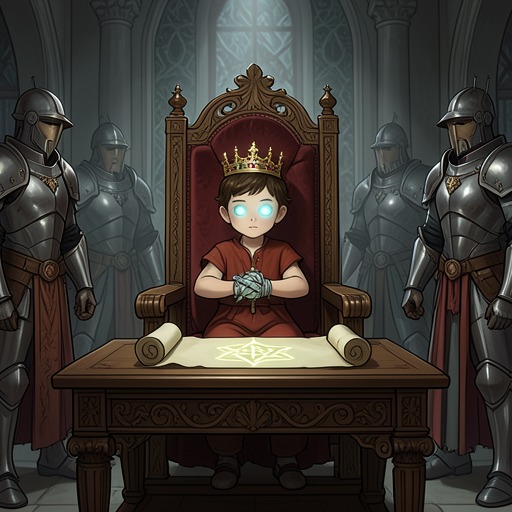
The test took place in a great hall under the eyes of the King and his council. Children of different social ranks and races waited together while people representing various magical disciplines gathered to claim the most promising candidates. The arrangement made the process resemble an auction, reducing children to the value of the abilities they might contribute. At the center stood a huge orb that sensed a person’s magic through touch. Those without magic left it dark; those with gifts caused it to reveal the nature of their power.
Theo approached the orb in terror, expecting it to expose Malthios rather than reveal anything of his own. Instead, the test confirmed that he possessed an independent magical gift. The orb erupted in a deep emerald-green glow so intense that it blinded everyone present before fading. The result was not a minor or obscure talent. Theo was a healer, and the brilliance of the display immediately caused the people in the hall to compete for him.
The competition ended when an elf in the robes of the court mage spoke over the others. She declared, “My apologies,” before asserting, “But, a person with a gift like this belongs in the Hero’s party. He will be sent to learn from the best healer in Algeya, then enter training with the next Hero when they are of age.” Her decision converted Theo’s success into compulsory placement. The test did not give Theo a choice among schools, crafts, or patrons; it assigned his body and talent to the Heroic institution.
Theo’s parents could do nothing to alter the decision. They stood by disappointed because the result would not benefit them in the way they had hoped. The following day, the court mage and guards escorted Theo to a nearby town, where he was to study under the priest who had served in Eliza’s party. The healer had been badly injured in the final battle and had lost the use of both legs. Malthios privately took credit for that injury, reminding Theo that he had dropped a pillar on the healer and adding that he always targeted the healer first. Theo’s new vocation was therefore tied from its first formal appointment to the violence of the war against Malthios.
Consequences for Theo and Malthios
The magic test confirmed a division that would govern Theo’s life: he possessed healing magic of his own, but he also housed the Demon King’s power. Malthios’s presence did not disappear when Theo’s independent gift was recognized. Instead, the result gave Theo a public identity that could conceal the private one. He could be known as a healer while remaining vulnerable to discovery as the Demon King’s host.
The event also established the limits of Malthios’s authority. Theo did not reject Malthios’s suggestions because he believed himself morally superior; he simply saw no reason to obey and hated being ordered around. His disobedience repeatedly frustrated the Demon King. Malthios responded with fits that left Theo bedridden with splitting headaches, threats to destroy everything Theo cared about, and insults intended to make him feel worthless and grateful for having been chosen. Yet these tactics changed nothing. Malthios was a prisoner in Theo’s mind and body, while Theo could not have a thought or feeling without Malthios sharing access to it. The test thus became an early demonstration of their mutual imprisonment: the institution claimed Theo from outside, while Malthios contested him from within.
The hostility nevertheless concealed a binding dependence. When Theo asked why Malthios did not simply kill him and move to another host, Malthios explained that transferring himself required a spell that had taken more than a human lifetime to prepare and cast. Even if Theo consented, the process would take years, and Theo’s death would also kill Malthios. The Demon King warned him not to do anything foolish, prompting Theo to mock him for caring and Malthios to reject the familiar name “Mal.” Their exchange reveals that the test did not place a powerful master inside a disposable vessel; it joined two lives whose survival had become inseparable.
The Hidden Cost of Selection
The capital’s decision gave Theo status as a healer but stripped him of control over the form that status would take. His gift was treated as evidence that he belonged to the Hero’s party, and his future was mapped toward instruction by the greatest healer in Algeya and eventual training with the next Hero. The test therefore began a pattern in which extraordinary ability becomes a reason for others to claim a person rather than a means of granting that person freedom.
That pattern later makes Theo’s fear of disclosure intelligible. Cargo eventually asks whether Theo will tell the others that he is “a demon spawn,” and Theo’s body freezes as Malthios immediately presses toward taking control. When the Hero’s party later comes to retrieve Theo through a portal, he understands that entering the capital will end his autonomy: those in power will know who he is and where he lives, and the court could force him back into the Hero’s party where the truth might be uncovered. The magic test is the origin of that danger. It was the first moment when an institution saw Theo clearly enough to assign him a role, but not clearly enough to recognize the person and secret beneath it.
The consequences extend into Theo’s relationships as well. His identity as a healer is what brings him into contact with Luc and the Hero’s party, while the secrecy imposed by his second identity continually threatens those bonds. Luc later speaks of the fate of the Hero as a life marked by temporary relationships because duty keeps carrying him onward, yet his connection with Theo develops against that prescribed future. Luc gives Theo his father’s silver ring, a textured band with a dark sapphire, and places it on Theo’s marriage finger. The gesture contrasts with the magic test’s institutional claim: the capital assigns Theo to a public destiny, while Luc’s ring marks a chosen bond.
Narrative Significance
As a plot event, Theo’s Magic Test combines revelation, selection, and entrapment. It reveals that Theo is genuinely gifted rather than merely a vessel for Malthios, but the same revelation makes him valuable to the Heroic system. His emerald healing magic saves him from the immediate fear that the orb will expose the Demon King, while simultaneously directing him toward the people and structures most capable of destroying him if the secret is discovered.
The event also foreshadows the later conflict between imposed duty and chosen life. The court mage’s decision treats Theo’s gift as belonging to the Hero’s party; much later, Luc rejects the demand that he continue the Heroic bloodline and says that he has chosen a quiet, peaceful life with the man he loves. The contrast is central to the story’s moral movement. Theo’s test begins with a child being selected because of what his magic can do for the kingdom. Its long aftermath asks whether a person marked as useful by war, prophecy, or inherited duty can reclaim the right to decide whom that power serves.
The most consequential irony is that the test both conceals and exposes Theo. It conceals Malthios by giving the child a legitimate, independent magical identity. It exposes Theo to the institutions that will later imprison and judge him. When Leafel’s people finally intervene in his trial and demand his release, their solidarity overturns the capital’s earlier assumption that Theo is primarily a public asset. The child once chosen in a hall where candidates were treated like livestock is ultimately defended as a person whose community, relationships, and chosen future matter more than the role assigned to his magic.