Bando returns to Latsei
The Reincarnationist PapersBando’s return to Latsei is both a homecoming and a test of whether memory can restore a life across generations. Traveling with Juan from Hawikuh, he reaches the sandstone village where he had once been Nez-lah. The villagers first see a stranger they fear; Teszin recognizes the man she loved, and the chief requires Bando to demonstrate the craft that Nez-lah had once practiced. When Bando succeeds, the village accepts him under his former name, making private recollection a public identity.
The road home
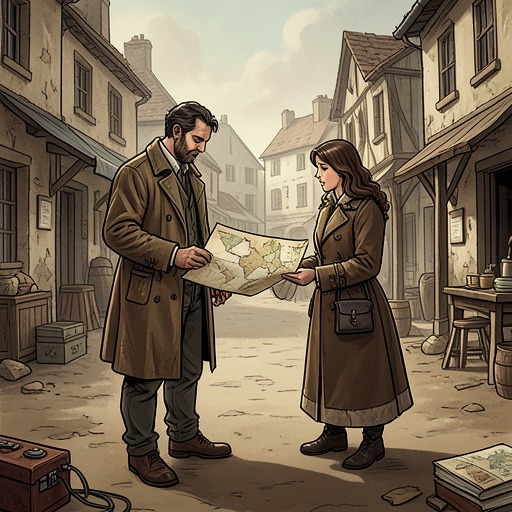
After Francisco Vázquez de Coronado established his headquarters in the vacated city of Hawikuh, he planned reconnaissance journeys along two footpaths leading east and northwest. Bando’s home lay along the northwestern route. He and Juan volunteered for that party and were ordered to leave four days before its main body. The separation mattered: if Bando was right about what awaited them, Juan expected not to see Francisco Vázquez de Coronado again. Juan also understood that, should he find gold, he would have to return south without the main force if he intended to keep it. Bando, meanwhile, said long goodbyes to the companions he had made among the ranks, and the two riders set out with their plans made.
The trail was smooth and well worn. Juan asked how far Latsei lay, and Bando estimated five days on foot or two on horseback. At a narrow valley running north into higher country, Bando left the trail and told Juan that they would be home the next day. They rode past sundown. Bando caught a rabbit for their meal and seemed eager to be moving again as soon as Juan had eaten; Juan told him to sleep because the next day would be busy. The exchange makes the approaching reunion palpable without turning it into certainty: Bando is impatient to arrive, while Juan watches him in the firelight.
Before the journey’s final stage, Juan had explained the Embe tattoo and the means by which the two could find one another again if they were killed. He described the group’s summer gathering in Zurich, at a small red-brick church marked with the same symbol, and told Bando that all fourteen members had different homes but met there on the longest day of the year. The directions give their journey to Latsei a second horizon. Bando is returning to a home from one life, but Juan frames their bond as one that can survive death and lead them to meet again.
Arrival at the sandstone village
At first light, Juan followed Bando wearing the armor breastplate he had bought in Compostela. The ill-fitting armor hung awkwardly on him, made for a man six inches taller and fifty pounds heavier. By midday its straps were digging into his shoulders. When Juan asked what they were looking for, Bando pointed out a city built into the rocks: about thirty buildings of different sizes, stacked into a three-tiered settlement beneath a vast stone overhang. Bando dismounted and told Juan, his voice cracking, that this was his home.
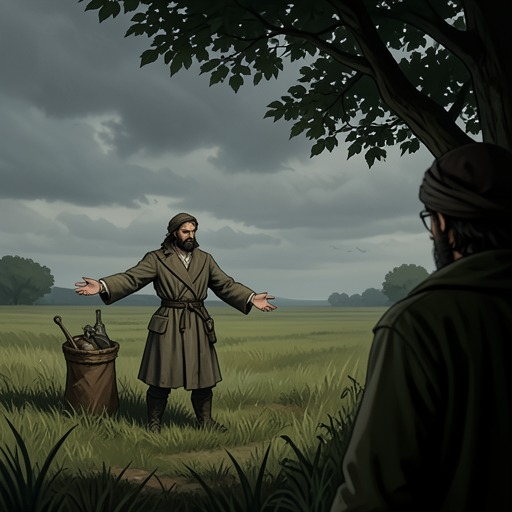
They left their horses and walked toward the village. The inhabitants had already spotted them; as Juan looked back, his horse was disappearing into the distance. He remembered the fear the horses had caused among the Zunis, but could not tell whether that display would help or harm them now. His fear was not death itself, which he had experienced eight times, but the pain he remembered as preceding it. Bando moved ahead with his head high and shoulders back, while Juan followed in armor, alert to the danger of being met as an intruder.
Fifty or sixty villagers gathered at the compound’s edge. Dressed in earth tones and adorned with silver, they closed around Bando in a widening and then tightening semicircle: children first, then women and men. Children touched his dark skin and drew back giggling; older children and some women reached for his hair and lips. Bando wept as he faced the crowd. He spoke in their language, and they stepped back; he then reassured them that he had traveled far to see them. But the chief, climbing a ladder to a wall above the gathering, called Bando Masaudu of the underworld and urged the villagers to fear him because of his skin. Voices in the crowd echoed the accusation. Juan put a hand on his sword and began to retreat.
Teszin recognizes Nez-lah
A woman’s voice interrupted the crowd’s hostility. Teszin, whom Bando had loved in his life as Nez-lah, came forward with long black hair streaked with gray and a painted buckskin poncho over her shoulders. Bando recognized her immediately and noticed that she wore no braids, which he associated with a married woman. Teszin examined him without speaking, then placed her ear against his bare chest and asked what name Nez-lah had called her. Bando answered, “Little deer.” She gasped and asked whether he was Nez-lah; he affirmed that he had come back.
Recognition did not immediately settle the village’s dispute. Teszin went to the seated chief and declared that Bando was Nez-lah because he knew things only Nez-lah could know. When the chief mocked her and challenged Bando, he chose a more public test: Bando had to say how long it had taken him to make the chief’s collar, a piece made of five rough silver discs joined by rawhide thongs. Bando answered that the work had taken two days. The chief then demanded that he make another in the same time, promising that he could stay if he succeeded and must leave if he failed. Bando agreed. The condition turns recognition into an ordeal measured not by assertion but by the return of a particular skill.
The collar and the name
Bando set to work, and Juan gave him space, returning quietly to camp with his sketchbook and going toward the cliffs north of the village. Late the next afternoon, Juan left Bando’s shop wearing the second collar, a perfect copy of the chief’s original, heavy around his neck. Bando and Juan brought the work to the chief’s home before a gathering crowd. When the chief emerged wearing the original, Bando announced that the work was done and that there would be a festival that night. The test had been completed within the prescribed two days, and the threatened expulsion gave way to public celebration.
At sunset, the villagers lit a bonfire in the center of the settlement. Bando, Teszin, and Juan sat beside the chief as honored guests, while five young men across from them played drums. During the gathering, Bando accepted a new public name. After blood was smeared across his palm and he pressed it to a heavy square stone, the chief asked what name he chose for himself. Bando turned toward Juan and shouted, “Nez-lah.” The chief placed the handprint stone, marked side down, into an unfinished wall of similar stones, then led the crowd in calling the name. Drums and dancing carried the recognition beyond the exchange between two former lovers: the community gave Nez-lah a place in its shared memory.
Reunion and restored belonging
The episode’s movement is from separation to recognition, but the return is not a simple resumption of the past. Bando reaches Latsei in a body the villagers regard as frighteningly unfamiliar; Teszin’s private knowledge identifies him, while his silverwork convinces the chief and his return to the name Nez-lah becomes a communal act. Each stage answers a different question: whether he is known to the woman who loved him, whether he can demonstrate the craft associated with his former life, and whether the village will accept him among its people.
Juan’s presence links this homecoming to the larger community of people who remember former lives. His instructions about the Embe tattoo and the gathering in Zurich establish that death need not end recognition between them. At Latsei, however, remembrance is not just a promise of a future meeting: it is tested in a lover’s phrase, in the making of a collar, and in a name spoken before the crowd. The return thus makes belonging something Bando carries as memory but must also have recognized by others.