Bobby Lynn Murray’s house fire
The Reincarnationist PapersBobby Lynn Murray’s house fire is the childhood catastrophe that gives Evan Michaels’s recurring fire-setting compulsion its remembered origin. In the flashback, a six-year-old’s attempt to continue building a toy tower by matchlight becomes an uncontrollable blaze; in Evan’s later life, the memory returns with such force that he recognizes himself as a ghost in Bobby’s room. The fire is both a domestic disaster and a rupture between lives, connecting a child’s fascination with flame to the adult arsonist who cannot keep the same scene in the past.
Background and Return of the Memory
The recollection surfaces during Evan’s last week in Minnesota. Unlike his other disembodied memories, it is stronger, cannot be controlled, and intrudes powerfully and often enough to demand satiation. Evan places it in Macon, Georgia, in 1976, and identifies its subject as Bobby, a boy whose life has left him few memories apart from this one. Seen through a child’s eyes, the episode is the strongest of the memories Evan has inherited from his three lives.
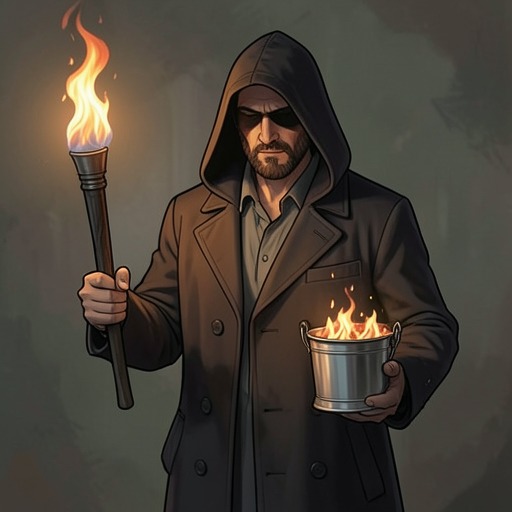
The remembered fire also presses directly against Evan’s present. As he lays a trail of vodka and accelerants and watches flame move through a room, he recognizes that he is reenacting something older: he is the ghost there, and the fire is for Bobby. The memory therefore does not arrive as detached information about another life. It intrudes into the act Evan is performing, connecting his deliberate present-day arson with the accidental fire that began in Bobby’s bedroom.
The Tower and the Match
Bobby is six and industrious. He has spent the day building a tower from wooden Tinker Toys, using brightly painted rods joined through drilled wooden wheels. The structure is taller than he is and stands in the corner of his small room beside the window. After supper, he returns to rearrange its side rods so that their colors match. His mother, Judith, puts him to bed at eight despite his protests; he wants to keep building and wonders whether he will have to move the tower outdoors to make it taller.
The room offers him a dim alternative to switching on the light. A streetlight shines beyond the window, and Bobby gets out of bed to inspect the tower. The curtain cord within reach only closes the curtains tighter, while the colored rods are too difficult to distinguish in the dark. He believes the construction cannot continue unless the color pattern remains consistent, but turning on the light has always revealed that he is awake.
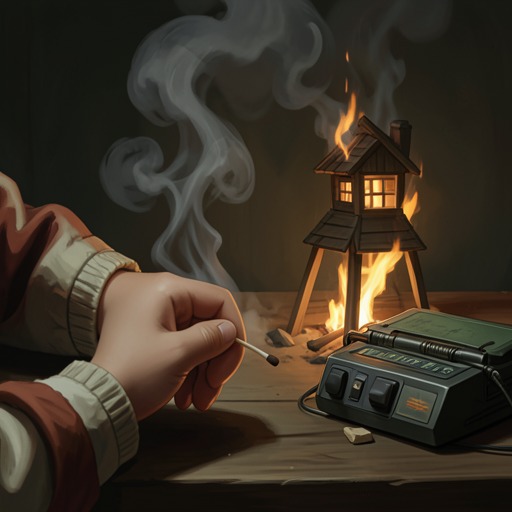
Bobby remembers seeing his mother’s boyfriend, William, use matches to provide light during car trips to Atlanta. He has taken a book of matches from the dashboard and hidden it in the footlocker at the end of his bed. Finding it among his toys, he tries to imitate William. His first seven attempts fail before one match catches. He watches the flame change from blue and gray paper to blackened, twisted cinder, so absorbed that he fails to notice how much light it gives. When it burns down to his fingers, he drops it and puts his scorched fingertips in his mouth. The match goes out before reaching the carpet.
Ignition and Escalation
Bobby lights another match, this time studying the colored rods on the floor. He holds a yellow rod beside the flame to check which side of the tower it belongs on. The fire jumps from the match to a support rod. Bobby watches, puzzled, as it races upward, blistering and blackening the paint before leaping across an unfinished connecting wheel to the next rod. Within minutes the tower’s wooden skeleton is burning, and flame catches the edge of the curtains behind it.
The materials around the tower carry the fire beyond the toy itself. Burning polyester curtains drip plastic onto the green carpet, which ignites; the flames then reach the wood paneling on the walls and ceiling around the window. The tower, once a careful arrangement of colors and joined pieces, becomes the path by which fire spreads through the room. Bobby watches it lean and fall. What began as an attempt to see and continue his construction has destroyed the structure he spent the day making, while the surrounding room becomes increasingly dangerous.
Bobby runs for the door, but its upper half is already yellow and orange with flame. As fire crawls down the door and the wall, his anger at the ruined tower gives way to fear. He repeatedly calls for his mother, then, winded by the thin air, retreats to the footlocker beside the bed. The room’s heat and smoke narrow the space in which he can move; his earlier curiosity has become a struggle to find safety.
Judith’s Arrival and the Last Recollection
Judith appears when the doorknob turns and the door flies inward, striking the burning paneling. For a moment, she stands in the doorway framed by dark-orange flames, looking at her open hand where the knob had been. As she raises her eyes to search for Bobby, the fire surges toward the fresh air and catches her threadbare blue-and-white cotton robe. The heat knocks Bobby from his seat. He crawls under the bed for relief and, after the flash subsides, sees his mother’s figure thrashing in the doorway, aflame.
This is the last memory Evan has from Bobby. The recollection ends not with an explanation or a resolved escape, but with Bobby beneath the bed and Judith burning in the doorway. Its abrupt limit gives the scene its force: Evan can recover the child’s path from fascination to terror, but the memory stops at the moment the household’s catastrophe becomes immediate and inescapable.
Consequences and Narrative Significance
The fire makes a sharp contrast between Bobby’s unplanned experiment and Evan’s later, deliberate use of flame. Bobby does not set out to burn the room; he wants enough light to sort the rods of a toy he has worked on all day. Evan, by contrast, lays accelerants and summons fire knowingly, while the remembered scene intrudes into his present action. The two episodes are not identical, but the recurrence of flame makes Bobby’s childhood disaster part of the pattern through which Evan experiences his own compulsion.
The memory also changes how Evan understands the fire he is making. As his present blaze spreads, he recognizes its connection to Bobby, and the language of a ghost turns a past event into a presence inside the current one. The remembered fire is thus more than an inherited scene: it is a link between lives, an origin point for Evan’s recurring urge, and a warning that fire’s movement can exceed the limits its maker expects. Bobby’s toy tower begins as something carefully ordered by color; once ignited, its structure becomes a route for destruction. That reversal is the image through which the memory connects the child’s room to Evan’s later acts.