Bobby’s fire memories shape Evan’s arson
The Reincarnationist PapersEvan Michaels’s connection to Bobby Lynn Murray is formed through a childhood fire that Evan remembers from the inside. The memory does not remain a distant account of another life: it breaks into Evan’s present, shapes his understanding of fire, and, during an arson in Minnesota, becomes an experience he recognizes as being for Bobby. The relation is therefore both inherited and enacted: Evan carries Bobby’s remembered terror into his own life, where the fire he deliberately summons answers a memory that once unfolded by accident.
The Memory That Breaks Through
In Evan’s last week in Minnesota, a disembodied memory from Macon, Georgia, in 1976 arrives more powerfully than the others. He describes it as different because he cannot control it. Though he has inherited relatively few memories from Bobby, this one, seen through a six-year-old’s eyes, stands out as the strongest among the past lives that matter to him. It continues to intrude on his current life, often and forcefully enough to demand satiation.
That difference gives Bobby’s memory a distinct place in Evan’s experience. It is not simply evidence that Evan has lived before; it imposes itself as a present need. When Evan watches flames climb through a building he has set alight, he recognizes the remembered scene and the purpose his current act has taken on: he realizes that he is the ghost in the room, and that this is for Bobby. The past is not only recalled but given a physical setting in Evan’s present.
Bobby’s Bedroom Fire
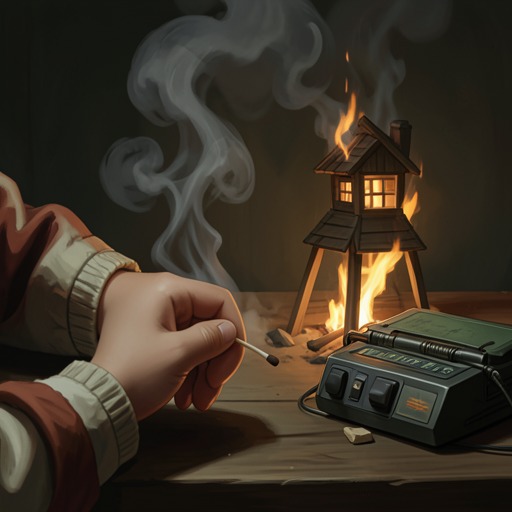
The memory begins with Bobby’s painstaking work on a tower of wooden Tinker Toys. The six-year-old has spent the day building it in the corner of his small bedroom, near the window. Its brightly painted rods and drilled wooden wheels form a color-coded structure; after supper, Bobby returns to rearrange the sticks so that the colors match. At eight o’clock his mother, Judith, puts him to bed despite his protests. He still wants to build higher and lies looking at the tower, wondering whether he will need to move it outside to continue.
In the dim room, the streetlight beyond the window provides too little light to distinguish the rods. Bobby knows the work cannot continue unless he follows the existing color pattern, but turning on the room light would reveal that he is out of bed. He remembers that his mother’s new boyfriend, William, used matches to provide light during a drive to Atlanta. Bobby has kept a matchbook from the car in a footlocker at the end of his bed. He finds it among his toys, takes a match, and tries seven times to strike it, imitating William.
The first flame holds Bobby’s attention for its own sake. He watches its blue and orange colors and the match change into a black, twisted cinder, barely noticing the light it could provide. When it burns down to his fingers, he drops it and puts his scorched fingertips in his mouth. The match goes out before it reaches the green carpet. He tries again, this time holding a yellow rod close to the flame to check where it belongs in the tower. The fire jumps from the match to the support rod. Bobby watches, puzzled, as it races up the painted wood, blisters and blackens the yellow paint, then crosses toward another rod.
Within minutes, the tower is burning, as is the edge of the curtains behind it. Burning polyester drips onto the carpet and ignites it; the fire reaches the wood-paneled walls and ceiling around the window. The tower leans and falls. Bobby calls for his mother, first in anger at the destruction and then in fear as he sees the flames on the bedroom door. Unable to reach the door through the heat, he returns to the footlocker and sits on the toy chest, struggling to stay awake in the smoke. His mother calls his name from the hall and opens the door. The fresh air feeds the fire, which catches on her threadbare blue-and-white cotton robe. Bobby crawls under the bed. Evan identifies the sight of Judith’s burning figure in the doorway as the last memory he has from Bobby.
From Inherited Scene to Deliberate Fire
Evan’s own fire-setting reverses the circumstances of Bobby’s first encounter with flame. Bobby strikes a match for light and to continue a toy-building project; the fire jumps unexpectedly to the tower. Evan, by contrast, prepares a deliberate path for fire, moving a lighter toward a narrow trail of vodka laid across a floor treated with methanol and wax. The flame travels along the liquid and spreads to the accelerants. As the fire climbs a post, Evan watches its progress and recognizes the remembered room as the one in which Bobby’s childhood ended.
The parallel is not a literal repetition: the two boys occupy different rooms and act under different circumstances. What links them is the flame’s movement through wooden supports and the moment a manageable task becomes an advancing fire. Bobby’s tower, carefully arranged by color, becomes the route by which the blaze takes the room; Evan watches flames climb the posts in the present and understands his role in the scene through Bobby’s memory. His deliberate arson thus gives the involuntary recollection an outward form, while the memory makes the act more than a present-day fire.
Recurrence and Significance
The remembered fire also explains why Evan’s current arson carries an element of compulsion. He says that Bobby’s memory continues to intrude and demands satiation; in the arson scene, he watches the flames with the attentiveness of someone who knows their behavior from within. The fire is at once a hazard Evan has set in motion and the medium through which the past returns. His recognition of Bobby does not erase the difference between Bobby’s accidental ignition and Evan’s intentional one, but it brings the two events into direct relation.
Bobby’s memory reaches its limit at the image beneath the bed: Judith is aflame in the doorway, and the recollection ends there. Evan inherits neither a complete account of Bobby’s life nor a detached history of the fire. He inherits a fragment charged with immediate danger, fixed on a child’s work, the match that was meant to help, and the mother who enters the burning room. Its force in Evan’s present lies partly in that abrupt boundary. The scene returns, but it does not become controllable; Evan can summon and watch a fire, yet the memory that gives it meaning remains the one he cannot command.