Bobby’s stained-glass panels
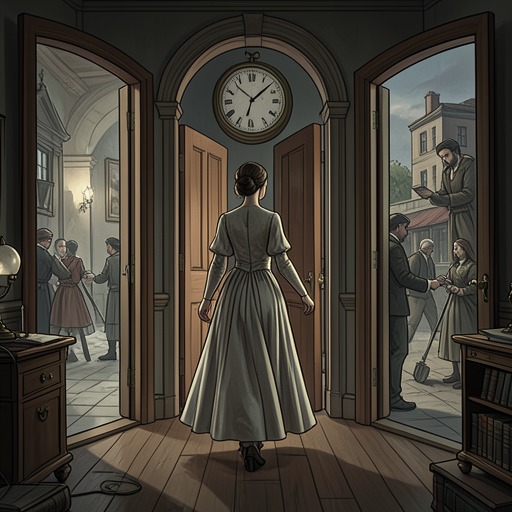
The Reincarnationist PapersBobby’s stained-glass panels are nine handmade scenes through which Poppy’s private history becomes visible to Evan Michaels. First encountered as luminous but seemingly unrelated pictures in three tall windows, they acquire their meaning only when Poppy identifies the figures as people from her own lives. Their progression from visual puzzle to personal record makes the windows both an artwork and an account of remembered history.
Form and First Encounter
Evan studies the panels after reading through the night, as dawn brightens the church. The nine scenes are set into three tall windows. In the early, faint light, their shapes emerge gradually; then reds, blues, yellows, greens, and whites flare into view. Evan spends about half an hour examining them before concluding that they do not form a recognizable biblical sequence. Their order is not explained by familiar religious imagery, and he is unsure whether the building is even a Catholic church.
The changing light makes the encounter unfold as an act of looking rather than an immediate revelation. Sunlight eventually passes through the glass and scatters colored beams across the hardwood floor, reaching Evan as well as the books beside him. The panels do not simply hang as pictures to be inspected: the morning light activates their color, and Evan’s prolonged attention lets their scenes take shape. His uncertainty persists even as he recognizes individual figures, because visual clarity has not yet supplied their personal history.
The Scenes in the Windows
The scenes present a range of lives rather than a single continuous episode. One young Native American man appears twice: first at a workbench admiring a piece of jewelry, then sitting with a young girl on a cliff above a southwestern pueblo. Another figure, a tall young Black boy, rides a white horse through open country and dances around a fire during a ceremony in a pueblo village. The panels place work, intimacy, travel, and communal ritual alongside one another without explaining their connections at first.
A woman in a red dress, with gold necklaces and headbands holding crimson scarves, occupies the central panel. Evan responds to her eyes as unusually compelling, even while judging her appearance harshly. Below her, a white man rows away from what appears to be a burning island. The same man appears older in a neighboring nocturnal scene, pursued through an old European city by a cloaked figure with a dagger. Deep blues, purples, and grays distinguish that chase from the brighter scenes around it, giving the two images of the man a visual contrast between escape and pursuit.
Evan’s favorite panel shows a pale, thin man dressed in royal French costume, complete with powdered wig and painted mole. He holds a flintlock pistol upright beside his head, ready for a duel; an opponent is visible behind him in a blossoming cherry orchard. Evan reads confidence and urgency in the duelist’s face, but also detects an unexpected suggestion that he is suppressing a smile. The final panel shows the same man shaping an orange glass ball in a workshop. Across the sequence, a threatened life and an act of skilled making belong to the same figure.
Poppy’s Work and the Key to the Images
When Evan asks who the figures are, Poppy calls them minor characters in history and explains that she cut, colored, and set the glass herself. She rises with the sun to see the windows. Her account gives the panels a double character: they are handmade objects she watches in the morning light, and scenes whose importance comes from lives that are not publicly prominent. Their personal quality, which Evan senses before he can explain it, is not an effect of a conventional religious story. It comes from the maker’s connection to the people depicted.
Poppy later confirms that the figures are the same people Evan has recognized and explains that the scenes come from her own lives: she is those people. This disclosure changes the panels’ status. The unfamiliar sequence is not a collection of invented historical illustrations but a selective visual record of lives Poppy has experienced across incarnations. The workbench, the pueblo, the woman in red, the boat, the nighttime pursuit, the duel, and the glass workshop become fragments of personal memory rendered in colored glass. The explanation resolves the puzzle of why the scenes feel so intimate without making them a complete or self-explanatory chronology.
Marco’s Escape and the Panels’ Significance
Evan identifies the man in the boat as Marco, and Poppy confirms the connection. She explains that Marco eventually escaped Murano in a small boat. Only official Venetian ships could enter the port; they supplied the island and carried away window glass, mirrors, and Cristallo for trade and export. Each ship brought ten to fifteen soldiers to check for stowaways, while the island governor counted the inhabitants after it departed. On the two occasions when men escaped, assassins hired by the Doge of Venice hunted them down and killed them, and their bodies were tied to the ships’ prows as a warning to the islanders.
That account makes the rowboat scene more than a generic image of departure. The apparently small figure fleeing the island belongs to a tightly controlled system of commerce, surveillance, and punishment. Poppy’s explanation also gives the panels a distinctive narrative function: they place the history of a life into an image that can be recognized before it can be understood. For Evan, the windows first offer beauty and unanswered questions; after Poppy’s disclosure, they reveal how one person’s many lives can be gathered into a handmade, visible archive.