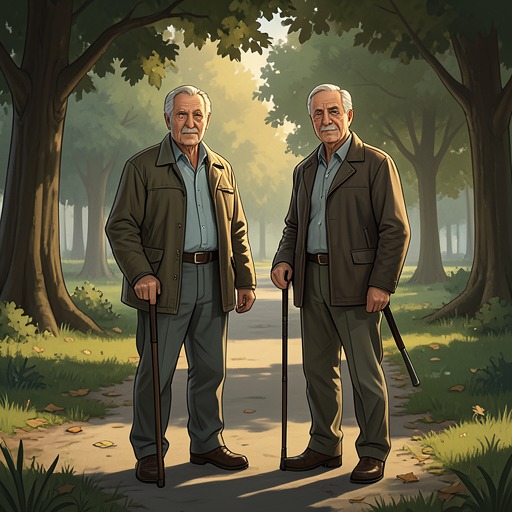
Clovis–Ramsay friendship and conflict
The Reincarnationist PapersClovis and Ramsay’s friendship is recast as a conflict between personal loyalty and military duty when Ramsay arrives at Al-Mocha with a force sent to capture the port. Their meeting turns an impending battle into a private appeal between old friends, but neither man can make the other abandon his course. Ramsay refuses to bring arms against Clovis; Clovis refuses to yield. The attack that follows destroys Clovis’s command and citadel, and the story ends with the two men separated by the different consequences of their refusals.
Shared Past and Opposing Duties
Clovis recounts their history to Evan while explaining why he built the tower that has become his penance. He had been hired in Damascus by Ali Abdul Pasha, who wanted to secure his late father’s territorial gains against the Ottomans. Appointed Sherif of Mocha, Clovis was charged with the port’s protection and security. He says he was content with the work and its pay until Ramsay appeared commanding a brigade of Dragoon fusiliers intent on taking the port and the coffee-producing highlands. The two men had once worked in the same profession, though Clovis distinguishes the soldiering of his own earlier service as an honorable trade.
Their opposing positions are not presented as the result of a personal quarrel. Clovis is responsible for defending the place where he serves; Ramsay leads an invading force. When Ramsay’s three-masted clipper, the Trade’s Increase, approaches beneath a Union Jack, the villagers initially gather to welcome what they believe is an English trading ship. The ship anchors broadside to the dock and brings its guns to bear, revealing the attack. A messenger summons Clovis from the stone citadel at the town’s center. He arrives with two lieutenants to find Ramsay at the gangplank, flanked by a dozen red-coated soldiers with bayoneted muskets. Ramsay turns and recognizes him; the sight of Clovis makes him go white. Their surprise is mutual, and the discovery forces friendship into the middle of a military confrontation neither man expected to face in this form.
A Private Appeal Before the Attack
Clovis has the crowd cleared and leads Ramsay up four flights of the citadel to its roof, away from their troops. The physical separation gives them a brief space for direct negotiation, but it does not resolve the conflict. Clovis demands an explanation for Ramsay’s presence outside the town. Ramsay says he will resign his commission immediately and will not bring arms against Clovis; at the same time, he still urges him to surrender. His warning is framed not as an adversary’s demand but as a brother’s appeal: Clovis does not understand the force arrayed against him.
Clovis answers that being outnumbered and underestimated would not be new to him. Ramsay counters that the danger is not merely numerical: Clovis is outgunned, with a sword, a dagger, and two short cannon mortars to defend the port. The exchange makes their disagreement concrete. Ramsay recognizes that Clovis’s defenses cannot match the attacking force and offers the surrender he believes can prevent a slaughter. Clovis treats resistance as a possibility even after Ramsay has shown him how badly the balance of arms is tilted.
Clovis does not answer Ramsay’s warning with anger alone. He puts an arm around him and invites him to join the defenders, proposing that they fight back to back as they had in the old days. Ramsay declines, apologizes, and says that stepping aside is the most he can do. Their affection remains visible in the embrace and in Ramsay’s refusal to attack his friend, but it cannot become a shared military action. Clovis recognizes that a message remains to be delivered: he gives the captain one hour to leave, threatening to throw the redcoats into the Red Sea if the ship does not depart. He thanks Ramsay for the warning and tells him to look to his own welfare. Ramsay salutes and leaves; Clovis informs his lieutenants and prepares for the attack.
Defeat and Divergent Consequences
The ship does not leave. In the first minutes of fighting, the attackers shoot men in the streets who carry sabers or daggers. Eighty of Clovis’s hundred volunteers are killed. The remaining defenders are driven into the citadel, which the attackers raze with cannon fire. Clovis organizes a retreat when only six men remain. They escape to a well on a hill and camp there for two nights. The other five want to return to town to avenge fathers, brothers, and sons; Clovis restrains them until the second night, when he can no longer dissuade them. On the third morning he wakes alone.
Ramsay’s refusal to fight Clovis does not spare him from punishment by his own side. Clovis later reports that Ramsay was put in irons, transported to England aboard the same ship, and hanged for refusing to engage the enemy. His attempt to protect his friend has therefore cost him his commission and, ultimately, his life. Clovis, meanwhile, survives the defeat but loses his force, his citadel, and the men who had followed him. The account places their choices in parallel without making their fates equivalent: Ramsay is executed after refusing to fight, while Clovis lives on at the site of his defeat.
The Tower as the Relationship’s Aftermath
After being left alone, Clovis waits a week, living on mollusks and water, then slips back into town under cover of darkness. He steals a British wagon and secretly loads it with stones from the collapsed citadel, gathering material night after night until he has enough to build the tower. He describes the structure as a penance and, when asked how long the work took, says that penance is measured by effort rather than time. The tower gives the aftermath a physical form: it is built from the remains of the place Clovis failed to defend, after the lives and companionship connected to that defense have been lost.
Ramsay’s brief intervention is the last point at which the two friends stand together. He offers warning, resignation, and a personal appeal, but cannot persuade Clovis to surrender; Clovis offers renewed solidarity, but cannot persuade Ramsay to join the fight. Their friendship persists in the language of brotherhood and in Ramsay’s refusal to attack, even as their duties and decisions divide them. Clovis’s final answer to what became of him is that he lived there. That spare ending leaves the tower and its labor as the surviving record of a friendship whose decisive act was not a reunion, but a refusal by each man to betray what he believed he owed.