Duty to watch for and introduce new members
The Reincarnationist PapersThe duty to watch for and introduce new members makes Cognomina’s search for isolated reincarnates an ongoing responsibility rather than a matter of chance. Poppy describes herself as the person who found Evan Michaels and treats introducing him to the society as her responsibility. Her account connects an outward-looking practice of vigilance with a direct obligation to the individual discovered: the newcomer is not merely a rare case to report, but someone who must be brought within reach of the community.
Meaning and Scope
Poppy explains that members expect there to be more people like themselves and therefore remain on the lookout for them. She links the search to a changing world: as the world becomes smaller, it is easier to find people who have been lost to the society. The obligation is thus both persistent and responsive to circumstance. Cognomina does not assume that all potential members have already been found; its members act on the expectation that others may still be living without knowing that anyone shares their condition.
The language of finding lost brothers gives the search a familial register, but the duty described is specific: to look for others and make an introduction. Poppy tells Evan that she will explain what she is allowed to tell him, marking a limit alongside her responsibility. Finding someone does not mean that every fact about the society can immediately be disclosed. The obligation begins a relationship and a process of introduction; it does not erase the society’s boundaries around what may be shared.
Poppy’s Introduction of Evan
Poppy’s encounter with Evan gives the duty its concrete form. Evan wants to meet people who understand what he has experienced, and Poppy answers that she found him and is responsible for introducing him to Cognomina. She takes his hand and strokes the back of his head as she reassures him. The gestures make the obligation intimate: the search culminates not in an abstract notification but in contact with a person who recognizes the newcomer’s need for guidance.
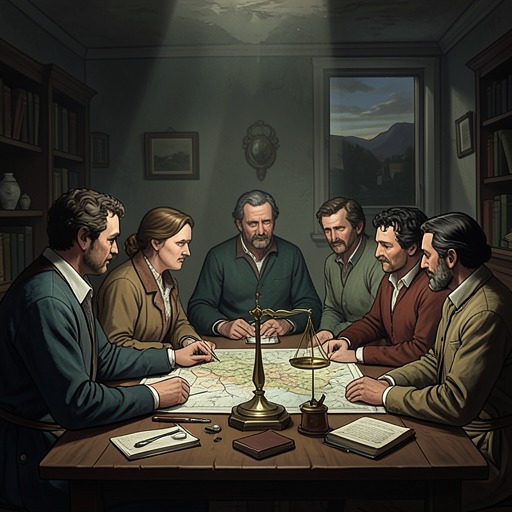
Poppy also says she will act as Evan’s advocate. That role places her beside him as he approaches the society, while keeping distinct the act of introduction and the decision about his status. She describes Ascension as a trial before a panel of five members. Evan must recount his life histories and answer questions, with dates, places, and people subject to verification; the panel, rather than the person who finds him, gives the decision. Poppy’s duty therefore brings Evan to the threshold of membership and helps him through the process, but does not itself confer confirmation.
Vigil Across Generations
The interval between discoveries shows why the obligation is described as a vigil. Poppy says the previous newcomer had been found about sixty years earlier and was older than she was. She also imagines others who may remain undiscovered for centuries, wandering without knowing that there are people like them. The contrast between a known gap of decades and the possibility of centuries without discovery makes the search larger than any single introduction: its duration cannot be set by the life span or convenience of one generation.
Poppy’s own history helps explain her investment in that work. She says she was found at about thirty-four, during her second trip, and was younger than Evan when the discovery happened. Her experience places her among those who were found, while her later search for Evan makes her a person responsible for finding someone else. The account does not specify how Cognomina organizes its watch or how potential newcomers are located; it establishes the expectation to keep looking and the personal duty to make contact when someone is found.
Rarity and Continuity
Poppy calls a new arrival rare, though less rare than it used to be. That qualification matters: each discovery remains significant, but the society’s continuing search is not based on the belief that discoveries are impossible or exhausted. A smaller, more connected world may make lost people easier to find, yet Poppy still speaks of scores of possible others and of centuries-long isolation. Greater ease does not remove the need for vigilance.
The duty consequently links Cognomina’s continuity to care for people beyond its known membership. Its members watch because undiscovered reincarnates may be alone; they introduce those they find because recognition must be carried by someone who already belongs. In Evan’s case, Poppy’s responsibility transforms his desire to find others like himself into an actual meeting, while the separate Ascension process preserves the distinction between being found and being accepted.