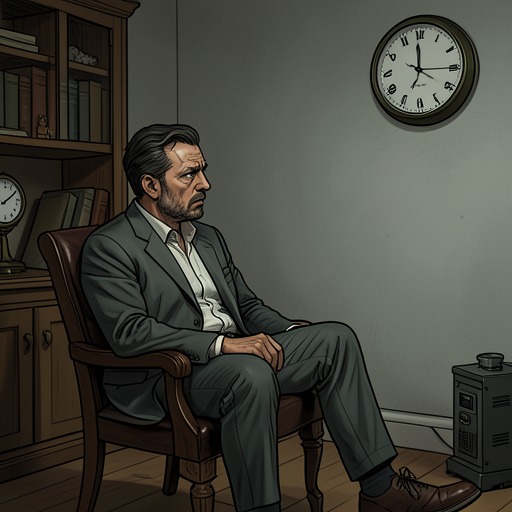
Evan Michaels’s Ascension
The Reincarnationist PapersEvan Michaels’s Ascension is the Cognomina’s identity trial and the threshold between Evan’s life as an outsider and his acceptance as a returning member. In the torchlit grotto, he must make memories from earlier lives credible to a panel; after a four-to-one decision, the test gives way to a communal welcome and the Embe tattoo that marks his place in the society.
The trial and its setting
The Ascension tests whether a candidate can prove to members who knew him in another life that he is the same person in a new body. The society’s procedure has changed over time. In the earlier practice described to Evan, members confronted a candidate and one ran him through with a spear. Acceptance came only if the candidate returned in another life and identified his murderer. In the modern trial, a panel judges evidence such as names, dates, places, and other details that can be verified. It is especially difficult the first time, when the candidate has not yet established a history with the society.
The setting makes the proceedings feel both judicial and ceremonial. Evan follows Poppy down between seventy-five and one hundred stone steps, guided by torches and the echo of his cane on the masonry. The staircase opens into a cavernous room supported by carved stone columns. A table and two chairs face a long console like a judge’s bench; tiered seats rise before a heavy black curtain. The architecture encloses the test in a space that is at once a courtroom and the hidden interior of the community whose recognition Evan seeks.
Before the proceedings resume, Evan is told to expect more questioning, followed by a break while information gathered by the Cognomina’s sources is checked. The panel will deliberate privately, then announce its judgment before the palingenesists. Confirmation is supposed to lead to a festival at which a new member chooses a name and is formally introduced. Ascension is therefore not only a test of memory: it is a staged passage from proof, through judgment, to public recognition.
Memory offered as evidence
When the hearing continues in Zurich, Evan approaches it with confidence rather than fear. Samas stands beside him as his new advocate. The gallery is full, but Poppy is not among those watching. Five panel members take their places, and the questions turn to Evan’s former life as Vasili. Asked for the name of the judge who convicted him in 1946, Evan gives the full name, Comrade Vlad Dukchov, and identifies the Committee for the People’s Justice. The Egyptian panel member marks his notes. A further question concerns the commandant at State Camp #4, making clear that the panel is testing precise recollection rather than accepting a general claim of familiarity with the past.
The judges also ask about Evan’s relationship with his parents in Minnesota after he realized he was different. Evan answers with the image of a cowbird, which lays its eggs in a robin’s nest. The host birds raise the young as their own until the difference becomes visible; then they reject the one who can now survive alone. Evan presents this as the shape of his own experience: an unexplained difference, followed by rejection, and a long period without understanding where he belonged. By offering the analogy to the panel and gallery, he makes his estrangement part of the case for why the Cognomina’s recognition matters to him.
The questioning turns next to fire. Evan’s first advocate had found him after he set one, and the panel wants to hear about it. The supplied account establishes the subject of the question but does not give his answer. That limit matters: the hearing tests a life through details that can be investigated, while the record of this episode also places Evan’s self-explanation alongside the specific memories being assessed.
Decision and obligations
Before announcing its decision, the panel sets out the conditions of membership. Cognomina members must keep the society, its condition, and its collective existence secret. They are expected to introduce new palingenesists, answer summonses to serve as judges or jurors, and take turns administering the society’s funds and activities. They must leave their assets to the Cognomina; after death, ten percent goes to a community fund for expenses and the upkeep of its facilities, with an accounting given at Sumerfest. They must undergo an identity trial in every later incarnation to reclaim their assets and pledge lasting allegiance to the other members.
These rules make acceptance more than a finding that Evan’s memories are true. Membership carries duties across lives: secrecy, service, property arrangements, and a recurring obligation to prove identity again. The old man presents the Cognomina as a family as well as a formal society, and Evan nods that he accepts its conditions. The arrangement binds personal belonging to collective responsibility; recognition is granted with obligations attached.
The old man then announces that the panel has voted four to one: Evan is what he claims to be and will be welcomed as a brother. Evan exhales in relief, and Samas embraces him. The gallery responds with both groans and cheers as wagers are settled, a reaction that gives the formal decision a public, almost festive afterlife. Mr. Diltz is the first to approach Evan with congratulations. The judgment has been private until this moment; its force becomes real when the assembled community hears it and responds.
Welcome and the mark of membership
At the celebration, Evan tells the gathered members that he is home. His words give the verdict an emotional meaning beyond verification: the people before him know the condition that has separated him from others, so he does not need to explain that feeling to them. He jokes that he is glad they did not have to kill him, recalling the older spear test. The crowd answers with hoots and howls, and musicians join the uproar as the gathering moves around the chaise lounge before the stage.
Poppy then reminds him that the welcome is not complete without the tattoo. She offers a fingerless leather gauntlet, laced underneath, with black ink along the edges of an Embe-shaped template on its top. Evan slips his hand inside as she fastens it. The tattoo, worn by members in successive lives after Ascension, makes the trial’s recognition visible on the body. The ceremony thus ends not simply with a verdict but with a mark that connects Evan’s newly confirmed identity to the society’s continuing practice.
When Evan asks for her name, Poppy gives him Nez-Lah and points to the lounge, then says that everyone there calls her Poppy. The exchange joins the ritual of chosen names to the intimacy of their personal history. For Evan, the Ascension resolves the immediate question of whether the Cognomina will recognize him; the welcome, the mark, and the people around him begin the harder work of making that recognition feel like home.