Evan Michaels’s Ascension Hearing
The Reincarnationist PapersEvan Michaels’s Ascension Hearing is the Cognomina’s formal test of whether he is the same person who lived before, and it turns his private memories into a claim judged by the society he hopes to join. Conducted in a torchlit underground chamber, the hearing makes membership depend on evidence that can be checked by people who knew earlier incarnations. Its four-to-one verdict accepts Evan; the ritual welcome that follows begins to transform that decision into a lived identity.
Purpose and Historical Form
The Ascension is required of members in each successive incarnation before they reenter the Cognomina. A candidate must persuade people who knew the earlier person that the new body contains the same identity. Names, dates, places, and verifiable experiences therefore matter not simply as recollections, but as evidence in a communal judgment. Poppy brings Evan before the panel as a neophyte who claims to be a palingenesist, states that she believes him, and asks the judges to decide whether he may become a candidate.
The hearing also carries the weight of an older, more violent custom. In the past, Poppy explains, members tested a candidate by running him through with a spear; acceptance came only if he returned in another life and identified his murderer. The contemporary procedure replaces that ordeal with a panel assessing testimony. The old test makes the present hearing’s reliance on memory and verification seem comparatively restrained, while the spear above the central judge keeps the society’s history of bodily danger visible in the room.
The Chamber and Its Participants
Poppy leads Evan down a staircase of roughly seventy-five to one hundred steps, its stone walls lit by torches. At the bottom, the stairs open into a cavernous chamber supported by twelve carved stone columns. A wooden table and two chairs face a long console like a judge’s bench; a tiered gallery stands before a heavy black curtain. The descent separates the hearing from ordinary domestic space, while the formal arrangement makes clear that Evan’s account will be heard and assessed in public.
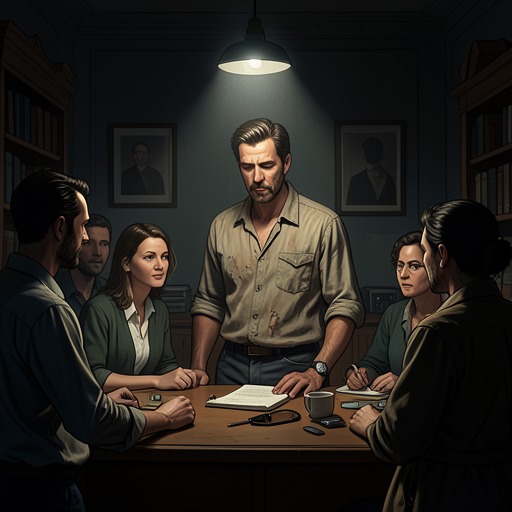
Five judges sit at the bench. The central place, beneath the spear, belongs to an elderly, white-haired man who presides over the proceedings. Among the others are a Spanish judge, an Egyptian judge who conducts much of the questioning, and Nadya, whom Evan recognizes from a cafe. The gallery has twenty seats and is less than half full. Mr. Diltz is among the few people Evan recognizes there, and a young scribe records the proceedings in a large leather-bound book. The panel, witness, candidate, and record-keeper give the chamber the shape of a court, but its subject is the continuity of a person across lives.
Evan’s Testimony
The presiding judge asks whether Evan understands what the Ascension involves and whether he wishes to enter the Cognomina. Evan answers yes, recognizing that the choice would alter the life he had known. The Egyptian judge then begins at the beginning, asking how many lives Evan remembers. When Evan looks to Poppy for direction, she quietly tells him to answer. Her role is both institutional and personal: she has assembled the panel, believes his claim, and serves as his advocate and witness.
Evan identifies his first remembered death as occurring in Istanbul in the fall of 1968. He cannot give an exact date or explain how he died; he recalls only collapsing on the floor of his room. Asked what followed, he says that he remembers being a little boy in Macon, Georgia. Later, after a meal and a pause in the proceedings, the Egyptian judge resumes the examination by asking about Evan’s first incarnation as Vasili Arda and his earliest memories as a child.
Evan gives the panel an account of how those memories became persuasive to him. In the fall of his first strange year, he began experiencing dreams and waking visions that initially seemed random. They gradually formed an order and became recognizably memories of Vasili’s life in the Bulgarian countryside. During the Minnesota winter, they grew longer, more vivid, and more frequent. Evan repeatedly reviewed them until he could use the language and music they contained; by summer, he could read, write, and speak Bulgarian and play the organ. Their detail made the experience tangible to him, though he had initially questioned whether it indicated a consciousness distinct from his own.
A second body of memories, those of Bobby Lynn Murray, arrived within two weeks. Evan says they followed Vasili’s and gave him a way to test what he had experienced: he left his parents and traveled to Georgia. His testimony thus presents more than an assertion that he remembers another life. It traces the memories’ development, the skills they conveyed, and the decision to seek confirmation in places connected to Bobby. The hearing’s questions turn those private experiences into a sequence the Cognomina can examine.
Verdict and Admission
After the hearing, the panel rules by a vote of four to one that Evan is what he claims to be and will be welcomed into the Cognomina as a brother. His relief is immediate. Samas puts an arm around him and hugs him; the gallery answers the ruling with a mixture of cheers and groans as wagers are settled. Mr. Diltz is the first to approach and congratulate him. The response makes the decision both official and communal: a judgment recorded by the panel is also a change in Evan’s place among the people gathered to witness it.
At the ensuing welcome, Evan addresses the group and says that he feels at home among people who understand what he has experienced. He jokes that he is glad they did not have to kill him, drawing an uproar from the crowd. The musicians, who had stopped while he spoke, begin again as people gather around a red velvet chaise lounge in front of the stage. Poppy reminds him that one step remains: the tattoo. She offers a fingerless leather gauntlet, with the black ink of an Embe-shaped template visible along its edges, and helps fit it over his hand. She gives her name as Nez-Lah, while noting that everyone calls her Poppy. The hearing’s verdict has admitted Evan to the society; the tattoo and welcome give that admission a public, bodily, and social form.
Significance
The event stages belonging as something neither memory alone nor institutional authority can secure. Evan must tell his history before people who can judge it, and the panel’s vote converts his claim into recognized membership. Poppy’s advocacy links those two sides: she brings him into the chamber and stands beside him as witness, without replacing the testimony he must give himself. The shift from the historical spear test to questions and verification marks a change in method, but not a disappearance of risk; the ritual still requires the candidate to place his identity before others for judgment. The four-to-one decision, followed by the Embe template and the crowd’s welcome, carries Evan across the boundary from neophyte to brother.