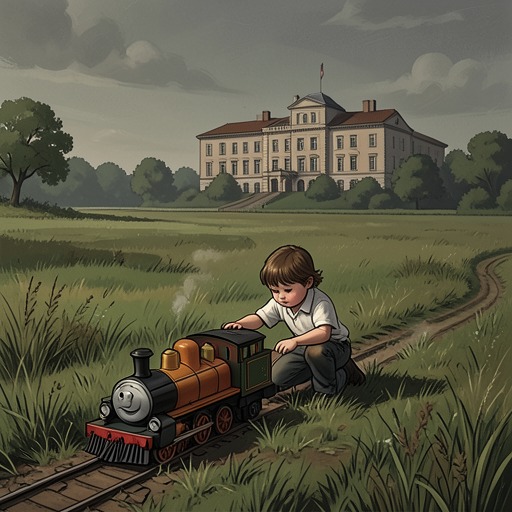
Evan discovers his past-life memories
The Reincarnationist PapersEvan Michaels’s discovery of his past-life memories turns a teenager’s baffling episodes of absence into evidence that another life is continuing within his own. What begins as involuntary daydreaming becomes a first-person record of the life of Vasili Blagavich Arda, and then a set of practical abilities Evan can learn to use. The discovery gives him a past he cannot explain to his family, and a new identity he must carry largely alone.
The onset of the memories
In the eleventh grade, Evan’s teachers repeatedly caught him daydreaming. The spells arrived without warning or pattern, sometimes lasting a second, sometimes several minutes. At first he had no name for what was happening: it felt like watching a film, but he could not understand how he might remember events that had never happened to him. The episodes were not initially a coherent history. They came as short features, then expanded over the course of that school year into multi-hour sequences that crowded his ordinary thoughts.
The memories varied in their persistence. Some replayed; others appeared once and seemed to vanish. Their first scenes were panoramic and often pastoral, peaceful to the point of boredom. Action and unfamiliar people appeared later. At first, Evan could find no central figure connecting the scenes. Gradually, visual and auditory impressions acquired emotional force, joined by tactile sensation, and the apparent structure changed: every scene belonged to a life experienced from behind the camera. The unseen person became legible as the focus of the events, while Evan experienced those events vicariously through the memories’ first-person perspective.
From involuntary scenes to learned skills
Evan eventually learned to summon the episodes deliberately and replay individual segments in an effort to arrange them into a timeline. Repetition made a memory more intimate, but also made the action within it easier to imitate. The person in the memories had been a farmer, an Eastern Orthodox church organist, a soldier, and a prisoner. Music was the first skill Evan brought into his present life.
At night, he sat in his darkened room and followed the remembered movements of calloused, dirty-nailed hands across the organ’s keys and levers. He learned one piece after another until he had enough confidence to try the instrument himself. A minister gave him access to an organ, and within weeks Evan could play eighteen songs. They were religious East European hymns, but did not suit Minnesota Lutheran services. The minister stopped the sessions after being impressed by Evan’s apparent gift but disappointed that it had not produced more traditional music. For Evan, the attempt had already established something more consequential: a skill held in the memories could be made active in his own hands.
Language offered a harder test. That fall, Evan began writing and understanding the unfamiliar script he had seen in the memories. Its reversed N’s and R’s and its unusual letters took a year of practice to master; for functional reading and writing, he could no longer rely on slipping mentally back into the other man’s past. He identified the language as Bulgarian and eventually learned the remembered man’s name: Vasili Blagavich Arda. The name gave the episodes an identity, while the writing offered Evan a capacity he could demonstrate outside them.
Disclosure and departure
Evan tried to make his discovery credible to his parents. He wrote pages in Bulgarian and read aloud from books he had requested from the University of Minnesota, explaining that another Bulgarian reader would understand the language. His parents had already treated the organ playing as a curiosity. The claim that he remembered the language from another man’s life provoked concern and annoyance; saying that he remembered another family, place, and time made them angry, especially his father. The more detail Evan offered, the less willing they were to understand him. He eventually stopped telling them. He wanted someone to recognize what he was experiencing, but this failed attempt became the last time he gave anyone the chance to do so.
With two months of high school remaining, Evan told his parents he was leaving and would not return. The announcement passed almost unnoticed after the shocks that had preceded it. In later narration, he locates his departure from Minnesota three years before and connects it to the beginning of his remembering: he left in search of himself and ended up in Los Angeles. The discovery therefore becomes not only an inward rupture but the cause of an early break with home.
The Change and its continuing effects
Years afterward, Poppy gives Evan a framework for the onset. She calculates that his memories began when he was eighteen and calls this transition the Change: as the body approaches maturity, memories from earlier lives flood back. The age and sequence fit a recurring pattern she has observed across incarnations. Some people take years to make sense of what returns; for others, the memories fall into place more readily. Each later awakening may become easier because the person has already experienced the confusion in another life. Evan remembers believing he was going crazy, a fear Poppy recognizes as part of the disorienting passage between an ordinary childhood and an unsettled sense of who one is.
Assimilating Vasili’s memories, and later those of Bobby Lynn Murray, further alters Evan’s sense of time. Events from earlier lives remain as clear as memories of his own life, and form what feels to him like an uninterrupted timeline, even though he can tell which life each memory belongs to. Historical anniversaries can make him realize that a remembered event happened long ago; otherwise, years may pass unnoticed in the merged stream. Perfect memory thus brings knowledge and continuity, but also makes the past impossible to put away. Evan later explains that he writes his story knowing he may return to it in another life with different eyes: the account becomes a record for a future self, as well as a way to preserve what the awakening has made difficult to forget.