Evan's first arson and deal with Officer Shirer
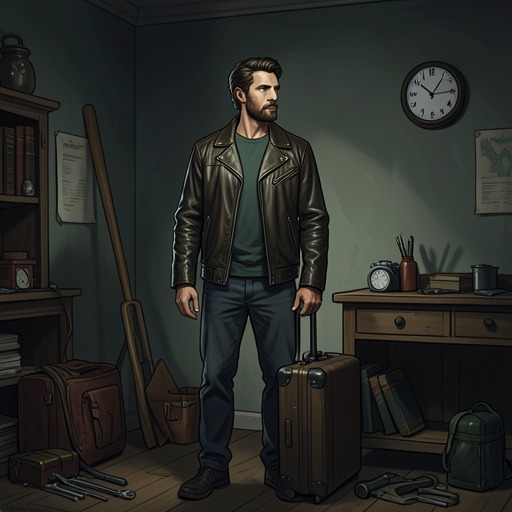
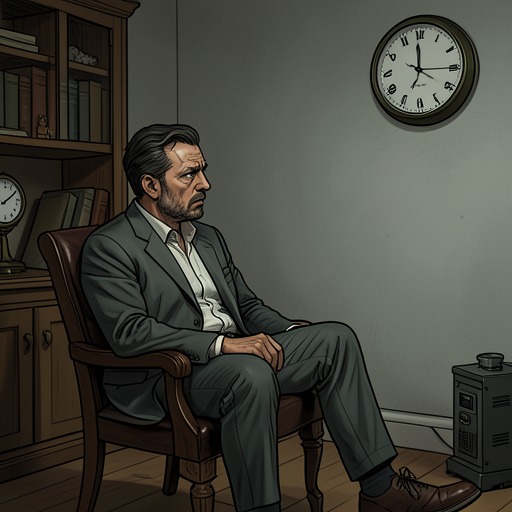
The Reincarnationist PapersEvan’s first arson-for-hire arrangement begins not with a client seeking him out, but with his being caught by the police while a building burns behind the officer questioning him. Officer Shirer turns that arrest into a bargain: Evan will burn the officer’s estranged wife’s house in exchange for release. The episode makes Evan’s passage into paid arson a transaction built from leverage, complicity, and a fire that keeps advancing while he tries to talk his way free.
The first fire and the police encounter
Evan recounts that he had set a fire in an abandoned apartment building in Watts and intended to watch it from across the street. Instead, Officer Shirer caught him leaving the building, cuffed him, and put him in the back of his squad car while checking his identification for warrants. Evan was clean, but that did not end the questioning. Shirer kept him there and asked why he had come out of an abandoned building at two in the morning.
As Evan improvised a story about scouting a photography location, smoke began slipping through cracks in the plywood covering the windows. The fire became increasingly difficult to conceal: smoke billowed from the second-floor windows, then yellow flames appeared near the open front door and climbed toward the upstairs windows. Evan kept speaking and watched Shirer rather than turn to look at the blaze. His invented explanation—that he was a photographer preparing to shoot Bruce Springsteen for Rolling Stone—was already coming apart, but he continued talking because he expected Shirer to turn around as soon as he stopped.
Shirer eventually broke off the interrogation and looked back at the burning building. He reversed the car and called the fire department with the address. When he accused Evan of starting the fire, Evan denied that Shirer could know it. Evan then tried to justify the arson by saying the building was due to be demolished and that the fire would save the city money. He asked to be let go. Shirer’s response shifted the encounter: rather than simply take Evan in, he proposed that Evan do him a favor, while Evan understood that the favor could earn his freedom.
Shirer’s offer
Shirer explained that he was divorcing and that his wife would keep the house. A judge had determined that they would divide its $60,000 in equity evenly, but she could not pay Shirer his half at once without selling the house, which she refused to do. The ordered alternative was $100 a month for twenty-five years, without interest. Shirer became angry while describing the arrangement. He then presented destruction of the house by an apparently accidental fire as a way to receive his $30,000 share in a lump sum. The same plan would leave his wife without a place to stay and without clothes.
Evan understood the proposal as a direct exchange: burn Shirer’s house and walk away. He says he decided within seconds. Shirer took a key from his ring and gave Evan the key together with a handwritten address. The objects made the arrangement practical, but the terms also preserved Shirer’s leverage. He held up Evan’s identification and said Evan could retrieve it the following night in exchange for the key if the house had burned; otherwise, Shirer would leave the identification beside the abandoned building. Evan nodded, and Shirer uncuffed him and let him out of the car.
The instructions fixed both the timing and the meeting place. Shirer said his wife left for work at 8:30 in the morning and often left the iron on. He told Evan to meet him at midnight the next night at the California Cafe beside the Coliseum, sitting at the counter. The account establishes these as the officer’s instructions; it does not describe the mechanics of the house fire. The bargain’s supposed accident is therefore part of Shirer’s plan, not a confirmed account of how the fire was set.
From a bargain to paid work
Evan says he carried out the job and met Shirer as agreed. The arrangement’s immediate result was not simply payment: the first bargain had exchanged freedom and the return of Evan’s identification for an act Shirer wanted done. A week later, a stranger visited Evan at his hotel. The stranger said that the “boys in blue” had told him Evan could help, then handed over an envelope containing an address and $2,000. Evan did not know what had happened on Shirer’s end, but accepted the money and did the job.
The first seven or eight jobs came through this kind of approach, according to Evan; after that, his name apparently circulated around town, and he continued taking work. In the conversation where he recounts the origin, he identifies the job under discussion as his nineteenth. The account thus distinguishes the initial coercive bargain from the later pattern: Shirer first used Evan’s predicament to recruit him, then introductions and payment connected him to further arson work.
Significance of the episode
The scene’s central reversal is that the officer who catches Evan does not simply enforce the law. Shirer uses the authority and access of his position to turn a detained suspect into an accomplice, making the police car both the place of interrogation and the setting for a criminal arrangement. Evan’s first intended audience for the Watts fire had been himself; trapped in the back seat, he must keep Shirer’s attention while the blaze becomes impossible to ignore. When Shirer finally turns around, the danger does not end. It changes form, becoming an offer that carries Evan from one fire to the next.
The episode also gives Evan’s professional beginning a concrete chain of causes rather than presenting it as a sudden career choice: an abandoned building, a failed cover story, a corrupt officer’s private financial grievance, a key and handwritten address, and then an envelope with $2,000. Shirer’s scheme depends on an insurance payout while explicitly disregarding the consequences for his wife. Evan, meanwhile, moves from seeking release to completing the work and accepting the next job without knowing what had become of Shirer. The growing sequence—from the first bargain, through seven or eight jobs received by introduction, to the nineteenth—shows how a single compromised encounter becomes an ongoing occupation.