Evan’s Cognomina Welcome Ceremony
The Reincarnationist PapersEvan Michaels’s Cognomina Welcome Ceremony completes his passage from candidate to accepted member: the panel’s decision is followed by a communal welcome, a deliberately alarming joke about the society’s former spear trial, and the application of the Embe tattoo. The episode makes membership more than a verdict. It joins proof of identity to a chosen name, a mark carried on the body, and a community that recognizes the person beneath changing appearances.
The trial and its setting
The ceremony rests on the Cognomina’s understanding of what it means to remain the same person across lives. Poppy has explained that the society is an extended family of twenty-eight, formed centuries earlier by people who had discovered they shared the ability to remember previous lives. Members wear the tattoo in each successive life after completing Ascension. The trial is meant to establish that a candidate in a new body is the same person known to the society before; verification becomes especially difficult the first time.
The custom has changed sharply over time. In the older version, members ran a spear through the candidate, who would be accepted only if reborn and able to identify the person who killed him. In the present procedure, a panel judges claims through evidence such as verifiable names, dates, and places. This history gives the welcome its edge: the spear is not an arbitrary prop, but the remnant of a once-literal test of continuity and recognition.
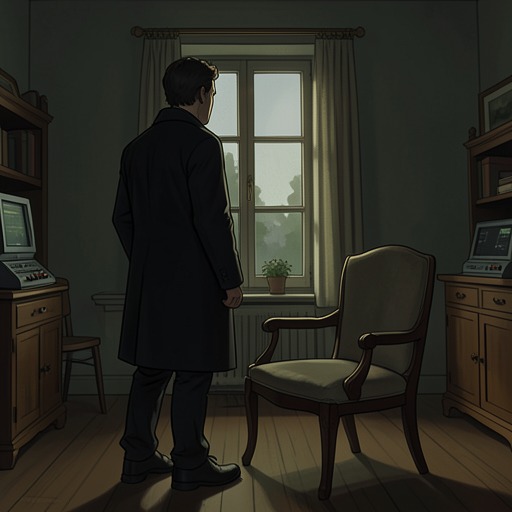
The proceedings take place below ground. Evan Michaels follows Poppy down a torchlit staircase of roughly seventy-five to one hundred stone steps, feeling for handholds in the old masonry as the brass tip of the Dragon cane echoes downward. The landing opens into a cavernous chamber with carved stone columns, a polished dark floor, a judges’ console, and tiered seats behind a heavy black curtain. The descent separates the gathering from ordinary surroundings; the hidden room also gives the society space to turn a private admission into a shared rite.
Acceptance and a name that survives
Before the welcoming ceremony begins, the old man announces that the panel has voted four to one to accept Evan Michaels’s claim. The formal language identifies him as a neophyte and welcomes him as a brother. His relief becomes visible: he exhales, wipes at tears, and is embraced tightly by Samas. Groans and cheers rise from the gallery as wagers are settled, while Mr. Diltz is among the first to congratulate him. The vote resolves the immediate uncertainty, but the reactions show that the decision has been watched and felt by the whole gathering.
The old man then explains another distinction the society preserves. The bodies its members inhabit will wither and fail; the names used in the outside world end with those bodies. Their Cognomina names, by contrast, identify the continuing individual through successive forms. Asked to choose such a name, Evan Michaels selects Evan, tying the beginning of his membership to the person he is now. Naming is therefore not a claim that the body will endure. It gives the society a way to recognize an identity understood to outlast it.
A staged return of the spear
The welcoming ceremony briefly makes the old test appear to return. The crowd forms two parallel lines, and Evan Michaels is left uncertain where to stand. A huge, nearly unclothed figure in red silk trousers and a tasseled fez emerges from behind the curtain. As the Egyptian member Auda removes a spear from above the panel, the giant, Chance, grabs Evan Michaels and pins his arms behind him. Samas calls out in alarm.
The threat is a prank, not an actual repetition of the historical ordeal. Once the curtain races aside with a mechanical clamor, revealing banquet tables, Persian rugs, a small stage, and a swimming pool, Chance releases Evan Michaels. The noise gives way to laughter, and Auda explains that Mr. Diltz had mentioned Evan Michaels’s concern about the spear. By turning that fear into a joke, the members echo their history while showing that the present ceremony no longer requires a candidate to die and return to prove himself. The scare ends in public amusement rather than judgment or violence.
The tattoo and the welcome made visible
After the room’s laughter settles, Poppy tells Evan Michaels that the tattoo remains. She brings out a fingerless leather gauntlet that laces beneath the hand; its upper surface bears the outline of an Embe-shaped template, darkened at the edges by ink. As she helps fit it to his hand, he asks her name. She gives the name Nez-lah and explains that everyone there calls her Poppy. The exchange places a personal introduction inside the wider custom of names that can differ between the group and the outside world.
Auda then arrives with a worn leather pouch fastened by three irregularly carved bone buttons. Inside are ink-stained tools with rows of tiny bone needles. He inspects the template, then mixes oil and dark powder in a black-stained white ceramic crucible. The ink is his own blend, made from poplar ash, roasted and ground tamarind pits, and poppy seeds intended to take the edge off. When Auda says the work is finished, Evan Michaels loosens the laces and removes the sleeve; the process has been quick, though Auda’s practice accounts for its speed. The mark makes membership bodily and portable, a sign meant to accompany its wearer into later lives.
From verdict to community
The ceremony’s parts move Evan Michaels through distinct forms of recognition. The panel tests his claim; the vote grants formal acceptance; the name connects that acceptance to a continuing self; and the tattoo gives it a visible form. The prank interrupts the solemnity without undoing it, letting the group acknowledge its frightening past while welcoming a new member through laughter, food, music, and company.
Evan Michaels tells the gathering that he feels at home among people who already understand what he cannot fully explain about his feelings. His remark that he is glad they did not have to kill him draws immediate hoots and laughter. Yet the welcome is not complete with the vote or the joke: Poppy reminds him of the tattoo, and Auda performs the final mark. The scene thus treats belonging as both recognition by others and participation in practices that will bind the new member to the society beyond this single night.