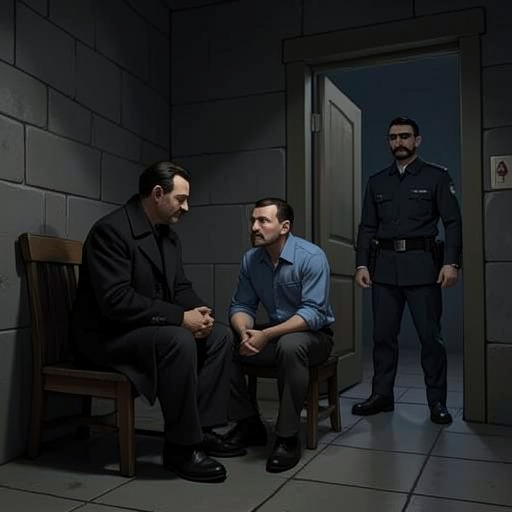
Evan’s Imprisonment in a Tunisian Desert Prison
The Reincarnationist PapersEvan Michaels’s imprisonment in a Tunisian desert prison turns confinement into both the setting for his autobiography and a pressure that reshapes his understanding of himself. Sentenced after refusing to cooperate in the recovery of a painting, he is transported from a city jail to an isolated fortress, housed in cell 145, and left to endure a routine of questioning and enforced solitude. In that narrowing world, he begins to record the story that has brought him there, while his attention grows so acute that the prison itself ceases to be the only thing he must escape.
Sentence and transfer
The imprisonment follows a hurried proceeding in a side room of the Tunis city jail. The meeting lasts fifteen minutes and consists, in Evan’s account, of accusations in Arabic, a comparison of his bruised face with photographs, and a sentence translated into English: twenty-five years without parole. A letter later informs him that he was also sentenced in absentia in Rome on the same day. That second twenty-five-year term is to run consecutively, imposed for his refusal to cooperate in recovering the painting. The combined sentences turn the prospect of release into something more remote than the already severe Tunisian judgment.
The next morning, Evan is taken with five other prisoners in an old bus whose windows are covered with welded steel plates. Armed soldiers accompany them, and the passengers cannot see the route. The bus travels over a rough road for hours, carrying Evan away from the city and toward a place whose location and name remain unspecified in his account. The transfer makes the change in his circumstances concrete: he is no longer awaiting judgment in a jail, but being delivered to a prison built for prolonged separation.
Arrival at the desert prison
Just before sunset, the bus stops at an old brown-brick fortress surrounded by featureless sand. Armed soldiers patrol the walls. Evan is the first prisoner off the bus and sees the prison before the others are led out. A dirt road stretches back toward the world he has left; he recognizes it as the last route by which he might imagine returning. His shoes hang around his neck, and he stands barefoot beside the bus. He considers walking away, but understands that he would not survive the attempt. A guard directs him through the gate with the other prisoners.
At intake, the prisoners pass through a delousing shower of white lime and receive red-and-white-striped prison uniforms. Evan is kept until last, and no shoes or socks are provided. The unequal treatment marks him out from the other men: guards treat them with apathy but address Evan more harshly. The deprivation is plain and practical. He enters the prison without footwear and with no freedom to leave, while the road beyond the gate remains visible as an unreachable alternative.
Cell 145 and Reginald
After being ordered down a dim corridor lined with steel doors, Evan is placed in the final cell, numbered 145. The small grey room has an open ceiling crossed by iron bars, a dust-covered floor, and a crude wooden cot. Reginald, an English-speaking prisoner with a Cockney accent, is already there. His faded prison clothes and worn appearance testify to a longer familiarity with the cell than Evan has acquired. Reginald introduces himself as the other man’s cellmate, establishing the companionship that will shape Evan’s daily experience inside.
Reginald’s presence offers care without changing the conditions of confinement. After Evan is taken for interrogations and returned to the cell, Reginald is awake to help clean him up and reassure him. Evan eventually recognizes that the reassurance is not a literal assessment of his condition so much as a kindness offered in a place where little else is available. Their exchanges also preserve a measure of humor. Reginald jokes about the prospect of Evan singing the American national anthem after he is gone, and Evan laughs with him; the moment briefly interrupts the prison’s routine, but the laughter quickly gives way to Evan’s recognition that he has reached a place shaped by his own choices and desperation.
Attention and the making of a manuscript
As days accumulate, the emptiness of confinement alters Evan’s attention. During the first weeks, he treats his growing powers of observation as a diversion, tracing cracks in the floor and counting his breaths. Over time, this concentration intensifies into a clarity he finds difficult to bear. His account describes the edges of things becoming more sharply defined until he begins to perceive his own limits against the larger world. The change does not remove the prison; instead, it makes mental escape seem increasingly distinct from physical escape.
Evan begins writing from a box beneath Reginald’s bunk, using notebooks and a pen. His setting differs sharply from the one he had imagined while reading autobiographies: he had wondered about the rooms where their authors wrote, the photographs nearby, and the trophies that testified to their achievements. He now records his own life from cell 145 in an unnamed Tunisian desert prison. The contrast gives the manuscript its immediate material frame. Rather than looking back from security or success, he is trying to understand his history while still living through its consequences.
Writing also serves as a way to direct his idle mind away from the sharpening observations that trouble him. It helps him reconstruct how he arrived in prison, yet does not settle the meaning of the account. Evan cannot decide whether these pages form an epilogue to the preceding events or whether imprisonment is the true beginning of the story. The uncertainty leaves the narrative open: his past has led to the cell, but the cell is changing the terms on which he can interpret that past.
Escalation and consequence
The interrogations and beatings become less frequent than they were during the first weeks, but Evan describes the evening removals and overnight sessions as increasingly thorough. He does not cooperate with the questions. Their intended effect, he believes, is failing, even as the pressure changes him in other ways. Reginald waits for his return and continues to care for him. At night, Evan’s own breathing can seem strangely separate from his will to continue, and rereading the opening portions of his manuscript makes him notice how much he has changed since writing them.
By the end of this account, the accumulated assaults on his mental defenses have brought Evan to a decision he understands as an escape from conditions that threaten to dissolve him. The passage presents that decision as a consequence of imprisonment, not as a completed outcome. The fortress has cut him off from the world beyond its gate; the manuscript gives him a means to examine how that separation has altered him, while the distinction between physical confinement and the increasingly perilous inward struggle grows less secure.