Francisco Vázquez de Coronado
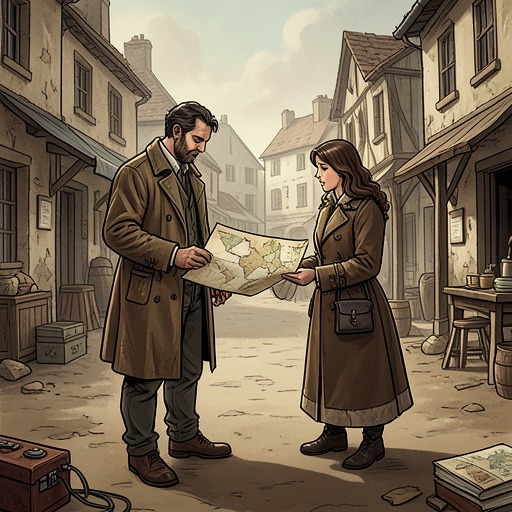
The Reincarnationist PapersFrancisco Vázquez de Coronado is the commander of the expeditionary force that carries Juan de Victoria from New Spain toward Hawikuh. His role is defined by the choices that organize the expedition: he presides over its formal departure, orders an attack on the Zuni city, and then uses the captured settlement as a base for further reconnaissance. The account presents him as a figure of military authority whose progress northward is also the setting for Juan and Bando’s journey toward Latsei.
Appointment and Expedition
A letter dated August 19, 1539, requests Juan’s service at Compostela as a lieutenant under Melchor Diaz, in the expeditionary force of Francisco Vázquez de Coronado. The letter, issued under the authority of Antonio de Mendoza, Viceroy of New Spain, also allows Juan passage aboard one of the King’s ships to Veracruz. Coronado is thus introduced as the commander within whose force Juan’s new commission places him.
Before Mendoza’s arrival at Compostela, the assembled force spends two weeks drilling. Its 250 cavalrymen and foot soldiers practice calisthenics, marksmanship with muskets, marching, horsemanship, and swordplay. The repeated exercises turn a collection of officers, enlisted men, and priests into a force joined, the narration says, by the shared prospect of facing the unknown. Coronado’s command is therefore presented not only through his later orders but also through the organized expedition that gathers around him.
The Departure from Compostela
The send-off begins at sunrise with a mass celebrated by Friar Antonio de Victoria at the eastern edge of town. After the sacrament, Mendoza addresses the assembled men on allegiance to God, the King, and Coronado. From a hastily built viewing stand, the viceroy signals the start of the parade. Coronado is sworn in first; the soldiers then pass an inspector, declare their possessions for the journey, and take an oath to uphold the name of God and King Ferdinand with a hand on a cross. Juan is the fifty-third to swear.
When the oaths are complete, the force forms ranks, unfurls pennons on its lances, and rides away as Mendoza watches. The ceremonial order makes Coronado’s authority public before the expedition enters the country beyond Compostela. In the days that follow, scouts ride ahead of the main body, often with native guides or in pairs. Juan and Bando travel together, extending the expedition’s reach well beyond the marching force.
The Assault on Hawikuh
After weeks of travel through river valleys and mountain passes, Captain Hernando de Alvarado reports finding a settlement described as a city built upon a city. Coronado orders the force to ride against it the next morning. The discovery sets off speculation in the ranks about what the settlement might yield, including talk of gold and jewels. By mid-morning, the expedition has Hawikuh in view: a multistoried city of mud walls and ladders that appears to offer little resistance and little wealth.
Coronado rides to the edge of a circle of ground corn flour laid around the settlement by two defenders. He dismounts with four officers, and, together with the priests, crosses the line to approach the walls. A group of five men meets them partway, and the two parties gesture and shout. Then a defender on the wall throws a stone that strikes Coronado’s white-plumed helmet and knocks him down. His officers drag their dazed commander back across the flour line, after which the Spaniards charge the walls. The defenders shoot arrows at the horses and throw stones at the main force; the Spaniards answer with crossbows and muskets. The fighting ends in less than ten minutes, and the surviving defenders, along with women and children, flee toward the surrounding hills.
Headquarters and Reconnaissance
The victors find little in Hawikuh beyond meager grain stores, two small emeralds, and pieces of garnet and agate. Coronado establishes his headquarters in the vacated city and plans to send reconnaissance parties to learn whether neighboring groups possess anything of value. Two footpaths lead away from Hawikuh, one eastward and one northwestward, toward Bando’s home at Latsei.
Juan and Bando volunteer for the northwestern route. Coronado comes to see them off and orders them to leave four days ahead of Captain Tovar and the main body of the second reconnaissance party. Juan recognizes that, if Bando is right about the route, this may be his last meeting with Coronado. He also understands that any gold he finds would have to be carried south without the main force, either alone or with Bando. The commander’s reconnaissance plan thus becomes a point of departure for a separate course of action: Juan and Bando ride onward ahead of the expedition, while Coronado remains behind at Hawikuh.
Narrative Role
Coronado’s appearances mark successive changes in the expedition’s scale and direction: from a force assembled and sworn at Compostela, to an armed body entering Hawikuh, to a headquarters dispatching scouts into neighboring country. The battle’s sudden reversal—from an approach across the corn-flour boundary to the commander being struck down and his officers charging the walls—gives his authority a physical vulnerability without ending his command. Once Hawikuh is occupied, his decision to establish a base and send out reconnaissance parties supplies the immediate circumstances for Juan and Bando’s journey toward Latsei. An endnote identifies the account of Captain Alvarado finding Hawikuh as historically accurate.