Hawikuh
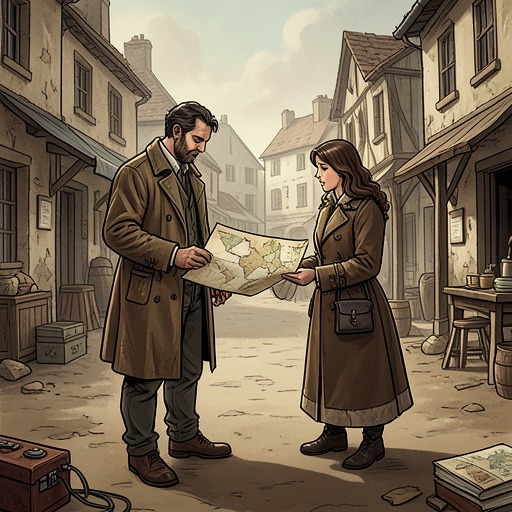
The Reincarnationist PapersHawikuh is a multistoried Zuni city of mud walls and crude ladders that the expedition of Francisco Vázquez de Coronado takes by force. First encountered as a settlement expected to yield wealth, it becomes the expedition’s headquarters and the point from which Bando recognizes a route toward his former home. The contrast between the Spaniards’ search for valuables and the place’s importance to Bando makes Hawikuh both a site of conquest and a threshold into remembered identity.
Setting and Approach
After weeks of travel through river valleys and mountain passes, Hernando de Alvarado reports finding a city beyond the horizon, described as a city built on top of a city. It is the first major settlement the expedition has encountered since Compostela. The report sets off anticipation among the soldiers, whose speculation turns to gold and jewels as they wait for the advance. Hawikuh is thus approached not simply as a place to reach, but as a possible source of riches.
By mid-morning the next day, the expedition is within sight of the city. Its mud walls and crude ladders appear to offer little resistance and little gold. Yet the scene at its perimeter shows that its inhabitants are preparing to defend it: figures hurry through the compound, while two men lay a narrow circle of ground corn flour around it. What looks to the advancing Spaniards like an inadequate fortification marks a boundary the encounter will breach.
The Assault and Occupation
Coronado dismounts at the corn-flour line with four officers and approaches the earthen walls alongside priests. Five men meet the party partway, and the two groups gesture and shout at one another. The exchange ends abruptly when a defender on the wall throws an egg-sized stone. It strikes Coronado’s white-plumed helmet and knocks him down. His officers drag him back across the line; the Spaniards then charge the walls.
The defenders shoot arrows at the horses and rain stones onto the main force. The Spaniards answer with crossbows and muskets, and the fighting is over in less than ten minutes. The surviving defenders, together with the women and children, flee toward the surrounding hills. The city is left to the victors, but the speed of the assault does not make its consequences abstract: flight and occupation are the immediate outcome of the brief battle.
Inside, the expedition finds meager grain stores, two small emeralds, and assorted garnet and agate. The modest haul sharply undercuts the soldiers’ expectations of wealth. Juan sits down with his notebook and sketches the fallen city, recording the place as an object of observation just after its capture. His sketching also places him apart from the frantic search for riches, though the expedition’s next movements will still be shaped by the prospect of finding something valuable.
Headquarters and the Road Beyond
Coronado establishes his headquarters in the vacated city and plans reconnaissance into neighboring territory. Two traveled footpaths lead away from Hawikuh, one east and one northwest. Juan and Bando volunteer for the northwest route, which is also Bando’s way home. They are ordered to depart four days ahead of Captain Tovar and the main body of the second reconnaissance group. When Coronado comes to see them off, Juan understands that, if Bando is right, he may never see the commander again.
The departure makes Hawikuh a temporary center from which the expedition fans outward, but also a point of separation. Juan recognizes that if he finds gold, he will have to return south alone or with Bando rather than with the main force; to keep it all, he would have to return alone. Bando, meanwhile, says long goodbyes to the friends he has made among the ranks. Their plans are made at Hawikuh, where military exploration and private calculation begin to pull the two riders toward different possible returns.
Recognition and Narrative Significance
After the capture, Bando rides around the corn-flour perimeter scanning the horizon. He then recognizes the place and urges Juan to follow him southeast. They gallop down a dusty foot trail to a small lake ringed with white salt, where dark footprints mark the crust along the bank. Bando rides straight to the water’s edge; his horse veers and stops, throwing him into the lake. He emerges laughing and splashing, then points toward the northwestern mountains beyond Hawikuh. The city’s surroundings, rather than its meager stores, have become the key to what he remembers.
Juan understands Bando’s reaction as a moment of vindication: the point at which what others have said is wiped clean and a person remembers who he has been. He counts Bando as the fifteenth person to experience that recognition, after fourteen before him. In this way Hawikuh’s significance changes sharply. The city first registers as a military objective and a disappointing prize; its nearby landmarks then prompt Bando’s recognition of a past life and orient him toward Latsei.
The route remains practical as well as personal. The trail out of Hawikuh is smooth and well worn, and Bando estimates that Latsei lies five days away on foot, or perhaps two by horse. The location therefore connects the expedition’s advance with Bando’s return: from a conquered settlement used as a headquarters, the two riders set out on a path that leads beyond the expedition’s immediate aims and toward the place Bando knows.