Juan loots the dead at Latsei
The Reincarnationist PapersJuan loots the dead at Latsei while Bando is escaping an angry crowd. The episode marks a consequential choice: Juan takes gold and silver from the bodies around him, and Samas later remembers the artifacts as the beginning of the wealth that shaped his later life. His account treats the act not as an isolated theft but as an origin point for a lasting conviction that opportunity must be seized, even when its moral cost is plain.
The opening left by Bando’s escape
As the crowd’s attention shifts toward Juan, Bando crawls away along the outside wall and runs toward the cliffs. Juan reaches Bando’s open doorway and sees the completed pieces gathered on the workbench. Their brilliance and quantity catch his attention; he steps inside to inspect them, then backs out while still watching the pile. His thoughts circle between the gold, the mob, and Bando. The pause matters: Juan has a chance to leave with Bando, but the wealth in the shop holds him there.
Juan calls for Bando to meet him by the horses so they can leave together. When he sees that the crowd has stopped pursuing Bando up the trail, he goes back into the shop. He lays Bando’s finished work on a rug and places the remaining gold jewelry on another, taking care not to damage the pieces. The two bundles turn a workshop’s valuables into portable loads. Juan is preparing to depart, but he has not yet finished collecting what he can carry.
Taking valuables from the dead
Outside, Juan looks for the angry crowd and notices a corpse with a rope at its waist. He removes the rope, then sees a silver bracelet on the dead man’s wrist and examines it. He searches the bodies for another length of rope and uses his sword to make small openings in the corners of the rugs, threading the rope through them to enlarge the makeshift bags. The practical details show the theft taking shape step by step: the rugs hold the workshop pieces, while the scavenged rope makes the bundles more capacious.
Juan then takes ornaments from the dead. He removes the bracelet, watches a necklace on a nearby woman, takes it, and moves on to a gold collar. By the time he hears Teszin cry out, he is partway through searching the bodies. Looking up, he sees Bando standing on the bluff, with Teszin calling to him. Bando does not answer her; he looks directly down at Juan, who still holds a large silver necklace partly draped around an old woman’s neck. Juan returns his gaze and smiles. The scene ends on that look: Bando can see what Juan has chosen to do, and Juan makes no attempt to hide it.
Samas’s later explanation
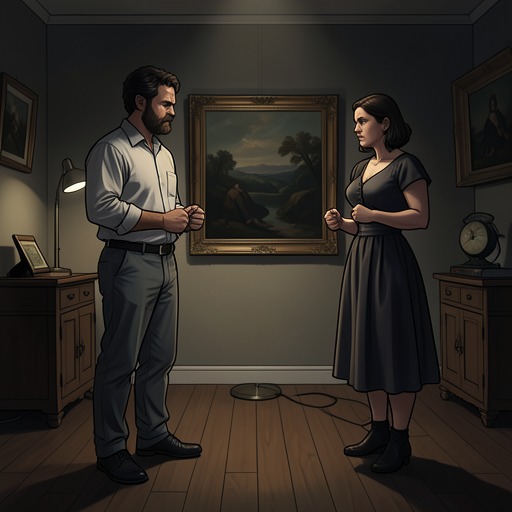
Much later, Samas tells Evan about the episode and is asked why he took the jewelry from the dead. He answers that they were dead and therefore could not be harmed by the theft, adding that they had not known the jewelry’s value. Evan objects that this does not make the act right. Samas does not claim the choice was right; he says that right and wrong are not the issue for him, and that he can live with what he did. His defense is personal and consequential rather than a claim of innocence.
Samas also identifies the artifacts’ proceeds as the beginning of his later wealth. He says that the money from them started everything and helped him become what he is. In his account, the episode becomes the point where a single act of taking valuables opens into a life of accumulated resources. He connects that wealth to the refinements and pleasures he considers important, including his private art collection, which he describes to Evan as his favorite place in the world. He does not establish that the particular pieces taken at Latsei became part of that collection; rather, he presents the proceeds as the means that enabled his later life.
Opportunity, value, and repetition
Samas uses Latsei to explain a broader principle: an opportunity should be seized because its benefits may last several lifetimes. He points to his situation with Bando as an example, and tells Evan that he would make the same decision in comparable circumstances. The event therefore carries two kinds of value in his telling. The jewelry has material worth, but the choice also becomes a precedent through which Samas explains his way of living.
That logic recurs when Samas later offers Evan two million dollars to steal The Rendezvous, a painting bound to Samas’s past identity and personal history. He says that the painting’s return would satisfy him, while acknowledging that someone more qualified would have a better chance of success. When Poppy later threatens the painting with a lighter to press Samas for a larger payment, he authorizes transfers of ten million dollars each to her and Evan. The later transactions are not the same as Juan’s actions at Latsei, but they echo the episode’s entanglement of opportunity, money, and personal value. At Latsei, Juan takes ornaments from the dead; in the later art dealings, Samas’s wealth is measured against the emotional meaning of a painting he has lost.
The episode’s significance rests in that unresolved contrast. Juan’s escape with Bando is shadowed by his decision to enrich himself from the dead, and Samas’s later account neither erases the act nor expresses regret for it. Instead, he makes it the beginning of a fortune and a practical lesson about opportunity. The memory reveals how he understands the distance between moral judgment and personal consequence: Evan can call the act wrong, while Samas insists that he can live with it.