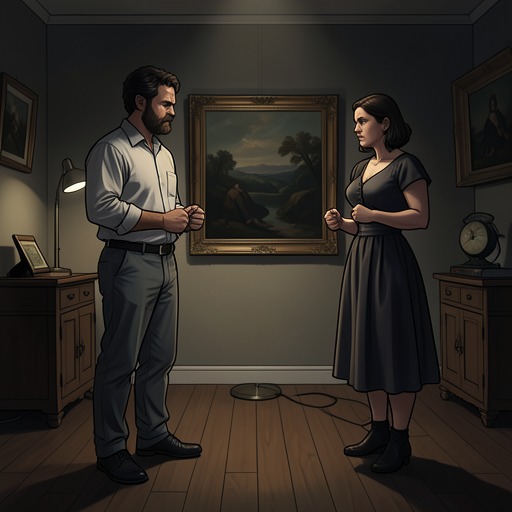
Juan takes Bando as his squire
The Reincarnationist PapersJuan’s rescue of Bando aboard the Maria de la Luz turns a concealed stowaway into his companion and brings their shared condition into focus: both remember lives before the present one. What begins as an encounter in a storm-tossed ship’s hold becomes a choice with immediate stakes, as Juan risks his own position to keep Bando alive and later explains why their memories set them apart.
Voyage and Discovery
The Maria de la Luz was the only ship scheduled to leave Cádiz for New Spain during the coming month. Its cargo included pickles, wine, religious objects, and mail, and its crew numbered twelve. Juan had obtained passage from Captain Miguel de la Garza with the help of a letter, but the voyage was aboard the captain’s vessel and subject to his authority.
On the fourth day at sea, worsening weather drove Juan’s attention to a figure concealed behind a pickle barrel in the hold. The compartment also served as crew quarters; Juan’s bunk stood at its rear, opposite the stairwell from the first mates. As the ship moved through high swells, the single lamp above the central table swung and shifted the light across the crowded space. Juan called out that he could see the hidden person. The figure withdrew farther behind the barrel rather than answer.
Juan approached and found a frightened African boy. He first asked whether the boy was Moorish, using an old form of Arabic, then recognized that he came from south of the desert. Instead of summoning the crew, Juan sat on the floor before him. After a silent examination of one another, Juan gave his name; the boy answered with his own: Bando. Their exchange established contact before they shared a language or an explanation for Bando’s presence.
Over the next two hours, Juan learned that Bando spoke some Portuguese and had survived for three days on pickles. Bando had learned Portuguese from sailors he encountered while traveling to the West African port of Accra and aboard the ship to Cádiz. Juan offered him bread, which Bando ate immediately. At sixteen, Bando had traveled a great distance at considerable risk, but the evidence does not establish his full reason for making the journey. His presence below deck made the danger concrete: he was an unauthorized passenger on a royal ship.
The Threat and Juan’s Intervention
Juan’s conversation with Bando was interrupted by a footstep on the stairway. Recognizing Captain de la Garza’s polished boot, Juan understood that Bando had been discovered. He told Bando to look down and remain silent, then loudly pretended that the boy had disobeyed instructions to stay in Cádiz. The performance was meant to give the captain a reason to see Bando as someone under Juan’s protection rather than as an unknown stowaway.
The captain rejected the concealment and said Bando would be killed. Juan then made a more direct appeal: he described Bando as his squire of three months, claimed to have left him in Cádiz, and said that he was responsible for the boy’s safety because of a family obligation. The account was a protective claim in the immediate confrontation; the scene presents Juan using the status of a squire to shield Bando from punishment. De la Garza accused Juan of failing in that duty and drew his sword.
Juan invoked the travel letter that had secured his passage. The captain countered that harboring a stowaway aboard the King’s ship carried its own punishment. When the captain ordered them both up from the hold, he pointed his sword at Bando’s chest and addressed him in Portuguese. While the captain’s attention was fixed on the boy, Juan quietly untied the larger of his two coin purses and dropped it at the captain’s feet. De la Garza stepped on it and met Juan’s stare. The payment, Juan’s letter, and his insistence that the captain accept his word together show the means by which he tries to turn an imminent threat into a negotiation. The scene establishes Juan’s intervention and the captain’s demand, rather than detailing a formal legal outcome.
Recognition Across Lives
The encounter develops beyond an act of concealment when Juan questions Bando about his memories and death. Bando recalls slipping twice, knowing how high he was, feeling afraid, and sensing a cold wind during a fall. He also remembers that after the fall he forgot his family for many seasons. Juan treats the specificity of the cold wind as the crucial evidence. In his judgment, this detail makes Bando’s account credible and shows that the boy is one of the people who remember former lives.
Juan later asks whether Bando had told anyone else about his first family. Bando says he had spoken to the elders in his village in Africa and to sailors on an earlier ship, as well as to Juan. The responses had been rejection and ridicule: the elders made him leave, and the sailors laughed. Juan had listened instead. That contrast gives the rescue a second dimension. He is not only protecting a stowaway from the captain; he is responding to a memory that others have treated as grounds for exclusion.
Secrecy and the Friendship to Come
At the campfire, Juan explains that people like them remember families from earlier lives, while others remember only the families they have now. Because outsiders do not share that experience, they may disbelieve them or make them leave. Juan warns Bando not to speak about the memories to anyone else, for both their safety and his. The warning turns private recognition into a practical bond: trust between them depends in part on protecting what they know from people who cannot understand it.
Juan also tells Bando that death will bring another birth and that, in a later life, they may meet again in different bodies and remember what they did together. He includes their shared meal of two rabbits as a particular memory that could persist across lives. Bando says that he wants them to be friends repeatedly; Juan assures him that they will, and says they are not alone in remembering. The episode thus joins immediate rescue to a larger promise of continuity. Juan’s actions keep Bando safe in the present, while his explanation offers the boy a place among others who share his memories—and gives their new friendship a possible future beyond either body.