Judith
The Reincarnationist PapersJudith is Bobby Lynn Murray’s mother and the central adult presence in the childhood memory that most powerfully intrudes on Evan Michaels’s present life. In the 1976 bedroom fire in Macon, Georgia, she comes to put Bobby to bed, then rushes to his room when it is burning; her blue-and-white robe catches fire in the doorway. The book later places her opposite Bobby again at a Scrabble board, preserving their bond in a scene whose meaning remains open.
Identity and Background
Judith is identified through Bobby’s memories as his mother. On the evening of the fire, she is young, and Bobby is six. She comes into his small bedroom at eight o’clock to put him to bed, while he protests because he wants to continue building a tower of wooden Tinker Toys. The contrast is immediate: Bobby is absorbed in his project, while Judith is carrying out the ordinary parental task of ending the day.
The evidence also places a new boyfriend, William, in the family’s circumstances: Bobby has seen him use matches as a light while they travel by car to Atlanta. It is William’s example that informs Bobby’s attempt to strike a match in his room. This detail helps establish the chain of events surrounding the fire, though the account does not describe Judith’s relationship with William beyond identifying him as her boyfriend.
The Night of the Fire
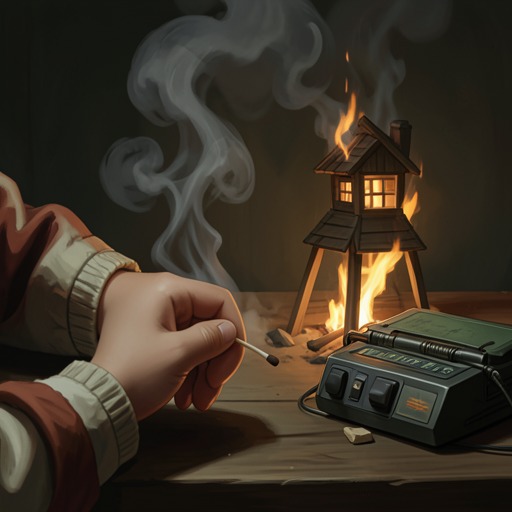
Judith’s first appearance in the remembered sequence is at the threshold of Bobby’s room. The boy has returned to his Tinker Toy tower after supper, and, after being put to bed, gets up to inspect it in the dim light. He uses a match, fascinated by its flame; the account traces the fire as it spreads through the room. By the time Judith calls for him from the hall, the flames have crossed the ceiling and walls, and smoke is making it difficult for Bobby to stay awake.
Judith calls Bobby again as she approaches the closed door. He sees the doorknob turn and the door fly inward against the burning rear wall. She stands in the doorway, framed by orange flames, and looks briefly at her open hand, where the doorknob had been. Then she searches for her son. The fire catches on her threadbare blue-and-white cotton robe as the flames rush toward the fresh air. The sequence gives her no extended speech or explanation: her presence is conveyed through her calls, her sudden arrival, and the danger that meets her at the entrance.
The heat forces Bobby from his seat. He crawls beneath the bed for relief and, after the flash subsides, sees his mother’s body thrashing in the burning doorway. This is the last memory Evan identifies as coming from Bobby. The account does not follow Judith beyond that image, so her fate is not narrated directly in this recalled scene. Its abrupt stopping point makes the doorway, rather than any later explanation, the boundary of Bobby’s remembered experience.
Judith in the White Room
Judith appears again in a very different setting: a vast white space with no discernible walls, illuminated by a glowing ivory light, while water drips faintly in the distance. She and Bobby sit across a kitchen table before a blank Scrabble board. Judith is described as young and as looking the way Bobby remembered her before the fire; her thin blue-and-white cotton robe is gathered tightly at her waist. The familiar garment connects this encounter to the bedroom memory, but the surrounding space is unlike the room where the fire occurred.
Judith eyes the letter tiles in her tray, smiles at Bobby, and says, “I get to go first this time Bobby,” The line makes turn-taking part of their exchange, but the scene does not explain what “this time” refers to. Nor does it identify the white space as a literal place or settle whether the encounter is a dream, a memory, or something else. What it does show is Judith and Bobby together again, facing one another across a game rather than separated by the burning doorway.
Narrative Role and Significance
Judith’s appearances are framed through Bobby’s remembered life and the later scene with him; the evidence offers no separate account of her life outside those moments. In the fire memory, she is first associated with a routine act of care—putting her son to bed—and then with an urgent response to danger. That ordinary beginning sharpens the reversal: the parent who comes to the doorway cannot immediately reach the child, and Bobby’s last memory of her is an image of her engulfed in flame.
For Evan, this is not merely a recollection of another person’s tragedy. The memory is described as stronger than his others, beyond his control, and powerful enough to demand attention in his current life. Judith’s role in it therefore anchors the force of Bobby’s past in a particular relationship and a precise, devastating image. Her later presence across the Scrabble board does not resolve what happened after that final memory; instead, it returns the pair to a quieter encounter, where the robe and the turn-taking line carry the trace of their shared past.