Latsei gold and silver jewelry
The Reincarnationist PapersLatsei gold and silver jewelry is the material link between a village’s catastrophe and Samas’s later wealth. In Latsei, it is at once Bando’s careful craft, the reward Juan believes he needs to escape his long-standing poverty, and a collection of valuables he takes from the dead. Much later, Samas describes money from the artifacts as what started his rise. The jewelry’s significance therefore exceeds its precious metal: it becomes the beginning of a wealth that can be carried across lifetimes through memory and influence, even when the objects themselves cannot be handed down in that way.
Materials and Making
The jewelry appears in two related forms. Bando works gold and silver into finished pieces, and Juan watches for the accumulating result. When asked whether the work is all gold, Bando gives a count of eleven gold and four silver. Juan accepts the amount as sufficient. He later finds the completed pieces gathered on the end of Bando’s workbench, their number and weight greater than he had dared expect. The narrative presents them as the products of Bando’s labor, not merely as a stock of metal: Juan is careful not to damage them as he packs them.
Other pieces are already worn by people in Latsei. Juan notices a bracelet on a body outside Bando’s shop that resembles one he had tried on there. As he searches the dead, he takes a silver bracelet, a necklace, and a gold collar. The crafted jewelry and the ornaments he removes from the dead are distinct parts of the haul, but the same crisis brings them together in his possession. The contrast is central to the object’s history: one part has passed through a maker’s hands, while another is taken from people who can no longer claim it.
The Latsei Acquisition
Smallpox has spread through Latsei, and Juan expects the victims to die quickly. His previous knowledge of an outbreak in Samarkand informs his judgment that few will survive. He considers leaving to avoid infection, but the value of Bando’s pieces makes another day’s stay seem worth the risk. His decision places the jewelry at the center of a contest between self-preservation and the hope of finally gaining wealth.
As the village’s distress grows, Juan imagines that the coming Ascension will let him join the ranks of the wealthy. For two hundred and fifty years, he has tried to match the wisdom, refinement, and culture of the others, while lacking their money. He has delayed Ascensions because he dreads returning without a fortune and facing their unspoken judgment. The jewelry promises to change that position. Its appeal is not abstract: he thinks about the gold and the pride it might bring, and he anticipates no longer feeling ashamed beside his peers.
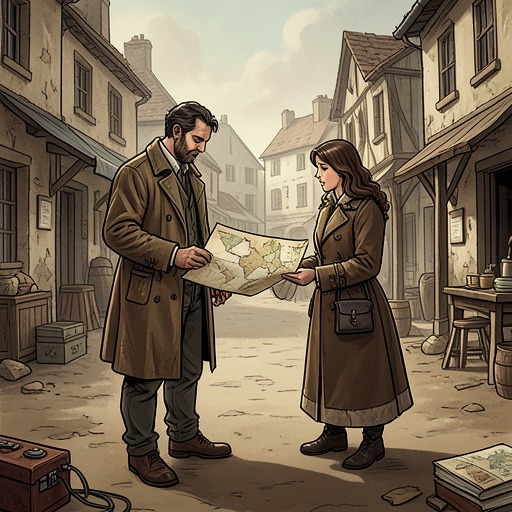
When a crowd drives Bando from his shop, Juan finds the finished pieces unattended. He calls for Bando to meet him by the horses, but does not wait in the shop. Instead, he uses rugs to carry the crafted pieces, taking care as he transfers them. Outside, he turns to the bodies and gathers additional jewelry, adapting the rugs with rope taken from the scene so they can hold more. He is partway through this work when Teszin’s scream draws his attention to Bando, standing on the bluff above the village. Juan looks back at him while still holding a necklace taken from an older woman. The image brings Bando’s labor and Juan’s appropriation into one view: the maker has returned, and Juan is carrying away both his work and the dead villagers’ ornaments.
From Artifacts to Wealth
Samas later connects the artifacts from Latsei to the start of his wealth. He tells Evan that the money from them allowed him to become what he is, and describes accumulated wealth as a source of the refinements that can make life enjoyable for a newcomer. That account gives the jewelry a long consequence beyond the village: its value becomes the material beginning of a life in which Samas can possess and sustain things that reflect his cultivated interests.
The private art collection Samas calls his favorite place in the world makes that transformation visible. It contains works associated with many lives and centuries of culture, with brass plaques identifying titles, artists, and dates. Samas estimates that any one of its pieces might fetch several hundred million pounds at auction, and says that most have been considered lost by art historians. The collection is not itself the Latsei jewelry, and the narrative does not equate their histories; rather, Samas’s account explicitly places money from the artifacts at the beginning of the wealth that enabled his later life and its cultural abundance.
Value Across Lifetimes
The jewelry’s history also illuminates the difference between remembering wealth and transmitting it. Cognomina’s holdings system allows a living designate to keep the assets of members who have died and return them to their new incarnations after their reemergence. Samas explains that this arrangement addresses a recurring problem: reincarnates can bequeath wisdom and experience to themselves, but ordinarily cannot pass acquired wealth directly from one life to the next. The jewelry’s proceeds matter within that wider history because they help establish material resources that can later be held and returned through the group’s system.
The object thus carries several kinds of value that do not resolve into one another. Its gold and silver can be counted; Bando’s workmanship gives the pieces a history of making; Juan sees them as a chance to claim status; and Samas remembers their proceeds as the foundation of a new life. Yet the acquisition also remains bound to the catastrophe in Latsei and to Juan’s choice to take valuables while the village mourns. The jewelry does not erase that beginning. It makes the distance between the desperate pursuit of wealth and the cultivated world built from it part of its enduring significance.