Leopold Diltz
The Reincarnationist PapersLeopold Diltz is the hereditary caretaker of the Cognomina’s Hotel St. Germain in Zurich, a trusted outsider who maintains the household and helps newcomers approach an institution whose tests cannot simply be prepared for. His quiet authority is practical rather than ceremonial: he receives Poppy and Evan Michaels, attends to their accommodation and meals, and answers questions about the organization and its ancient grotto.
Identity and Background
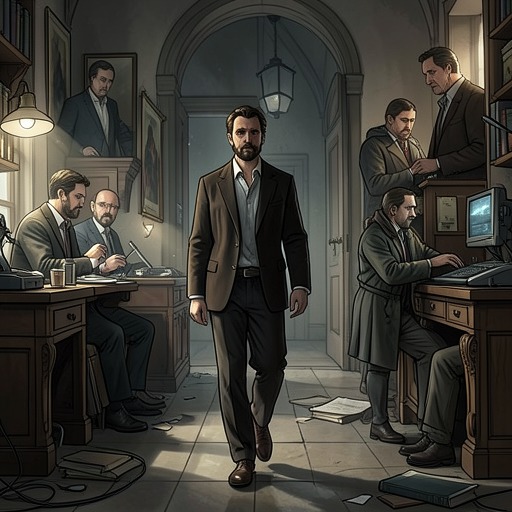
Diltz first appears at the hotel’s entrance, where two deadbolts are drawn back before the door opens. Tall and thin, a little over six feet, he wears a tuxedo jacket that hangs loosely on his frame. Evan observes a narrow, chiseled face that gives little away about his age; grey mixed into black hair and a tired posture suggest a man of about fifty-five. Diltz has no hand tattoo, marking a visible distinction between the caretaker and the Cognomina members he serves. He greets Poppy warmly and addresses Evan in English with a thick German accent.
He identifies himself as the hotel’s caretaker and Evan’s host, and leads the pair into a lobby lit by a large silver-and-crystal chandelier. Oil paintings and sketches hang above red velvet armchairs and couches. The carefully prepared suite and formal welcome establish Diltz as the person who makes the Cognomina’s secluded gathering place function as a place of arrival and residence, not merely as a threshold to its hidden affairs.
A Hereditary Position Outside the Cognomina
When Evan asks whether Diltz is one of the Cognomina, Diltz distinguishes his work from membership: he describes himself as an organizer, something like a secretary. His position, he explains, was inherited. The men in his family have served as caretakers for five generations, and the family has a unique relationship with the organization. Diltz says they are the only people in the world the Cognomina can completely trust. The claim places his authority in a long-standing family arrangement rather than in the members’ shared condition or rites.
Diltz took over the role after his father died in 1974. That detail gives the inherited trust a specific personal chronology: he did not merely arrive as a hotel employee, but succeeded a parent in an office his family had held across generations. The account does not describe the father or the circumstances of his death beyond its connection to the succession.
Host and Guide to Evan
Diltz attends to the small arrangements of Evan’s stay as well as its larger anxieties. At a meal, he invites Evan to join him, asks for rye rolls and seltzer, and shares the table. Later, while they eat dinner, Evan watches Diltz chew as loud voices and the clatter of silverware sound beyond the closed door. Against the noise outside, Diltz speaks calmly about the impending Cognomina assessment: from what he has been told, preparation is impossible, and the candidates he has asked have described the experience in the same way. Evan remains unconvinced and says this offers little comfort; Diltz acknowledges his concern and makes himself available if needed.
That willingness to serve as a point of contact matters because Evan is facing an unfamiliar test and does not trust the reassurance he has received. Diltz cannot promise success or make the process predictable. Instead, he offers the more limited support his position allows: an account of what others have told him and practical availability to the candidate.
When Evan asks what happens to neophytes who fail, Diltz reports that some have failed, but that no failed neophyte has returned remembering the failure. He then rises to answer a gentle knock at the door, ending the exchange with the matter unresolved for Evan. Diltz’s answer is carefully bounded by what has been related to him; it supplies information without claiming certainty about an outcome the candidate cannot readily verify.
The Hotel and the Grotto’s History
Diltz also connects the present hotel to the site’s longer history. Asked about the enormous, old-looking grotto where the Cognomina had gathered, he explains that it was once part of an old church. For hundreds of years, the organization had access to it by paying tribute to the church. After the church was destroyed by fire in 1743, the Cognomina bought the ruin and built the present edifice over its foundation and the grotto.
His explanation makes the hotel more than a convenient residence: it stands above a space whose use predates the building and whose continued access was once negotiated with the church. The sequence Diltz recounts—tribute, fire, purchase, construction—shows the Cognomina’s long connection to the grotto while grounding that hidden history in a specific change of ownership and a dated destruction. As caretaker, he is both host to Evan in the present and a source of knowledge about the place in which the organization has established its home.