Macon, Georgia
The Reincarnationist PapersMacon, Georgia, is the remembered setting of a childhood fire that becomes inseparable from Evan Michaels’s later relationship with fire. In 1976, six-year-old Bobby Lynn Murray tries to examine a carefully color-coded toy tower by matchlight; the flame catches, spreads through his bedroom, and reaches his mother Judith. Evan recalls the episode as Bobby’s most powerful memory, and his own later fire-setting becomes a deliberate return to that scene.
Setting and remembered life
The novel locates this episode in Macon in 1976, identifying the city through Bobby’s childhood rather than through a broad description of its streets or landmarks. The remembered setting contracts around a small bedroom: a window with curtains, a streetlight outside, a bed, a footlocker, and the corner where Bobby has spent the day building. Macon is therefore presented as the place of a particular domestic world, reconstructed through the objects a child notices and the limits of what he can see.
Bobby is six and unusually industrious. He has made a tower from wooden Tinker Toys, thin brightly painted rods joined by drilled wooden wheels. It stands taller than he does, and he has arranged the colors so that the rods on each side match. After supper he returns to reorganize the sticks and consider how to make the tower taller still. When Judith puts him to bed at eight, against his protests, he continues to think about the unfinished building and whether he might have to move it outside to extend it.
The bedroom before the fire
The room’s nighttime light shapes the accident. A streetlight shines through the bedroom window, but it is too dim for Bobby to distinguish the colors of the rods. The curtain cord within reach only draws the curtains tighter. Turning on the room light is not a workable solution: Judith always discovers when he is out of bed. The scene’s danger grows from this ordinary constraint. Bobby wants to continue a task governed by a color pattern, but the available light cannot tell him which piece belongs where.
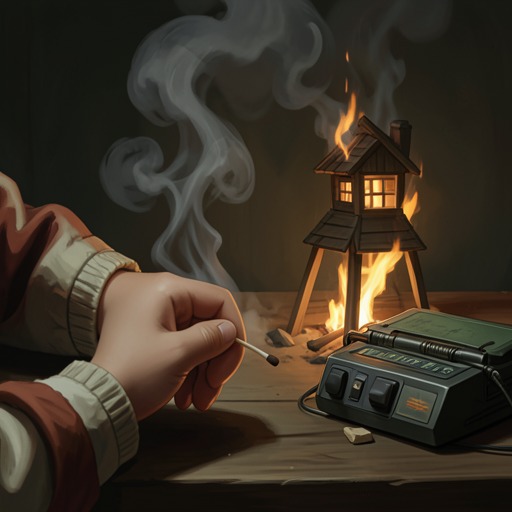
He remembers seeing his mother’s new boyfriend, William, use matches for light during car trips to Atlanta. Bobby has kept a book of matches taken from the dashboard in the footlocker at the end of his bed. He finds it among his toys and tries to imitate what he saw. The first match takes seven attempts to strike. He watches its colored flame and the paper turn black, absorbed by the burning itself rather than using it to illuminate the tower; when the match reaches his fingers, he drops it and puts his scorched fingers in his mouth. The sequence makes the child’s curiosity concrete: the match is at once a borrowed technique, a source of fascination, and a hazard whose consequences he does not yet understand.
The fire and its consequences
With another match, Bobby holds a yellow rod close to the tower to check its place in the color scheme. The flame jumps from the match to the wooden support. It runs up the rod, blisters and blackens the paint, then leaps across a connecting wheel. Bobby watches, puzzled and hypnotized, as the fire transforms the structure he built. Within minutes the tower’s wooden skeleton is burning, along with the edge of the curtains. Burning polyester drips onto the carpet; the fire then reaches the wood paneling around the window and spreads across the walls and ceiling.
Judith calls from beyond the door and comes into the room. Bobby looks up as she opens it, and the flames rush toward the fresh air. They catch on her threadbare blue-and-white cotton robe. The heat knocks Bobby from his seat; he crawls under the bed and looks out after the flash subsides, seeing his mother’s burning figure in the doorway. The remembered account stops there: this is the last memory Evan has from Bobby. Macon’s bedroom is thus fixed in the narrative not by an aftermath or a citywide account, but by the child’s last sight within a rapidly changing room.
Return through Evan’s memory
The Macon episode is not a detached historical vignette. Evan says that, during his last week in Minnesota, a forceful memory from Bobby’s life intrudes without being controllable. It is the strongest of the memories he has received from the three lives he considers worth recounting, and it recurs with enough force to demand an outlet. While setting another fire, Evan recognizes the scene as being for Bobby and understands himself as a ghost within it. His present performance echoes the childhood ignition: he lays a trail of vodka, watches blue flame spread and climb wooden posts, and summons what he calls the monster.
The return links two distinct situations without making them identical. Bobby’s fire begins in a child’s attempt to see and continue his work; Evan’s is deliberate, conducted with accelerants and a planned route through the room. Yet the match’s leap from hand to toy becomes a pattern Evan recognizes in his own fires. Macon consequently functions as the source of a memory that is both intimate and recurring: the bedroom’s color-coded tower, matchbook, and fire remain present in Evan’s later actions, even as he tries to control what Bobby could not.