Minnesota
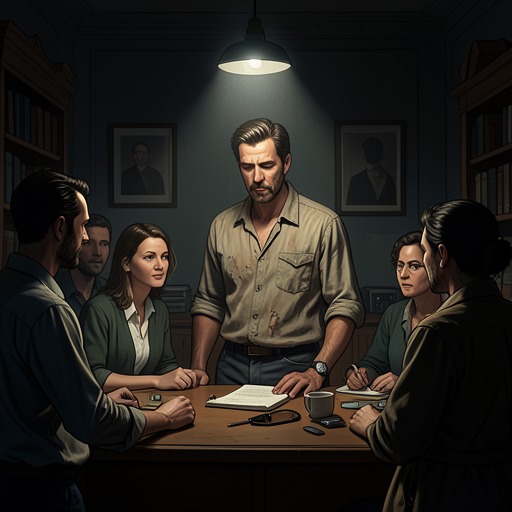
The Reincarnationist PapersMinnesota is the setting for the first sustained emergence of Evan Michaels’s past-life memories and for the rupture between those experiences and the family life he is about to leave. The state is named through the Lutheran church whose organ he learns to play, but its deeper importance lies in the contrast between an ordinary adolescence and a consciousness increasingly occupied by another person’s remembered life. In Minnesota, inherited memory first becomes a skill, then a claim Evan cannot make understood, and finally part of the history he carries away.
Setting and the Awakening
Evan’s memories begin during his junior year of high school as episodes his teachers describe as spells. They arrive without warning or discernible pattern: some last only a second, others several minutes, and at first Evan experiences them as watching a movie rather than remembering anything he has lived. The distinction matters. The scenes seem to belong to someone else, because their events have never happened in Evan’s present life; only gradually does their first-person perspective make them feel like memories.
The episodes grow from short, occasional features into hours-long sequences that crowd his ordinary thoughts. Their early scenes are panoramic and pastoral, sometimes peaceful to the point of boredom. Later, action and recurring figures appear. Evan recognizes that the varied scenes share an unseen central participant: the person behind the viewpoint, whose sensations and experiences are reaching him. The progression from images to emotional response, thought, and identity makes Minnesota the ground on which an inexplicable spectacle becomes personal knowledge.
Skills and Recognition
The memories do not remain confined to Evan’s attention. He begins to reproduce abilities associated with the other life, first at the church organ. Within weeks, his hands move over the keys to play eighteen East European Gothic hymns. The minister regards the ability as a gift, but the songs do not fit the congregation’s Minnesota Lutheran practice, and he eventually ends the sessions. The episode gives Evan a brief, concrete form of recognition: others can hear the music, even if they interpret its source differently from him.
A more difficult test follows when Evan begins to write and understand Bulgarian. Its unfamiliar alphabet includes reversed N’s and R’s, new letters, and familiar letters not used in the same way. He practices for a year before he can read and write functionally without mentally slipping back into the life from which the language comes. He identifies the remembered man as Vasili Blagavich Arda. The contrast between the two skills is telling: organ playing is publicly audible, while language and the memories behind it require Evan to persuade people to accept an explanation they cannot verify for themselves.
Family Conflict and Departure
Evan tries to make that explanation credible at home. He writes pages of Bulgarian and reads aloud from books he has ordered from the University of Minnesota. His parents first treat his claims as idle fantasy; their response hardens as he insists that another Bulgarian would understand his writing and that he has inherited the language and musical ability from another life. What he wants is not simply permission to pursue an unusual interest, but someone willing to believe that the memories are real. Instead, repeated attempts to explain them bring increasing anger, especially from his father, until Evan falls silent. He describes this as the last chance he gives anyone to understand him.
With two months of high school remaining, Evan tells his parents he is leaving and will not return. Their earlier conflicts have made the announcement seem almost unsurprising, though not entirely. His father makes a half-hearted attempt at reconciliation. His mother gives him a worn lighter, apparently recognizing Cyrillic letters on its surface and connecting them with the Bulgarian letters Evan has shown her. She says nothing as she presses it into his hand after supper, but holds and rocks him at the table. Evan packs and cries through the night. The gesture does not settle the dispute about his memories; it gives their separation a moment of tenderness without undoing it.
The Barn and Minnesota’s Significance
The following night, Evan burns the barn with the new lighter. The narrative presents this act after the brief reconciliation, so the ending of his Minnesota childhood is not a clean escape from family conflict. The gift that accompanied his mother’s silent affection becomes the instrument involved in a destructive act, and the memories that drove him into isolation remain with him even as he leaves. The barn’s burning gives departure a material consequence: he does not merely announce a future elsewhere but leaves behind a damaged home.
Minnesota therefore marks both the beginning of Evan’s attempt to live with his memories and the end of his effort to have his parents share his understanding of them. Its church, school, household, and barn form a sequence of ordinary places where the extraordinary becomes observable in fragments: hymns can be played, Bulgarian can be written, but the life that explains them remains beyond his family’s acceptance. The state’s importance is less a detailed geography than a formative setting for this separation between remembered identity and the people who know Evan only in his present life.