New Spain
The Reincarnationist PapersNew Spain is both an administrative destination and a vast, unfamiliar landscape in Juan de Victoria’s expeditionary story: a commission directs him there, Veracruz marks his arrival, and Compostela becomes the staging point from which the force sets out toward the unmapped interior. Its appearance shifts from a vividly green coast to the disciplined routines of a colonial expedition preparing to move beyond the edge of the map.
Arrival at Veracruz
A letter dated 19 August 1539, issued under the authority of Antonio de Mendoza, Viceroy of New Spain, requests Juan’s service at Compostela. It commissions him as a lieutenant under Melchor Díaz in Francisco Vázquez de Coronado’s expeditionary force and provides passage aboard any of the King’s ships to Veracruz. New Spain thus first reaches Juan through a document that turns an invitation into a route, rank, and military obligation.
The ship enters Veracruz’s harbor past a coastline Juan sees as overwhelmingly green: grass, trees, vines, rocks, and water. The port itself appears in stark contrast, with two dozen white buildings set against that vivid landscape; a church bell as large as any in Madrid rings as the ship rounds the point into the harbor. Local people and Spaniards run toward the beach, while small boats come out to meet the larger vessel. The text describes their pilots as tan-skinned, dark-eyed people with straight black hair, and shows Bando trying to speak to them in an unfamiliar tongue.
Once ashore, the crew and other arrivals fall to their hands and knees to kiss the sand, cross themselves, and offer prayers. Juan and Bando do not join them: Bando remains knee-deep in the water, looking out to sea, while Juan gives thanks for the commission that brought him there and wonders whom Bando is thanking. The landing presents New Spain as a threshold approached through different responses—religious ceremony for most of the arrivals, and a quieter, unresolved moment between Juan and Bando.
Compostela as a staging ground
Compostela is described as a small, sleepy town at the very edge of the map, one of the few settlements in the region without an Indian heritage. When Juan and Bando arrive, two hundred and fifty cavalrymen and foot soldiers are already assembled. The expedition’s preparations are not instantaneous: for two weeks, officers, enlisted men, and priests drill in calisthenics, musket marksmanship, marching, horsemanship, and swordplay. Repetition gradually gives the gathering force the cohesion of a body bound together by the prospect of facing the unknown.
Mendoza’s arrival brings the preparations to a formal close. The send-off begins at sunrise with a mass at the eastern edge of town; afterward the viceroy speaks of allegiance to God, the King, and the commander, Don Francisco Vázquez de Coronado. The ceremony makes the expedition’s governing structure visible in a sequence of public acts: Coronado is sworn in, soldiers declare their possessions for inspection and record, and each takes an oath on a cross to uphold God and King Ferdinand. Juan is the fifty-third to swear. When the final officers have taken the oath, the ranks form, pennons unfurl above the lances, and the force rides beyond the map as Mendoza watches.
The road beyond the map
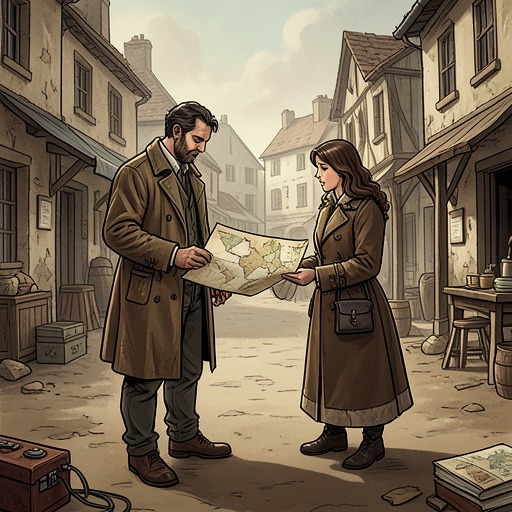
The scouts travel days ahead of the main force, either with native guides or in pairs. Juan and Bando ride together, so the expedition’s advance into New Spain’s interior is also the setting for their developing partnership. On the fourth night out from Compostela, Bando returns from hunting with two rabbits for Juan to cook. The practical detail places the great expedition alongside the repeated necessities of travel: scouting, finding food, and relying on a companion ahead of the main body.
New Spain’s role in these episodes is defined by movement between connected but distinct spaces: the authority that issues a commission, Veracruz as the point of arrival, Compostela as a site of training and oath-taking, and the country beyond it as the scouts’ route. The shore’s unfamiliarity and the repeated reference to the edge of the map give the departure its sense of crossing into the unknown, while the expedition’s paperwork, drills, and ceremonies show how thoroughly that crossing has been organized by colonial authority.