Poppy's Church
The Reincarnationist PapersPoppy's Church is both a former place of worship and the home that becomes Evan's refuge after he is shot while fleeing the scene of an arson. Its Gothic stonework, stained glass, and vaulted nave preserve the building's religious past, but its empty pews and rooms folded into a household mark a quieter transformation. The church shelters Evan when he cannot safely seek medical help, and its architecture makes that refuge feel at once exposed to the city and removed from it.
Setting and Architecture
Evan first encounters the building from its rear stairwell, where he has fallen beneath garbage while trying to evade the police. Fourteen concrete steps lead from the basement to street level; above them, rough-cut limestone rises into the night. At the foot of the steps, he finds a wooden door and tall stained-glass windows glowing faintly green, red, and yellow from inside. The church is not introduced as a destination he has chosen but as the place where his escape leaves him injured, hidden, and temporarily beyond the officers' immediate reach.
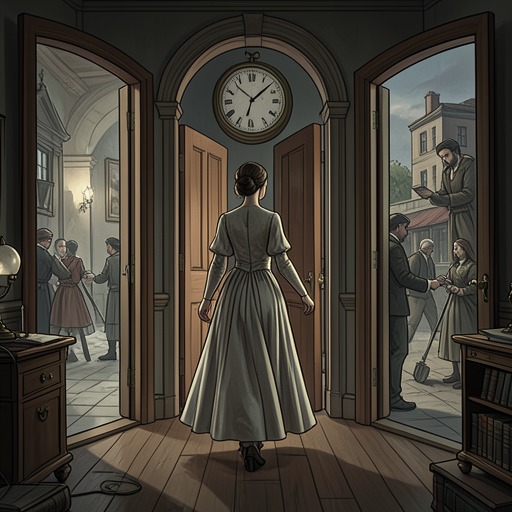
The rear view gives way to a fuller picture when Evan sees the interior in daylight. His room opens directly into the nave, an enormous space lined with rich wooden panels that climb fifteen feet before angling inward toward a high, vaulted ceiling. The hardwood floor has been cleared of nearly all the original pews; two remain in front of a short stage where the pulpit once stood. Three Gothic-arched stained-glass windows punctuate the rough-stone back wall. Even in dim light, the scale and materials retain the character of a church, while the removed furnishings make clear that it no longer operates as one.
The front of the building carries the same mixture of survival and alteration. Its large wooden doors open into a traditional vestibule, where a carved stone baptismal font remains, unused and resembling an empty bird bath. A balcony rests on a round wooden pillar, and stairs lead up to a loft beside the entrance. From the street, the doors sit within a twelve-foot Gothic arch cut from limestone; above them is a circular stained-glass window. A square bell tower rises at one corner, its small open arches screened with wire mesh to keep birds out. These are not merely remnants glimpsed in passing: the old religious structure remains the frame for the ordinary movements of the household.
A Refuge After the Shooting
The church enters Evan's life at a moment when injury and legal danger are bound together. A bullet has torn through the sole of his shoe and into his heel, leaving him bleeding and unable to walk. He fears that seeking treatment at a hospital would expose the arson and lead to arrest. He considers calling Henry for help, but instead reaches the church and is discovered there by Poppy. The building provides a possible place to hide, but the first shelter is not yet assurance: Evan remains suspicious of the charity offered by a stranger and unsure how long he will be allowed to stay.
Poppy initially proposes calling an ambulance. When Evan explains why he fears going to a hospital, she changes course and returns with Antonio, an elderly man with snow-white hair and a soldier-straight bearing. Together, Poppy and Antonio take Evan by the arms and raise him from the floor. That physical act shifts the church from accidental hiding place to human refuge: the help comes through the people who make a home there, not through the building alone. Evan later learns that the church has long since ceased to serve its original purpose and is Poppy's home; she offers to show him around once he is recovered.
Domestic Life in a Former Church
The transformation is visible in the contrast between the sacred fittings and the household routines. The baptismal font is no longer in use, the pulpit has given way to a short stage, and most of the pews are gone. At the same time, the building contains a room for Evan and a kitchen where meals are prepared and shared. Antonio brings him a white terry-cloth robe and tells him breakfast will be ready soon. Later, Evan follows the sound of dishes toward the kitchen, where Antonio sets out water glasses at a table with three places. The old sanctuary is not just a dramatic shell around the action; the building's rooms accommodate care, rest, and the repeated work of daily life.
That combination also shapes how Evan experiences the place. His first view is a dark stairwell, a wound, blood, and a faint colored glow from the windows. After an unexplained period of lost time, he wakes to a room opening onto a vast nave, and daylight reveals details that the darkness concealed. The shift is from concealment to orientation: the same building that first holds him out of sight gradually becomes legible as a household. Its scale remains strange to him, but its domestic rhythms begin to give the injured fugitive a temporary place within them.
Narrative Significance
Poppy's Church joins two kinds of threshold. Architecturally, it stands between public street and private home, with imposing doors and a high stone facade enclosing rooms used for domestic life. In Evan's immediate circumstances, it lies between pursuit and rescue: he arrives unable to walk and afraid that any official treatment will expose him, then accepts help from Poppy and Antonio inside a place whose former religious identity has been recast as a home. The preserved windows, font, nave, and tower keep the past visible even as the building serves a new purpose.
The church's significance therefore rests in the tension between what remains and what has changed. It is recognizably a church, but Poppy describes it as her home; its sanctuary is empty of almost all its pews, yet the rooms support an active household. For Evan, that conversion has practical consequences before it has any larger meaning: the former church gives him somewhere to recover when the street, the hospital, and the police all seem dangerous. Its architecture makes the refuge memorable, while its inhabitants make it usable.