Samas
The Reincarnationist PapersSamas is a member of the Cognomina whose identity spans remembered lives as Juan de Victoria and Emil Restoud. In the present, he becomes a welcoming guide and advocate for Evan Michaels, offering both personal reassurance and practical help. His stories also make memory tangible: it preserves a childhood friendship across lifetimes, a marriage built through years of letters, and a portrait whose loss feels like the loss of part of himself.
Identity and the Cognomina
At a toast with Evan, Samas introduces himself by the name he uses within the Cognomina and makes clear that it is not a temporary alias to be discarded after Ascension. For him, the society’s name is his real name there. That distinction reflects the group’s unusual continuity: its members remember prior lives and must establish their identity anew before rejoining the society in another body.
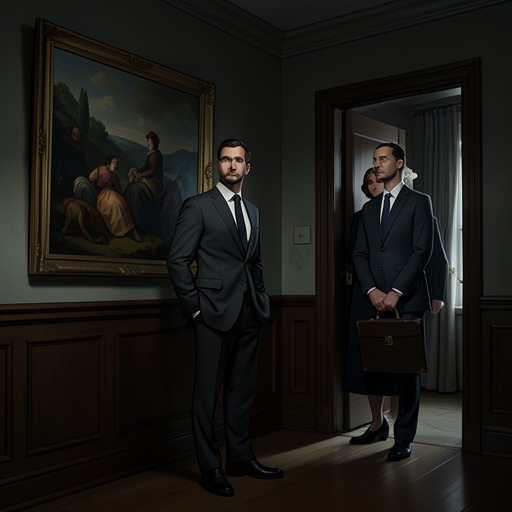
Samas has no official role in Evan’s Ascension hearing. He explains that he came as a spectator because he wanted to meet Evan, and that the confirmation of a newly found member feels like the arrival of another relative. Unlike Poppy, who advocates for Evan, or Ramsay, who serves on the panel and is restricted from contact during the proceedings, Samas is free to speak with him. He offers himself as a kindred spirit and an available source of answers, making the society less remote to a candidate who otherwise feels shut out of its process.
When the panel accepts Evan by a four-to-one vote, Samas embraces him. The official decision is followed by relief, cheers, groans from those whose wagers have failed, and a noisy welcome. Samas’s response embodies the familial meaning he has already attached to Ascension: Evan’s proof is not merely a successful examination but a new member’s return to a community.
Juan de Victoria and Bando
Samas recounts an earlier life as Juan de Victoria, a conquistador. In that remembered life, Juan recognizes that others do not share his memory of previous families. When he speaks about it, elders send him away and sailors laugh at him; Bando, by contrast, listens. Juan warns Bando not to tell others, both for Bando’s safety and his own, and explains that death will lead to a new family while the present life remains part of memory.
Juan imagines their friendship continuing after death: they could meet again in different bodies, remember what they had done, and share even the small details of their life together. Bando answers that he wants them to be friends over and over again, and Juan promises they will meet again, adding that other people like them exist. The scene gives Samas’s belief in reincarnation an intimate measure. His account is not only about the survival of identity but about a friendship that ordinary families and witnesses cannot recognize.
Love, art, and remembered lives
Samas also relates a life in which he was the art dealer Emil Restoud. While living in Rome, he attended a concert where the woman who would become his wife was playing in the string section of the London Philharmonic. He had brought Japanese clients in hopes of closing a six-piece deal, but his attention shifted to the musician. She was initially cool toward him, particularly when she realized he knew nothing about music; he persuaded her to tour some of the city’s galleries with him the following day.
Her knowledge of contemporary art matched his own, and Samas recalls that he was already in love by the end of that day. He followed the orchestra’s schedule, attending performances in Florence, then continuing to see her in Trieste, Belgrade, and Athens. After meeting her backstage in Cairo, they spoke for about an hour and began corresponding. Five years, two dozen meetings, and 101 letters later, she became his wife. He arranged for their wedding at the Grand Mosque of Cordova, spending a fortune and using about a dozen political favors to make it happen.
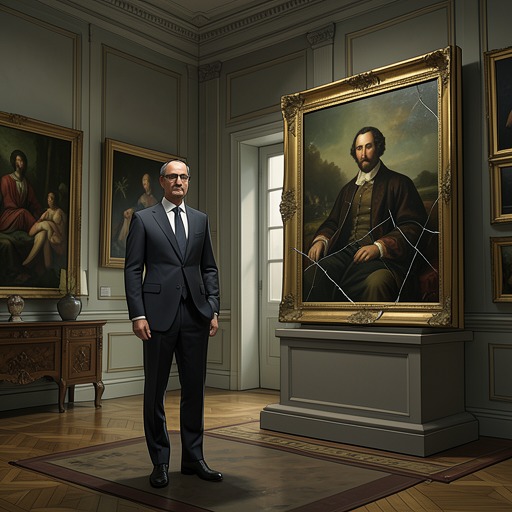
Another of Samas’s remembered relationships is tied to The Rendezvous, the only portrait he says he possesses of himself as Emil Restoud. Jan Vermeer painted him over a week of long sittings. At first the stillness exhausted Emil, who secretly shifted position; Vermeer would set down his brush, come over, and gently put him back in place. Emil began moving deliberately to invite that touch, and by the fourth day the two had become lovers. In the fall of 1674, Emil bought three more works from Vermeer for five hundred silver francs apiece; Vermeer died the following year.
Samas says he kept the portrait in his Amsterdam home for more than 250 years, in the same room where Vermeer had painted it. Although every work in his collection carries a history and value for him, this one is bound to both the painter and his former self. When it was taken from his wall, he describes the loss as the loss of part of himself. The painting’s importance thus rests not simply on its artistic or monetary value, but on its connection to a remembered love and a particular life.
Advocate, mentor, and host
During Evan’s Ascension, Samas recognizes the frustration of being unable to ask questions freely. Evan has limited access to people involved in the process and is dissatisfied with how Poppy has handled his advocacy. Samas listens without claiming authority over the hearing and offers to answer what he can. His help is personal rather than procedural: he cannot decide the outcome, but he can make sure Evan is not left entirely alone with his uncertainty.
After Evan is accepted, Samas remains present at the celebration. At one point he is so absorbed in the banquet that he asks a passing hostess for dessert and a large bottle of brandy while others watch him. The comic moment gives his welcome a sociable, bodily quality: the new member is entering a gathering of people who eat, drink, joke, and make room for one another, not merely an institution with rules.
Samas later takes a more practical role in Evan’s affairs. He sends instructions to Tunis, directing Evan to study the painting and the layout of the Tunisian National Gallery, learn the route from the gallery to the dock, and find the boat The Panta Mine at slip 15. Its captain, Flynn Coogan, is waiting with most of the needed supplies; anything else can be found in the open-air bazaar near the gallery. The letter leaves the rest to Evan, combining precise logistical preparation with a direct transfer of responsibility.
The painting and the limits of partnership
When Poppy arrives at Samas’s home with Evan, Samas is on the balcony and has just been told by the hotel that Evan left with someone. Seeing Poppy, he reacts with anger and suspicion. The meeting turns toward the painting and the terms on which it will be returned. Poppy hands the canvas to him and insists that he contact Mr. Diltz to confirm that the arrangement is complete. Samas accepts, tucks the painting under his arm, and makes the call, his earlier bravado giving way to resignation.
The encounter complicates his role as Evan’s mentor. Samas can welcome a newcomer as kin and entrust him with a difficult assignment, yet his attachment to the painting also makes the transaction charged and contested. Poppy does not simply deliver the canvas; she presses Samas to honor the deal and verify it. The recovered portrait returns to its owner, but its passage exposes the bargaining and personal grievances that lie beneath the language of family.
Narrative significance
Across his remembered lives, Samas is presented through stories that preserve different kinds of attachment: Juan’s promise to Bando, Emil’s devotion to Vermeer and his musician wife, and the present-day welcome he extends to Evan. The names and circumstances change, but memory carries relationships forward and gives objects and rituals a history that outsiders cannot see. His account of Ascension makes that continuity the basis of Cognomina membership; his conduct toward Evan shows it becoming a practice of hospitality and guidance.
Samas therefore connects the society’s abstract claim—that a person can return and remember—to concrete bonds and obligations. He tells Evan that the community is a family, offers himself as a confidant, and helps him enter its life. At the same time, his stories reveal that remembrance is not a clean escape from loss: it preserves the people who are gone, but also the painful absence of what has been taken from one life into the next.