Samas and Zohra’s house
The Reincarnationist PapersSamas and Zohra’s house is a two-story coastal home where domestic life, a museum-like display of history, and the protection of Samas’s art collection share the same space. Set beside a small beach on the Atlantic, it is built to admit the ocean’s sound while guarding its paintings from the corrosive sea air; later, its coastline and nearby harbor also figure in Samas’s plan for an escape from the Tunisian National Gallery.
Setting and construction
The house stands at the end of a gravel road winding off a narrow highway that follows a craggy coast. From the road, its white stucco catches the bright sun; the property sits down by a small sandy beach. Two Great Danes, one black and one black-and-white, run up to meet the arriving visitors. The approach makes the house feel secluded without separating it from the working coast around it: the Atlantic is close enough to be heard from the rooms and to shape how the home is used.
Samas says he had the house built thirteen years earlier, around the time he married Zohra. He first came to the area to close a deal with a client seeking a mint-condition Egyptian sarcophagus from the thirteenth dynasty. After the client died, Samas bought the property, demolished the standing house, and built the present one. Its origin is therefore linked to the same trade in antiquities that informs its interior, but the new building is also tailored to the couple’s life there.
A home arranged as a museum
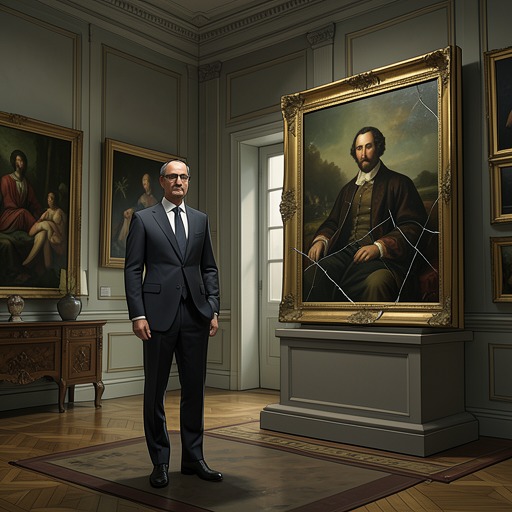
Inside, the house is crowded with objects from the past. Greek, Roman, Egyptian, and Chinese artifacts stand beneath square protective glass covers on white pedestals, while framed charcoal sketches fill the walls. Against this profusion, traditional furnishings are sparse, almost Spartan. The contrast directs attention away from ordinary domestic ornament and toward the displayed collection; the narrator even considers whether that effect was deliberate.
The house’s rooms thus present Samas not only as a host but as a collector whose surroundings are organized around art and history. The objects are not confined to a public gallery: they are woven into the couple’s private home. That arrangement gives the residence a double character. It is lived in, yet its displays and protective measures make parts of it resemble an institution devoted to preserving and viewing valuable works.
The bedroom and the sound of the sea
The upstairs bedroom opens toward the Atlantic through sliding glass doors that cover its entire east wall. When Samas slides them back, the room opens onto the ocean; a breeze stirs the mosquito-net canopy above the bed, and the sea’s sound gradually fills the space. The view is striking, but sound is the more consequential feature of the setting.
Samas explains that he has experienced a sleeping disorder in his last three lives. A point of land jutting into the sea about a quarter mile up the coast and a group of rocks farther down form what he describes as an acoustic chamber, amplifying the ocean’s constant noise. That sound helps him sleep, and he keeps a recording of it in Zurich. The coast is therefore not merely scenery around the house: its particular shape and acoustics answer a recurring condition that has followed Samas across lives. The home’s openness to the sea is at once architectural and practical, connecting a specific landscape to an enduring personal need.
The protected collection and its operational role
A separate, secured room gives the house’s collecting purpose a more controlled form. Samas enters a code at an electronic keypad beside a thick white door, taking care that Evan cannot see the combination. The door opens with a brief rush of air. Inside, multicolored canvases cover all four walls, their frames of differing sizes interlocking like a huge, dissonant jigsaw. Diffused light comes from the sterile white ceiling and floor; two wooden chairs and a small white table sit at the center. The room’s laboratory-like atmosphere sharply contrasts with the open bedroom and the artifacts displayed through the rest of the house.
Samas says the sea air is corrosive and can dull paintings’ colors over decades. The canvases carry small brass plates giving each work’s title, artist, and date, while their restricted room and keypad mark the collection as something to be carefully protected. After dinner, Samas leads Evan there and shares wine as they look at the works. The scene joins hospitality to guarded access: the house welcomes a guest, but the collection remains behind a code-controlled door.
The residence also serves as a base for planning. Samas says he knows the security system at the Tunisian National Gallery because he bought a master schematic and floor plan from an inside source. In discussing the planned exit, he identifies the Gallery’s alley door and says a boat and crew will be ready at the harbor to take Evan to the beach visible from the living-room window. The house is not itself the site of the theft, but its view of the shore gives the proposed escape route a concrete destination. Across its different rooms, the same property holds a private collection, domestic welcome, a landscape attuned to Samas’s needs, and the practical outline of an operation.