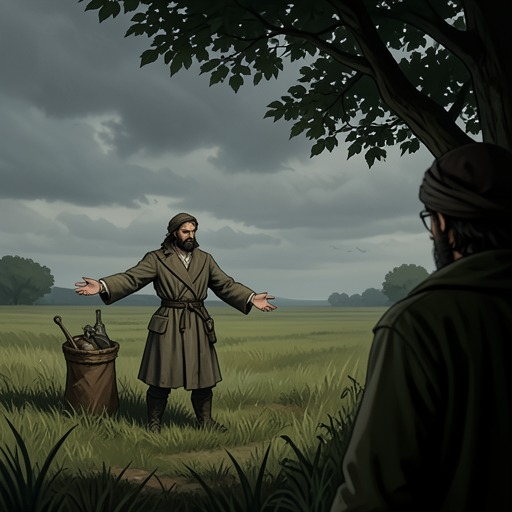
Samas and Zohra’s marriage across religious differences
The Reincarnationist PapersSamas and Zohra’s marriage is presented as a durable intimacy across religious difference: Samas remembers continuing as an individual through death, while Zohra places her faith in a religious afterlife. Their bond does not depend on settling that disagreement. Instead, Samas describes loving and accepting her, and the visit Evan Michaels makes to their home shows that shared life in hospitality, food, and conversation.
Marriage and Disclosure
Samas tells Evan that he has been married to Zohra for thirteen years. The revelation surprises Evan, who had assumed that someone as unlike ordinary people as himself would not enter into the familiar institution of marriage. Samas’s answer unsettles that assumption: his repeated lives have not kept him outside everyday attachment. When Evan asks whether he has married in other lives, Samas confirms that he has, though he offers no further account of those marriages. The detail places his present marriage within a recurring history without suggesting that each union was the same or that Zohra shared those earlier lives.
Samas describes telling Zohra about his condition after they were already married. He jokes that this left her options somewhat limited, but adds that she had worked out most of it by then. His humor does not erase the asymmetry in the timing: she learned the full account after the commitment, rather than before it. Yet he presents the disclosure as part of their closeness, insisting that love and intimacy cannot remain wholly separate from knowledge of the person loved. He says that Zohra knows, and that she loves and accepts him. In his telling, acceptance is not a claim that she shares his explanation of existence; it is a quality of their relationship that can hold difference without making it a barrier to love.
A Reunion in Morocco
When Evan accompanies Samas to Morocco, the marriage appears not as an abstract claim but as a familiar domestic bond. As they leave the airport, Zohra runs toward Samas. He gathers her into his arms and lifts her effortlessly; she nestles her head against his neck. Their greeting is physical, affectionate, and unreserved. Samas then introduces her to Evan, and Zohra greets the guest by name, saying that Samas had told her about him on the phone. Her firm handshake and steady eye contact make the welcome direct rather than ceremonial.
The scene also gives the couple’s home a place in the relationship’s public life. Samas had invited Evan to stay as his guest and praised his wife’s cooking, especially her native cuisine. Zohra’s welcome fulfils that invitation: she receives the person Samas has chosen to bring into their household. Later, she serves a meal of roasted rabbit and guinea fowl with couscous, followed by rice, unleavened bread, yogurt, and mint tea. Samas eats enthusiastically and identifies the main dish as a favorite. These details make the marriage legible through shared routines and hospitality, not only through Samas’s explanation of what love means.
Faith and Difference
At the meal, Evan asks about religion in the region and then asks Zohra about her own beliefs. She identifies herself as a Sunni Muslim, answering with evident pride. Samas’s account of their marriage makes clear that this faith is not a secret from him: when Evan asks whether she knows about his condition, Samas says that he told her after they married. The scene places her religious identity beside his account of survival beyond death without depicting either as a passing curiosity or a reason the household cannot function.
The contrast becomes explicit when Samas describes his view of existence. He argues that the present life—its meals, conversations, friends, lovers, and cherished ideas—is all people can know as their world, and that people should use their time to enrich it. He distinguishes those who return with continuing consciousness from people who do not, or do not know that they do. When Evan asks whether Zohra accepts this account, she answers that she has faith rather than needing to buy into Samas’s argument. Samas laughs at her concise reply, but the laughter reads as affection in the exchange: he does not answer by dismissing her belief.
Acceptance as a Shared Practice
Samas explains that Zohra believes living according to the code of the Koran will allow her to ascend to heaven after death. He says that if this belief makes her happy, it makes him happy too; he also leaves open the possibility that she may be right. His position is not that her faith and his experience are identical. Rather, he refuses to claim certainty about what he cannot know on her behalf. He suggests that her hope may even help explain why she will not return, but presents that possibility as speculation, not established fact.
That restraint connects their marriage to Samas’s broader emphasis on living in the here and now. He urges Evan to enjoy the meal, bringing a philosophical disagreement back to the table where Zohra’s cooking and their company are already present. Evan observes Samas’s evident contentment and the brightness with which he speaks about returning. The relationship therefore offers a grounded counterpoint to Evan’s sense that people like him cannot participate in ordinary life: Samas’s recurring existence does not prevent marriage, domestic pleasure, or regard for a partner whose faith differs from his own. Their closeness rests not on a shared answer about the afterlife, but on a practiced willingness to let each other live by what gives life meaning.