Samas’s private art collection
The Reincarnationist PapersSamas’s private art collection is a trove of paintings gathered across centuries, but it is also a self-portrait in a broader sense: Samas says he commissioned every work in the room and modeled for several of them. Kept behind a secured door in his coastal home, the collection turns private wealth into a personal archive. Its blankest space—a place reserved for a portrait by Jan Vermeer that Samas says he cannot have—makes absence part of the collection’s meaning.
Setting and Display
The collection belongs to a house that already resembles a museum. In its other rooms, artifacts from Greek, Roman, Egyptian, and Chinese cultures sit beneath protective glass on white pedestals, while charcoal sketches fill the walls. Traditional furnishings are sparse. Evan’s attention is drawn instead to the objects and images, so that the house’s arrangement seems to make its past the primary feature of domestic life. Samas says he had the home built thirteen years earlier, around the time he married Zohra.
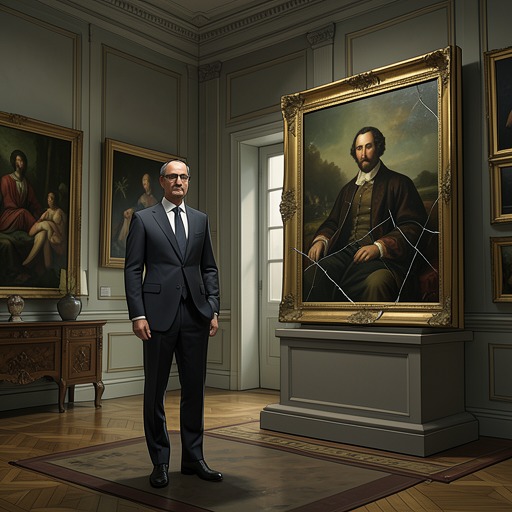
The paintings occupy a more restricted space. Before opening its thick white door, Samas enters a code into an electronic security keypad, taking care that Evan cannot see it. The door opens with a whoosh, and the room beyond is closed off from the sea air, which Samas says can corrode paintings and dull their colors over decades. Its atmosphere is controlled enough to suggest a laboratory: diffused light seems to come from the sterile white ceiling and floor, and two wooden chairs and a small white table stand at the center. The paintings, rather than the furniture, command the room.
They cover all four walls, frame to frame. Differently sized frames interlock into a vast, dissonant jigsaw, turning the room into a continuous surface of pictures. Each work has a small brass plate set into the bottom of its frame, identifying its title, artist, and date. The room is therefore both a display and an ordered record, even as the packed arrangement resists the calm spacing of a conventional gallery.
Scale, Value, and Historical Absence
Samas calls the collection the best of the best and describes it as centuries of culture and art gathered in one room. As Evan moves among the canvases, he recognizes names including Cezanne, Bassano, Gaugin, Caravaggio, David, Van Dyck, and Manet. The range of artists makes the room feel less like a collection organized around a single period than an accumulation across different artistic histories.
Asked to estimate its worth, Samas refuses precision: without putting the works up for sale, he says, there is no way to know. He nevertheless estimates that any one of them might sell at auction for several hundred million pounds. He adds that he has held most of the paintings so long that art historians consider them lost. Their absence from public knowledge, in his account, would increase their value further. Samas claims that his is the only privately owned collection of its kind in the world; the claim is his, and the paintings’ reported obscurity is central to how he explains their exceptional worth.
The collection’s value thus rests on more than the works’ names or estimated auction prices. It depends also on their long removal from view. The same history that makes them intimate possessions makes them, in Samas’s telling, almost unavailable to art history. The secure room protects the paintings from the corrosive coastal air, while its locked entrance also marks the boundary between Samas’s private possession and the outside world.
Samas as Patron and Subject
Samas connects the collection to the wealth that enabled his life. He says money from artifacts started all of this and helped him become what he is now. He also tells Evan that amassed wealth matters to newcomers because of the difference it can make in a life, bringing refinements into focus. The art is not merely evidence of wealth: Samas presents it as one of the things that gives that wealth pleasure and purpose.
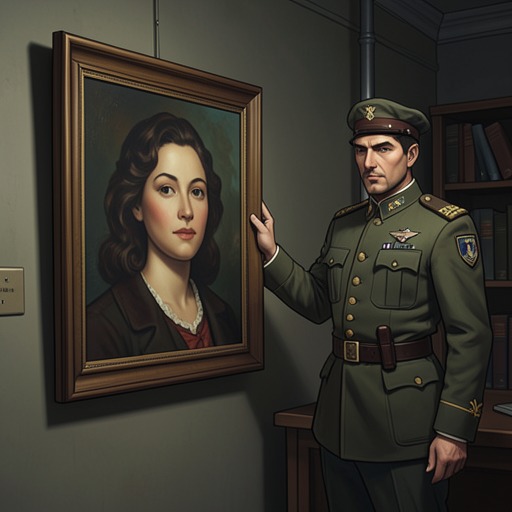
He then explains that the collection is his passion, but that its deeper attraction lies in its connection to him. All the works, he says, have one thing in common: himself. He commissioned them and modeled in several. On each of his last six trips, he had at least one portrait made. His delight in these commissions comes across as an enduring appetite rather than a casual interest; portraiture repeatedly makes him both the collector who arranges the art and the person represented within it.
That pattern gives the room a distinctly personal chronology. Its brass labels preserve the identifying particulars of each work, while Samas’s account supplies another thread running through the collection: his own presence, renewed in portraits across successive trips. The paintings gather many artists and centuries, but the patron insists on a common center. The collection’s breadth and its self-referential character are not opposites; together, they define what the room means to him.
The Missing Portrait
When Evan asks which painting is Samas’s favorite, Samas points not to a canvas but to a bare rectangle measuring two by three feet. He identifies the absent work as a portrait of himself, painted by Jan Vermeer in 1670, and calls it the one he cannot have. The blank space is therefore not an empty wall awaiting decoration. It records a particular work and a limit within a collection otherwise described as exceptionally complete and valuable.
The missing Vermeer sharpens the tension between possession and absence that runs through Samas’s account. Most of the collection, he says, has been out of art historians’ sight for so long that they regard it as lost; here, a work is absent even from his own room. He can describe the portrait and point to the place it occupied, but cannot claim it among the paintings surrounding him. The collection’s most personal image is consequently present as a vacancy, making the room’s abundance answer to one conspicuous lack.