Summer solstice
The Reincarnationist PapersThe Summer solstice is the recurring meeting time at Giza through which the first reincarnated companions maintained their bond across successive lives. Beginning in the fourth century, the annual reunion turns a fixed day and place into a means of recognition: when one companion dies, the other can wait for that person to return in a new body. The custom predates the Cognomina, but its logic of return and identification becomes part of the society’s history and ritual life.
Origins at Giza
The tradition began with two people who found one another and agreed to meet each year at the pyramids of Giza on the Summer solstice. The longest day of the year offered a dependable point of reunion: if one died, the other could return to the same spot and look for the friend in a new incarnation. What might otherwise have been an untraceable separation was given a place and a date to which both could return. After a few lives, the companions began marking themselves with the symbol of their assigned meeting place. The mark’s three peaks represented the pyramids, making the landscape itself a sign that could travel with them into fresh incarnations. The Summer solstice thus provided more than a calendar date; it joined a recurring encounter to a recognizable emblem.
From a Pair to a Society
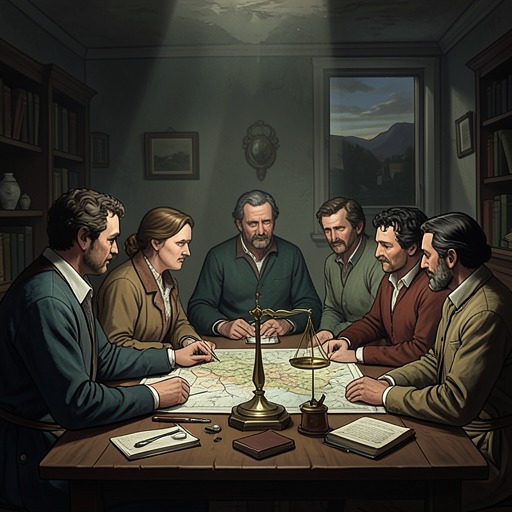
The account of the tradition’s growth centers on a reunion at Giza. After an absence of eighteen years, one of the original companions returned as a young man and found not only his old friend but two other people bearing the same Embe symbol. One had discovered a new reincarnated person who already knew another. In this telling, the meeting’s intimate purpose—to find one returning friend—also opens into the recognition of a wider community. The Cognomina was formally established later, in 839, by its first six members in Zurich. Its institutional foundation therefore followed the older practice of returning and meeting one another, rather than beginning it. Poppy said she entered the society in 1649 and that the earliest members were still alive; she described return as a continuing pattern shared by all of them.
Recognition Across Lives
The society’s later identity practices preserve the same problem the Giza meetings addressed: how to establish that a person in a new body is someone known before. Members wear the Embe tattoo in successive lives after passing the Ascension. In the contemporary procedure described to Evan Michaels, a candidate must persuade judges with verifiable names, dates, places, and other details; an older custom had tested recognition by requiring a candidate to identify the person who had killed him in a previous life. Evan’s acceptance shows the personal consequence of that system. After a four-to-one vote found that he was who he claimed to be, he was welcomed as a brother. Poppy then presented the fingerless leather gauntlet used to apply the Embe-shaped tattoo, marking his entry into the community. The ceremony is not identified as taking place on the Summer solstice, but its proof of identity and bodily emblem echo the older reunion practice: return alone is not enough; the returned person must be recognized.
Narrative Significance
The Summer solstice gives the novel’s recurring lives a point of continuity without making recurrence effortless. Friends can be separated by death and by years of absence, yet the fixed annual meeting makes recognition imaginable and gives waiting a shared form. The expansion from two companions to four at Giza also anticipates the Cognomina’s development from private reunion into an organized community. The pyramids’ three peaks persist as a portable sign of that history. Across the account, the day, place, and mark work together: the solstice sets the time, Giza anchors the meeting, and the Embe symbol helps identify those who return. The tradition therefore links cyclical time to the society’s lasting practices of memory and membership.