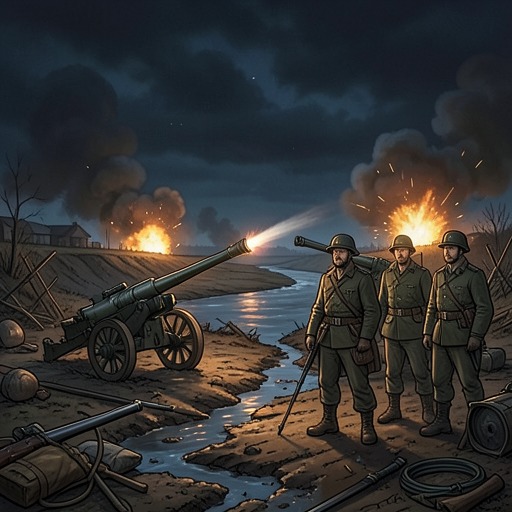
The Battle of the Cherna River
The Reincarnationist PapersThe Battle of the Cherna River is a September 1918 artillery engagement in which Captain Hoxa’s Bulgarian crews turn an exposed position into a night attack, only to face an approaching French infantry assault and a river that cuts off retreat. Through Vasili Arda’s place among the gun handlers, the battle’s carefully controlled artillery rhythm is set against weather and terrain that steadily overwhelm the plan.
Background and Position
The action takes place on September 18 and 19, 1918, after the Bulgarian front has been retreating for three weeks. The ground where the Cherna River flows into the Vardar forms a small triangle, which Vasili recognizes as a poor place to make a stand even for a single night. He is not a military strategist, but the exposed geography makes the danger plain: the position offers little assurance of safety, while the river is already a defining boundary of the encampment.
Vasili spends the autumn day stacking seventy-five-pound, two-foot artillery shells in rows three deep beside the emplacement. Five Krupp 77 mm howitzers face south toward Greece and two French divisions somewhere beyond the horizon. As evening approaches, Captain Hoxa warns the crews that they may have their chance to fire. He orders camps and gun positions prepared within an hour, has the horses tied beside the river, and restricts the encampment to a single cooking fire, to be extinguished before dark. His warning that two full-strength French divisions are in the valley makes the quiet preparation feel less like routine than a pause before contact.
The Ambush and First Salvos
As the evening darkens, Captain Hoxa’s unease about the position hardens into an order to attack. He plans a surprise assault on the French camp once the rain begins, intending to catch the soldiers asleep in their tents. When a corporal starts to object, Hoxa draws his revolver and points it at the man’s face, making clear that dissent will be answered with the pistol. The order divides the ammunition: most crews are to begin with high-explosive shells, while Vasili and the other members of the second squad prepare five white-phosphorus rounds. Their bright bursts are meant to mark the target for the other two companies, which cannot see the French bivouac directly.
The storm arrives over the French camp, with wind blowing from the south and lightning, thunder, and rain directly above the intended target. After waiting through hours of mounting apprehension, Hoxa gives the command to fire. Vasili passes a phosphorus shell to the loader; the gun answers with a flare of orange muzzle fire, and the round travels two miles before bursting. Burning fragments spread through the air in ghostly white trails, turning the signal into a terrible spectacle. Hoxa adjusts the gun’s elevation, and the crews reload for the next shot.
The five howitzers soon fire together. Their flashes briefly illuminate the camp, while the guns’ recoil shakes the earth. Hoxa stands between the second and third guns, raising his riding crop to signal a hold as shells from the first company arrive from the west and another volley follows from the east. Once those companies have joined the engagement, he sweeps the crop down and orders the guns to fire again. In the rain, the artillery settles into a repeated cycle: fire, reload, and fire, with Vasili among the handlers moving heavy rounds to the loaders and clearing spent casings from the emplacement.
The River and the Counterattack
The firing becomes a laborious rhythm measured in seconds. Vasili and the other handlers pass heavy rounds to the loaders while Vasili snatches the smoking casings from the mud and throws them toward the river; the five guns fire a salvo about every ten seconds. Then a casing splashes into the water. In a lightning flash, Vasili sees that the shallow, swift Cherna has swollen into a torrent, its brown, silty current rising between the banks. The river is no longer merely the edge of the position: it has become a barrier that closes off retreat. A loader’s cry of “Shell! Shell!” pulls Vasili back into the work before he can keep watching the flood.
The French counterattack changes the guns’ task. As explosions approach, Hoxa orders the barrels raised to forty degrees and calls for phosphorus rounds; his warning is a single shouted word announcing infantry. The breech operators crank the guns upward, and Hoxa directs the crews to keep tracking the advancing troops as they fire. Because the phosphorus shells weigh less than the shorter high-explosive rounds, the handlers and loaders can shorten each reloading cycle by a full second. The flashes also serve Hoxa’s wider plan: the other two companies have been told to redirect their fire whenever they see the white bursts, and larger white and yellow explosions begin appearing around the first impacts.
The crews continue adjusting their aim as the French draw nearer. Hoxa calls for successive increases in elevation while the storm rages, standing on a mound between the second and third guns and signaling each salvo with his riding crop. The rising gun barrels mark the approach of the infantry, while the flooding Cherna removes the possibility of escape. The phosphorus rounds now burst close to the Bulgarian position, their white trails spreading in branching patterns that the narration likens to giant spiders. With every adjustment, the fire that had been directed toward the distant French camp is brought back toward the guns themselves.
At their maximum elevation, the guns can send shells a mile upward, but the rounds land only three hundred yards away. Hoxa looks at the raised muzzles in frustration, wishing they could point higher. The four breech operators announce readiness together. Vasili’s attention fixes on Hoxa just as lightning strikes the number-three barrel behind the captain; the flash illuminates Hoxa’s mud-caked brow, set jaw, and steady, wrathful eye. His mouth forms the command to fire, but the thunder that follows drowns out his speech. Vasili remains transfixed by the image as the battle reaches its point of greatest immediacy: the guns are trained toward the approaching enemy, the river blocks retreat, and the storm briefly makes the captain’s silent command visible.
The Battle’s Human Scale
Before the guns speak, the scene briefly contracts to twenty-two tired, dirty men drinking thin barley soup from metal cups. Their synchronized, fifteen-minute slurp gives the encampment a fragile routine, set against the sunset storm gathering beyond the valley. That contrast shapes the battle’s scale: the artillery plan belongs to commanders, but its execution is measured through the men who handle each shell and casing, and through Vasili’s sharpened attention to what the storm changes around him. The confrontation is thus rendered not as a distant account of troop movements but as labor under pressure, where weather and terrain steadily alter what the crews can do.