The Founding of the Cognomina in Zurich
The Reincarnationist PapersThe Founding of the Cognomina in Zurich marks the shift from recurring meetings among reincarnated companions to a formally organized society. The account traces that institution to six founders in 839, while locating its deeper roots in a much older practice of recognizing one another across successive lives. Its history also explains why the society came to treat secrecy not as a preference but as protection against catastrophe.
Earlier Meetings and Recognition
The tradition that preceded the Cognomina’s formal establishment dated back to the fourth century A.D. The first two members said to have found one another began meeting every year on the summer solstice at the pyramids of Giza. Returning to the same place gave each a way to find the other after death and reincarnation: the meeting could resume even when one friend returned in a new body.
The gatherings eventually produced a practical sign of recognition. Members marked themselves with the symbol of their assigned meeting place, making it easier to identify one another in fresh incarnations. The mark associated with Giza represented the pyramids’ three peaks, a place-name turned into a bodily sign that could travel with a member from one life to the next.
The society’s origin story describes how the circle widened. After an absence of eighteen years, one member returned as a young man and met his old friend at the usual gathering; two other people bearing the same symbol were there as well. One of the original pair had encountered a new member who already knew another. The account presents this meeting as the beginning of a growing community, while acknowledging that it was transmitted as a story rather than a fully verified record of the society’s earliest formation.
Formal Establishment in Zurich
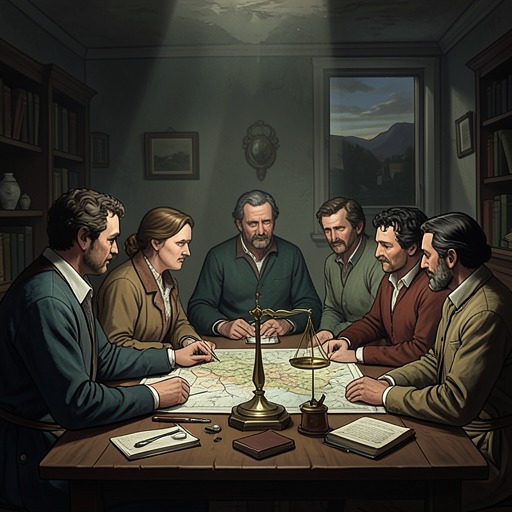
The Cognomina itself was established in 839 by its first six members in Zurich, then a small village in the Swiss confederation. The formal society thus arose from a tradition of reunion that had already continued for centuries: the gatherings at Giza supplied a means of finding one another, while the Zurich foundation gave the returning members an enduring collective identity.
The name Cognomina was explained as a Latin term meaning to remember the same name. That meaning connects the society’s title to its central problem: a person may return in a different body, but must still be recognized as the same individual. Members wore the three-peaked mark after passing the Ascension, the society’s trial for proving identity and reentering the group. The mark therefore signified more than a shared past; it also indicated that a returning member had been accepted again.
Disclosure and the Turn to Secrecy
The society’s history later supplied a grim reason to restrict knowledge of its existence. Around the turn of the first millennium, its seven members had accumulated a fortune comparable to that of nearby kingdoms. One of the oldest members became trustee and disclosed the Cognomina to villages within several days’ ride, without the other members’ permission. He later said he had hoped to establish a kingdom ruled by the seven as a royal family across successive incarnations.
The disclosure instead exposed the group to attack. Within a fortnight, villagers killed all the members and looted the treasury. In the account given to Evan Michaels, this disaster explains the tradition of keeping the society secret: a conspicuous mark and a publicly known claim to extraordinary continuity could invite violence rather than recognition. Secrecy became a boundary between members, who could share an otherwise difficult-to-explain existence, and outsiders, who might fear or exploit what they learned.
The Founding’s Institutional Legacy
In the society encountered by Evan Michaels, secrecy and recognition operate together. The twenty-eight members are sworn to conceal the Cognomina, and they do not disclose their identities to a candidate until that candidate has been accepted. New members must undergo Ascension, persuading a panel through verifiable names, dates, places, and other details that they have lived before. The earlier method was far more severe: a candidate was run through with a spear and accepted only if, after returning in another life, the candidate could identify the murderer.
Membership carries continuing duties as well as recognition. Members must maintain secrecy about the society, its condition, and its collective; introduce new palingenesists; and answer summonses to serve as judges or jurors. They agree to leave their assets to the Cognomina, with ten percent of those assets going after death to a community fund whose accounts are presented at Sumerfest. Each must undergo a trial in every successive incarnation to prove identity and reclaim assets, take a turn administering the society’s funds and activities, and pledge allegiance to its members. These rules turn the founding’s concern with survival into a system of mutual obligations across lifetimes.
Evan’s acceptance shows the system in operation. After a four-to-one vote, he was welcomed as a brother; Poppy then gave him the fingerless gauntlet used to apply the Embe-shaped tattoo. The old practice of marking a meeting place had become part of an admission rite, joining recognition of a returning individual to the society’s present-day rules. The founding story therefore endures not simply as an origin account, but as an explanation of why the Cognomina makes trust, proof, secrecy, and renewed acceptance inseparable.