The Rendezvous
The Reincarnationist PapersThe Rendezvous is Jan Vermeer’s 1670 portrait of Samas in his earlier life as Emil Restoud. More than a work in his art collection, it is the sole portrait he retained of that identity and a material link to a relationship he remembered as deeply personal. Its history runs from a commission in Delft to a home in Amsterdam, wartime seizure, decades of searching, and a proposed recovery in Tunis that turns the painting into both an object of devotion and a bargaining instrument.
Commission and Making
Samas encountered Vermeer’s work in a Delft bread shop, where a small painting of a young woman at a table admiring a loaf of bread drew his attention. The baker identified the artist and explained that Vermeer had offered the painting in exchange for half a year’s worth of bread. Samas recognized the work as exceptional and left word that he wanted to commission Vermeer, arranging to meet him at the shop two Mondays later.
Vermeer arrived for their meeting in his best but threadbare clothes, carrying himself with confidence despite his limited means. Samas gave him an Amsterdam address and a purse containing one hundred silver francs for supplies. Vermeer arrived there on time with his canvas and materials. Over lunch, he spoke of having studied with no one and having no explanation for his talent; Samas provided him with a guest room so that they could begin work early the next morning.
The portrait took a week of sessions lasting ten hours a day. Vermeer worked slowly and required Samas to hold a pose for long stretches. When Samas shifted, Vermeer would pause, come over, and gently reset his position. What began as the practical difficulty of sitting still became a means of closeness: Samas deliberately shifted so that Vermeer would approach, and an intimate relationship developed during the sittings. Vermeer named the finished portrait The Rendezvous. Samas later bought three more of his works in the fall of 1674, at five hundred silver francs apiece; Vermeer delivered them personally and died the following year.
A Portrait Bound to a Past Life
The painting was the only portrait Samas possessed of himself as Emil Restoud. For more than two hundred and fifty years it hung in his Amsterdam home, in the same room where Vermeer had painted it. Its significance therefore rests not only in its authorship or artistic value, but in the conjunction of an image, a place, and a remembered relationship. Samas had a history with every work in his collection, but he regarded this one as especially precious because it preserved an image of both his former identity and the person he had loved.
That attachment explains why the painting’s removal meant more to him than the loss of an artwork. When the Nazis took it from his home in 1940, an SS captain selected the Vermeer and left two other works that were also in the house. Samas later described the theft as the loss of part of himself. The portrait’s private meaning and its public status as valuable art thus remain inseparable: it is at once a singular personal record and a sought-after object passing through political and institutional hands.
Seizure and the Long Search
Samas searched for the portrait for five years, until the end of the Second World War. Ramsay helped him arrange a meeting in Berlin with a Luftwaffe colonel in the closing days of the fighting. The proposed exchange was ten thousand British pounds, since Reich Marks had become worthless, and passage by boat from Rostock to neutral Sweden for the colonel. Samas prepared two hundred thousand pounds because he hoped the officer might also control other stolen works, and had a truck ready to carry the anticipated cache.
The Red Army reached the colonel first. From a concealed position in a thicket, Samas watched soldiers remove narrow crates from an anti-aircraft tower and load them onto a truck bound east. The colonel’s body lay at the base of the tower. After the soldiers had departed, Samas searched the structure and found a handwritten German manifest among the scattered papers. It listed the objects moved into the tower over three years, including The Rendezvous, but the crates themselves were gone. The manifest confirmed that the portrait had been there while offering no immediate way to recover it.
It took Samas twenty years to locate the work in the Soviet Union, where it was stored at the Hermitage with the other objects named on the manifest. In 1985, General Secretary Gorbachev gave it, along with several other works, to the Government of Italy as a political offering. The Italians leased the paintings to galleries around the world, while the portrait was listed as doubtfully attributed to Vermeer. Samas made a generous offer every year for three years; even leaving the amount open for the Italian government to set did not secure a sale.
The Tunis Plan and Its Reversal
When the Italian government leased The Rendezvous to the Tunisian National Gallery for a year, Samas resolved to have it back in his possession by the end of the loan. He considered the gallery’s security inadequate and had obtained a master schematic of its security system and a floor plan from an inside source the previous month. His account identifies the obstacles: alarmed doors, windows, and skylights; two guards on duty, making rounds every twenty minutes; motion detectors covering the floor plan; and pressure-sensitive mounts connected to the main alarm.
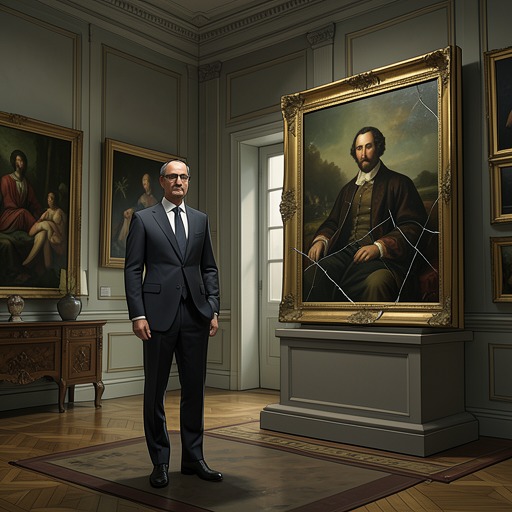
The proposed method was to remove the portrait from its frame, detach the canvas from its internal stretcher, and leave with it rolled so that the painted surface faced inward. The canvas was held by two small nails in each inside corner; a small hammer could remove them. Cutting along the back of the internal frame would leave enough material for the painting to be stretched to its usual size again. These details make the contemplated theft less a matter of taking a framed picture than of separating a vulnerable canvas from the security system built around its display.
The plan’s purpose changed when Poppy used the portrait’s vulnerability to renegotiate the payment Samas owed. With a lighter held at the painting’s lower corner, she threatened damage unless he offered a more substantial sum. Samas proposed three million dollars; Poppy demanded twenty million. Samas then instructed Mr. Diltz to transfer ten million dollars each into the accounts of Poppy and Evan Michaels. The transaction ended the immediate dispute, but it also recast the painting: the object Samas had sought for decades as a piece of his past had become leverage in a present-day negotiation. Its movement through private memory, wartime plunder, state custody, and attempted recovery gives The Rendezvous its distinctive place in the story.