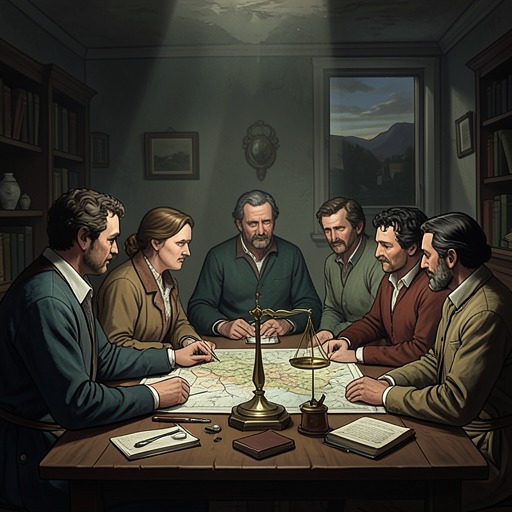
The summer-solstice reunion at Giza expands the reincarnated group
The Reincarnationist PapersThe summer-solstice reunion at Giza expands the reincarnated group from an enduring pair into a network of people able to recognize one another across lives. Retold by Poppy as the community’s origin story, the encounter joins a recurring meeting at the pyramids to the first shared sign of belonging: the three peaks that would become the Embe symbol.
Background and the Giza meetings
The tradition of reincarnants returning to meet one another began in the fourth century A.D., before the Cognomina existed as a formal society. The first two people to find each other arranged to meet every year on the summer solstice at the pyramids of Giza. The location and date gave each a dependable point of return: if one died, the other could expect to meet that person again in a new body at the same place.
Across several lives, the pair began marking themselves with a symbol associated with their assigned meeting place. The three peaks of the pyramids made recognition easier when they encountered one another in unfamiliar bodies. A recurring reunion thus acquired a visible sign, turning a private expectation into a means of identification.
The reunion and the group’s expansion
At one Egyptian summer gathering, one of the original pair returned in a young body after an eighteen-year absence. He found his old friend accompanied by two other people bearing the same Embe symbol. The meeting revealed a connection extending beyond the first pair: one of them had found a new reincarnant who already knew another. Recognition now linked several people rather than simply restoring a single friendship.
Poppy presents this encounter as the beginning of the wider group, while qualifying the account as the story of how it began. The reunion’s significance lies not in a formal admission procedure but in the discovery that repeated returns could bring separate pairs into contact. The annual gathering made those connections visible and gave the expanding circle a shared point of recognition.
From recurring encounter to institution
The Cognomina was formally established in 839 by its first six members in Zurich, while the practice of returning to Giza and meeting at the summer solstice predated that organization by centuries. The sequence distinguishes the group’s origin from its later institution: first came the repeated meetings and the widening network; later came a society that could preserve their identity and obligations across successive lives.
The Embe mark also outlasted the original Giza encounters. In the later Cognomina, members wore it as a tattoo after passing the Ascension, a trial in which a candidate had to prove to people who knew the earlier life that they were the same person in a new body. The mark recalled the pyramids and the old practice of finding one another, while the Ascension made recognition an organized condition of rejoining the society.
Secrecy and lasting significance
The reunion’s legacy was a community whose growth depended on recognition but whose continued existence depended on discretion. The Cognomina’s history included a later disclosure that ended in the deaths of its members and the looting of its treasury; afterward, secrecy became a tradition. The contrast gives the Giza meetings a lasting importance: a symbol that once enabled people to find one another also became part of a guarded identity.
The story’s movement from two annual companions to a larger circle and, eventually, a formal society makes memory more than an individual possession. The returning members need signs, places, and repeated encounters to make continuity legible to one another. Giza is therefore both a meeting point in the group’s history and the setting for a method of recognition that would persist long after the original pair’s reunion.