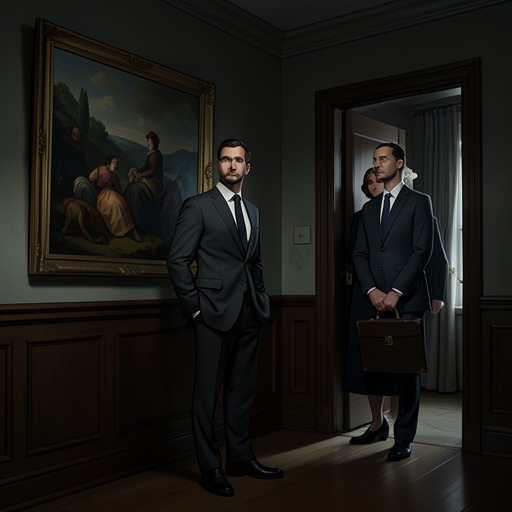
Tunisian National Gallery
The Reincarnationist PapersThe Tunisian National Gallery is the Tunis setting of Samas’s proposed attempt to recover The Rendezvous, a painting once taken from his wall and later carried through a succession of international collections. In the planning described in the novel, the gallery is at once a public institution, a mapped security system, and the final destination of a work Samas intends to reclaim. Its small scale makes it conspicuous and, in his view, harder to penetrate than a larger building.
Setting and security
Samas describes the gallery as small, reflecting the small country in which it stands. Its modest size is not an advantage to a would-be thief: based on his experience, removing an object from a large building is easier than stealing one from a building of this scale. The gallery’s compactness therefore shapes the plan from the outset, complicating an operation that might seem simpler in a more extensive space.
The security measures he recounts cover the building’s entrances, interior and display fixtures. All doors, windows and skylights are alarmed; two guards are on duty continuously and make rounds every twenty minutes. Motion detectors cover the entire floor plan, while pressure-sensitive mounts holding the paintings are wired into the main alarm system. The plan Samas describes must contend not with a single barrier but with layers that connect movement through the building to the alarm.
The schedule adds another constraint. A new guard shift begins at midnight, and staff empty the trash and mop the floors before the gallery reopens. Samas considers hiding in a trash can as a possible way to remain inside, then rejects it because the overnight routine would expose the attempt. The gallery’s daily maintenance and staffing arrangements are thus as consequential to the proposed operation as its alarms and sensors.
Samas’s reconnaissance
Samas does not base his assessment solely on documents. He says he has visited the gallery twice: once to see the painting and also to check the cameras and sensors shown on the security schematic. He reports that the drawing is accurate down to the guards’ schedules. His visits turn the plan from a paper account into a site he has personally surveyed, although the evidence establishes the accuracy of his reconnaissance, not that a theft has taken place.
The documents are unusually detailed. Samas produces a tightly rolled set of blueprints and spreads them across the kitchen table, showing the floor plan and identifying the location where The Rendezvous hangs. He says he bought a master schematic of the security system and a building plan from an inside source the previous month. The source had been affiliated with his group for about fifteen years. The gallery consequently enters the story through a combination of institutional layout, security information and long-standing access to an insider; Samas can point to the painting’s position and describe the protections around it with precision.
The painting’s route to Tunis
The painting’s presence in the gallery follows a long and violent itinerary. Samas says it was taken from his wall in 1940 and traveled toward Berlin. It then went to Moscow, where it remained for forty years, before passing through Rome, New York, Singapore and Johannesburg, and finally reaching Tunis. The route gathers several changes of place into the history of one object, while the gallery becomes the latest stop in a journey that began with its removal from Samas’s home.
Despite those transfers, the painting retains a material link to that earlier home. Samas says it still rests in the gold-painted oak frame he placed it in as soon as the oils had dried. The unchanged frame contrasts with the work’s passage through cities and collections: its location and custody have repeatedly changed, but the frame preserves a trace of the moment Samas first housed it. In the gallery, that continuity makes the painting not merely the target of a planned theft but a surviving piece of his personal history.
The gallery as the focus of a proposed theft
At the time of the conversation, the Italians have leased the painting to the Tunisian National Gallery for one year. Samas intends to have it in his possession by the end of that period and considers the gallery’s security suspect. The deadline gives the proposed recovery a defined window, while the temporary loan places the painting in Tunis rather than making the gallery its permanent home.
The plan is to enter the building, remove the portrait from its frame, cut it free from its internal frame and leave. The display mount makes that sequence especially risky: pressure-sensitive supports are connected to the alarm, and the building’s other detection systems cover the floor. Samas acknowledges that the exit will be the most difficult part. In his assessment, any route out will trigger the alarm; the advantage, as he sees it, is that the painting will already be in hand.
He proposes a particular escape route on the floor plan: a door opening onto an alley, followed by a journey to the harbor, where a boat and crew would be waiting to take the thief to a beach. The discussion also establishes that Samas offers two million, with an account to be opened upon confirmation and Diltz to transfer the money once he receives the painting; the recipient could call to confirm the funds. These are terms and logistics of a proposed operation, not evidence that the gallery is entered or that the painting is successfully removed. The institution’s narrative importance lies in the concentrated problem it presents: a well-specified target, a layered security system, and a narrow window in which Samas hopes to reclaim an object bound to his past.