Tunisian National Gallery security plans
The Reincarnationist PapersThe Tunisian National Gallery security plans are the practical center of Samas’s proposed operation to steal The Rendezvous. Bought from an inside source and checked against Samas’s own visits to the gallery, the documents locate the painting and detail the building’s protections. Their importance lies in the contrast they establish: the gallery appears small and heavily monitored, yet Samas considers its security vulnerable, with escape from the building the central problem. The plans turn that judgment into a specific, testable assessment rather than a guess.
Provenance and Physical Form
Samas tells Evan that he has a master schematic of the gallery’s security system as well as a floor plan. He bought both from an inside source the previous month, describing the source as someone affiliated with his group for about fifteen years. The account establishes the plans’ immediate provenance but does not identify the source or explain how the documents were obtained. Their arrival therefore reflects access through a longstanding connection, not simply Samas’s independent inspection of a public building.
When Samas brings the documents to Evan, they are rolled tightly under his arm. He spreads the blue-and-white sheets across the kitchen table, where the two can examine the layout together. The modest physical presentation contrasts with the weight of the information: a compact set of plans gives the prospective thieves a view of the gallery’s interior, its security arrangements, and the picture’s position within it. Evan notices that Samas speaks of the operation in the plural, but does not press him on the implication at that point.
What the Plans Show
The floor plan marks The Rendezvous with a small red sticker. Samas identifies the marked location from two visits to the Tunisian National Gallery, during which he went both to see the painting and to look for cameras and sensors shown in the schematic. He says the documents are accurate down to the guards’ schedules. The sticker thus links the larger technical drawing to the operation’s particular objective: not merely entering a museum, but finding and removing one specific work.
The plan also allows Samas to explain why the building’s scale matters. He describes the gallery as small, in keeping with the small country, and says that this works against the thieves: in his experience, removing an object from a large building is easier than doing so from one of this size. The drawings offer useful detail, but their precision does not make the task simple. They expose the density of the protections and the limited space in which the operation must be carried out.
Security and the Proposed Theft
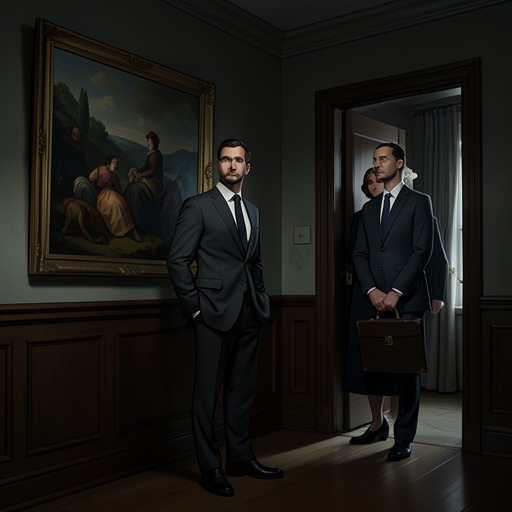
Samas outlines a plan to enter the building, take the portrait out of its frame, separate it from its internal support, and leave. The schematic and floor plan let him assess the obstacles to that sequence. The doors, windows, and skylights are alarmed; two guards remain on duty at all times and make rounds every twenty minutes; motion detectors cover the entire floor plan; and the paintings hang on pressure-sensitive mounts wired into the main alarm system. Evan questions Samas’s claim that the system is suspect because the listed measures sound extensive. Samas maintains that they are, and locates the operation’s principal difficulty in getting out of the building.
The plans therefore serve less as a ready-made solution than as a map of constraints. They establish where the target is and what protections surround it, but the discussion leaves the escape problem unresolved. Their detail supports Samas’s confidence that he understands the gallery while also making the risks visible to Evan. The object’s role in the plot is consequently double: it equips the proposed theft, and it gives the pair grounds to recognize how much remains difficult even when the interior has been carefully documented.
The Painting’s History and the Plans’ Wider Context
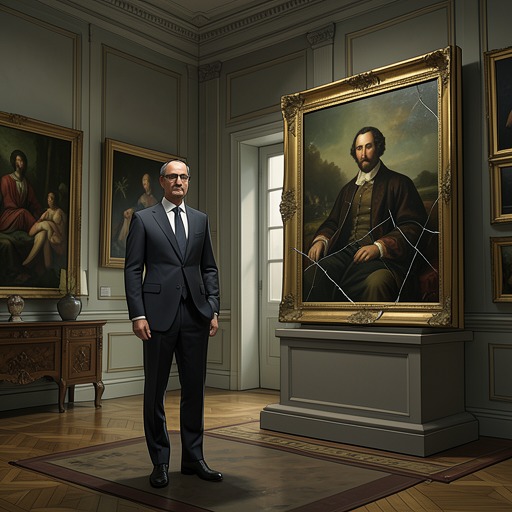
The red marker carries a history beyond the gallery’s present layout. Samas explains that The Rendezvous was taken from his wall in 1940, then traveled on its way to Berlin, spent forty years in Moscow, and later passed through Rome, New York, Singapore, and Johannesburg before reaching Tunis. Despite that circuit, it remains in the gold-painted oak frame Samas put it in when the paint was dry. The floor plan’s small mark thus locates a work whose passage across cities and collections has not erased its connection to Samas’s earlier life.
The inside-source provenance also sits within the Cognomina’s broader culture of secrecy, though the evidence does not establish that the source supplied the plans as an official act of the society. Cognomina’s twenty-eight members are sworn to secrecy, and newcomers are admitted only after acceptance. Its tradition of concealment follows a historical disaster: after one member disclosed the society to nearby villages in an attempt to establish a kingdom, villagers killed the members and looted their treasury. The society’s rules also bind members to secrecy and mutual obligations. Against that background, the plans’ passage through a long-standing insider connection shows how confidential access can make a complicated operation possible, while the documents themselves remain focused on the gallery’s physical defenses and the location of The Rendezvous.