Tunisian desert prison
The Reincarnationist PapersThe Tunisian desert prison is the remote fortress where Evan Michaels is confined after receiving a twenty-five-year sentence in Tunis. Cut off from the world by desert, armed guards, and a sealed gate, it becomes more than the destination of his imprisonment: in cell 145, Evan’s effort to record his story gives shape to an existence organized around punishment, enforced waiting, and the slow sharpening of attention.
Setting and Transfer
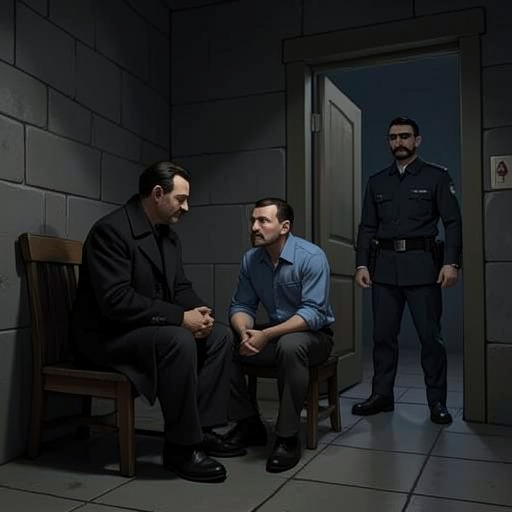
Evan’s route to the prison begins after a fifteen-minute proceeding in a side room of the Tunis city jail. The trial consists of accusations gestured at in Arabic, a comparison between Evan’s bruised and swollen face and photographs, and a sentence translated into English: twenty-five years without parole. He later learns that Rome has tried him in absentia on the same day and imposed another twenty-five years, to run consecutively, for refusing to cooperate in recovering the Vermeer. By the time he learns this, the painting is beyond the authorities’ reach and he believes he has found resolve, though the prison will test that conviction.
The morning after the Tunis hearing, Evan is taken with five other prisoners in an old, rust-colored bus. Steel plates welded over its windows leave the passengers with no view except the machine-gun-carrying soldiers. As the bus pitches over a crude Tunisian road, heat builds inside the sealed vehicle; Evan braces himself with cuffed hands and focuses on dust rising from the road and drifting through narrow shafts of light in the roof. The journey’s physical confinement anticipates the more complete isolation waiting at its end.
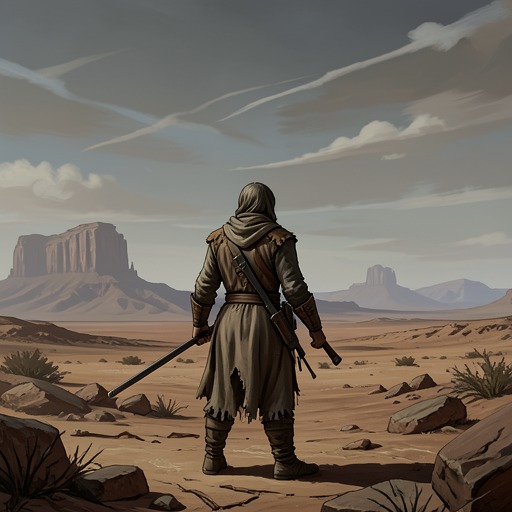
The bus stops just before sunset. Evan is the first prisoner off, and the first to see the destination: an ancient, menacing fortress of brown brick, its color merging with the seemingly endless sands around it. Armed soldiers patrol the wall tops. The road stretching back from the prison represents, to Evan, the last visible connection to the world beyond the walls. Barefoot, with his shoes hanging by their tied laces around his neck, he imagines walking back along it, even knowing the journey would be unsurvivable. A guard seizes his shirt and pushes him into line; Evan goes through the open steel gate with his head lowered.
The Fortress and Its Regime
The prison’s isolation is reinforced by the contrast between Evan’s treatment and that of the other prisoners. The guards speak with their countrymen and treat them apathetically, while Evan receives shouts and harsh shoves. His first stop inside is a delousing shower in which prisoners strip and pass through a cloud of white lime, holding their breath and covering their eyes. Evan is made to go last. On the other side, a set of red-and-white striped cotton fatigues awaits him, but no shoes or socks. The bare feet that had accompanied his imagined escape become part of the conditions imposed on him inside.
The route to his cell is itself an introduction to the prison’s violence. After an officer orders Evan not to speak, Evan nods, blood running from his nose. He is sent down a long, dim hallway lined on both sides with closely set riveted steel doors. Slapping, clubbing, and catcalls accompany the guards’ handling of him until he lands before the last door, marked 145. Four guards seize his limbs and heave him into a small gray cell; the door shuts behind him as their laughter recedes down the corridor.
The cell is starkly furnished: its open ceiling is crossed by iron bars, and a crude wooden cot occupies the room. Dust covers the floor where Evan is left motionless. The cell’s number gives the place a precise address within an otherwise anonymous institution, while its barred ceiling and steel door make clear how little control a prisoner has over movement, privacy, or contact with the outside.
The Outpost and Its Routine
The prison is also known among its inmates as the Outpost. Reginald tells Evan that this is the name Steen used and that Steen said the place had once been a French Legionnaire outpost. The explanation reaches Evan secondhand; the prison’s former purpose is not independently confirmed. Even as an uncertain account, it gives the fortress a history that predates its present role as a remote jail.
The daily meal arrives through a small trap door. When a guard calls out in Arabic, Reginald wakes, replaces the lid on the wooden chamber pot, and passes it through the opening. A fresh pot comes back with two stainless-steel bowls and a brown disk of unleavened bread. Reginald calls the food the Outpost’s finest. There is another meal in the afternoon, he explains, and a grapefruit every other day. The small details of the exchange—an anonymous hand at the opening, the returned pot, the bowls and bread—show how even basic necessities are delivered through a barrier that keeps the prisoners separate from those who serve them.
Cell 145 and Reginald
The cell’s other occupant is Reginald, a Black prisoner whose striped fatigues have faded from red and white to pink and dingy gray. The trouser legs are ragged below the knees and the sleeves torn away, exposing his arms. His head is shaved, his body taut and muscular, and his face marked by worry; his bright, wild-looking eyes suggest a mischievous spirit. He greets Evan in a Cockney accent and introduces himself. That first encounter makes cell 145 more than an isolated box: it is also the site of an unexpected companionship between two men imprisoned by the same system.
Reginald’s care continues after Evan has been taken away for interrogation. Beatings and torture are less frequent than during the first weeks, but the evening abductions and all-night sessions grow more thorough and earnest. When Evan is returned, Reginald is awake and waiting. He cleans him up and tells him he looks fine. Evan no longer believes the reassurance, but understands why Reginald offers it. The ritual cannot undo the violence; it provides a form of attention and care inside a place designed to reduce its inmates to bodies under guard.
Confinement and the Written Account
As days run together, the prison’s enforced idleness changes how Evan experiences his surroundings. At first he treats his heightened attention as a novelty, tracing cracks in the floor or counting his breaths into the thousands. Over weeks, perception becomes so acute that objects seem to acquire sharp edges, as though a lens were bringing the world into an intolerable clarity. That clarity eventually overtakes the prison as the focus of his attention and becomes, in its own way, an object of escape.
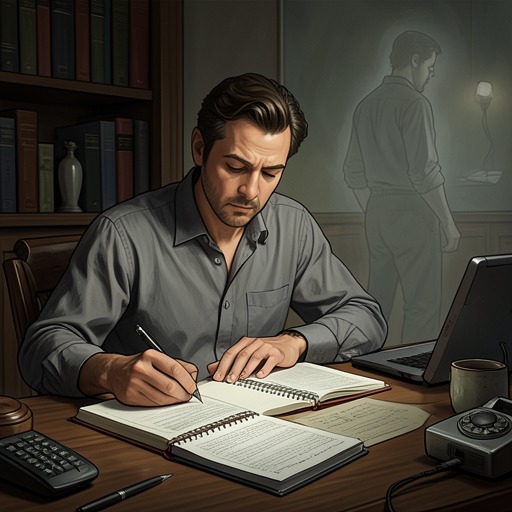
Evan begins writing in notebooks and uses a pen taken from the box beneath Reginald’s bunk. His account comes from cell 145 in an unnamed Tunisian desert prison, rather than from the desk, photographs, or trophies he had imagined accompanying other autobiographies. Writing helps occupy his idle mind and makes it possible for him to understand how he arrived there, but it does not settle what the narrative means: Evan cannot tell whether the prison is the epilogue to his story or whether everything before it was a lengthy prologue.
The prison thus frames both a physical sentence and an act of narration. Its walls confine Evan, its interrogations repeatedly return him to the cell, and its routines make time seem to accumulate without distinction. Yet the notebooks preserve a different kind of movement: through writing, Evan reconstructs the path that brought him behind the gate, even while the prison’s violence and his own sharpening awareness leave the future of that account unresolved.