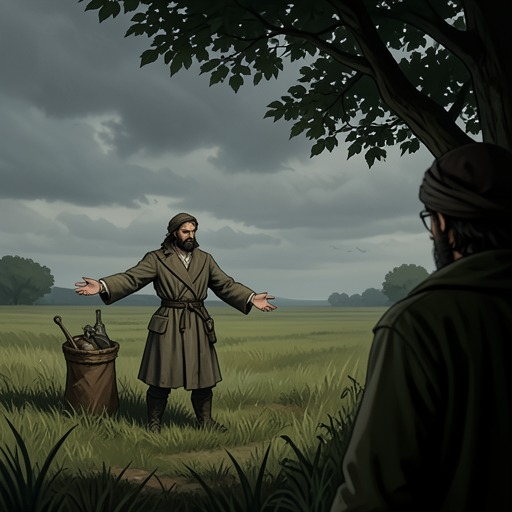
Zohra
The Reincarnationist PapersZohra is Samas’s wife and an accomplished cellist whose brief appearance in Morocco gives the novel a vivid counterpoint to the reincarnates’ unusual continuity across lives. Introduced through her affectionate reunion with Samas, she emerges as more than a domestic presence: she recognizes that Evan has lived before, speaks confidently about her own faith, and answers Samas’s account of existence with a compact statement of belief.
Identity and Marriage
Samas says that he and Zohra have been married for thirteen years. When Evan reacts with surprise that someone like Samas could be married, Samas treats the question as a misunderstanding of ordinary intimacy: Zohra knows about their marriage because, as he explains, closeness and love cannot be separated from telling the other person. The exchange establishes both the duration of their marriage and Samas’s conviction that honesty is integral to loving someone. His laughter gives the conversation warmth, but it does not make the disclosure seem casual; he is clear that Zohra knows who he is.
The conversation also gives their marriage a practical, everyday dimension. Samas describes his wife as an excellent cook whose specialty is native cuisine. That description sits beside the extraordinary premise of their lives: the couple’s relationship belongs to familiar domestic routines even as their identities extend beyond a single lifetime. The contrast is not presented as a problem to solve. Instead, Samas’s account makes enduring love and household life part of the ordinary world he values.
Arrival in Morocco
When Samas and Evan leave the terminal in Morocco, a petite, middle-aged, dark-skinned woman runs toward Samas. He lifts her effortlessly into his arms, and she nestles against the nape of his neck. Her greeting and embrace make their long partnership immediately legible through action rather than explanation. The reunion is intimate and physical: Samas holds her close, while she responds with the ease of someone returning to a familiar bond. She speaks English with a British accent, another detail that marks her as an individual rather than simply an extension of Samas’s home or background.
At the meal that follows, Zohra participates directly in Evan’s conversation. When he asks about the region’s dominant religion, she answers that Islam predominates, while Berber folk religion survives in the countryside and Jewish enclaves remain in some cities. The answer is specific and measured, setting out a varied religious landscape rather than reducing the region to a single description. Asked about her own beliefs, she identifies herself as a Sunni Muslim and speaks with a small measure of pride. Her faith is thus stated in her own voice, within a conversation that also includes Samas and Evan’s differing perspectives.
Knowledge and Belief
Zohra’s awareness of Evan’s past is revealed when she asks whether his time in Turkey belonged to a previous life. Evan is unprepared for her knowing; he looks to Samas, who subtly confirms the implication with a nod. Zohra’s question shows that she understands the central fact Evan has been discovering about himself, although the scene does not explain when or how she learned it. Her recognition also places her within the private circle surrounding Samas, where reincarnation is not merely an abstract idea but knowledge that can be brought into ordinary conversation.
The clearest contrast between Zohra and Samas comes when Evan asks whether she accepts Samas’s view of human existence. Samas has described a world without divinity, locating its meaning in present experience, relationships, ideas, and the finite lives of people who do not remember surviving death. He argues that those who retain consciousness across death should especially value the life they have. Zohra does not take up his argument point by point. She answers that she does not need to buy it because she has faith. Samas bursts into laughter and says that this is why he loves her. The moment preserves their difference without turning it into a rupture: he responds to her conviction with delight, and she remains unmistakably herself beside his philosophy.
Narrative Significance
Zohra’s role is concentrated in a handful of scenes, but each adds a different dimension to the account of the reincarnates. The reunion at the terminal makes Samas’s home life tangible; the meal gives Zohra room to describe religious plurality and name her own Sunni faith; her question about Turkey confirms that she knows Evan’s history reaches beyond his current life. Together, these moments make her both a participant in the group’s knowledge and a person whose beliefs are not reducible to that knowledge.
Her marriage to Samas holds the scene’s contrasts together. Their shared life includes affection, food, and familiarity, while their approaches to belief remain distinct: Samas grounds meaning in the present and in continuing individual consciousness, whereas Zohra places her confidence in faith. The novel offers no resolution of that difference, and the exchange does not require one. Samas’s laughter and declaration of love make their acceptance of one another the scene’s quiet outcome.