Zurich
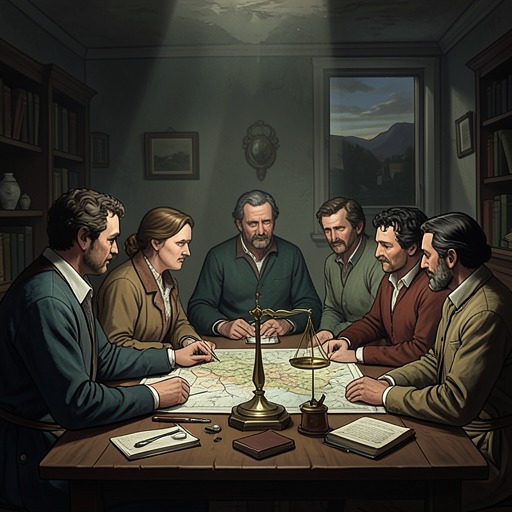
The Reincarnationist PapersZurich serves both as the historical home of the Cognomina and as the place where Evan Michaels must prove that he belongs to it. Its significance lies not in a public monument or civic institution, but in the hidden continuity the society claims for itself: a community founded there in 839, traced in scattered records, and sustained through successive lives.
Historical traces and foundation
The account of the Cognomina’s origins reaches further back than its Zurich foundation. From the fourth century, its first two members are said to have met each year at the summer solstice by the pyramids at Giza, returning to the same place so that a survivor could recognize a friend in a new body. As their circle grew, they adopted a hand-mark to make recognition easier. The three peaks of the pyramids became the design later associated with the society’s Embe tattoo. The account says that six members established the Cognomina in Zurich in 839, making the city the site where a recurring reunion became a formal society.
Historical references offer a separate, fragmentary trail. A fifteenth-century passage in the Konstanz Codex, a largely heraldic work by Konrad Grünenberg, mentions a Zurich-based guild whose members bore a distinctive crossed-flail mark on the right hand. Ludwig Meyer von Knonau’s 1826 history of the Swiss Confederation also describes a secretive group of landed nobles in Zurich, called auslanders, who carried the same crossed mark as if branded. That passage was removed from the two-volume 1829 reissue. These records do not establish every detail of the society’s own origin story, but they place reports of a secretive Zurich group and a shared hand-mark centuries apart.
A city made into a durable home
Zurich’s importance to the Cognomina is institutional as well as historical. The society’s founding there distinguishes its formal organization from the older practice of members finding one another in successive lives. In Poppy’s account, the members’ continuity depends on more than memory: a designated custodian holds the property of those who have died and returns it when they reappear in new incarnations. If that custodian dies, the holdings pass to a living alternate. The system makes property, like identity, something the group must preserve across a person’s absence.
That arrangement addresses a recurring limit of the members’ condition. They can carry wisdom and experience into another life, but cannot simply pass wealth or land from one incarnation to the next. A custodian and an identity-verification process allow the society to restore what a returning member could not otherwise inherit. Zurich is therefore not merely the place named in the foundation story; it is the setting for a community whose endurance rests on recognition, trust, and the deliberate return of its members’ possessions.
The city and Evan’s Ascension
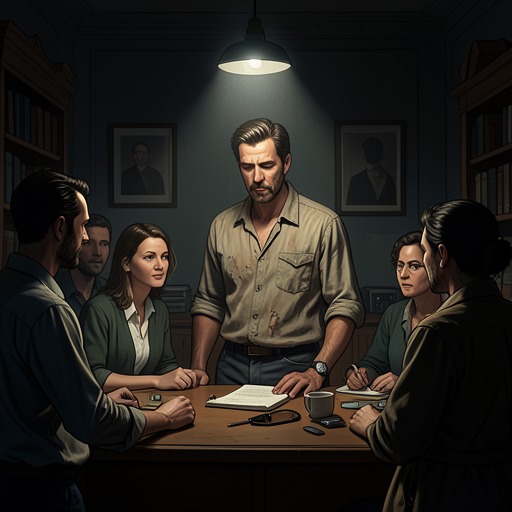
In Evan’s present-day story, Zurich becomes the place where the Cognomina’s private history is tested against verifiable evidence. He returns to the city for proceedings at the Hotel St. Germain, arriving with confidence that he can convince the society of who he is. In a grotto, he stands before a panel of five judges while a full gallery watches. The contrast is sharp: a community whose members have kept their identities secret for centuries must decide whether a newcomer’s remembered life can be proved.
The trial, called the Ascension, is designed to establish that a candidate is the same person known to the society in a previous incarnation. Earlier practice had been far more violent: a candidate was run through with a spear and accepted only if, after returning in another life, he could identify his killer. In Evan’s time, a panel instead weighs names, dates, places, and other details that can be checked. Zurich’s hidden society thus turns the city into a place of examination, where remembered experience must withstand outside verification.
Verification, recognition, and return
The inquiry reaches beyond the panel room. During a break in the proceedings, Poppy explains that the society is likely using the time to verify Evan’s statements. Its agents can investigate obscure records in different places: a Texas judge can check a speeding ticket from Slayton; a Georgia clerk can examine Bobby’s mother’s driver’s-license application; and a Bulgarian party bureaucrat can search military records for Vasili Blagavich Arda’s service with the 138th under Captain Hoxa in 1918. The process makes Zurich the center of a dispersed investigation, connecting the candidate’s memories to records held elsewhere.
The chamber’s architecture gives that judgment a physical threshold. Evan follows Poppy down a torch-lit staircase of roughly seventy-five to one hundred steps, feeling along the old stone wall for handholds as the brass tip of a cane echoes below. The stair opens onto a cavernous room with carved stone columns, a polished dark-stone floor, a judges’ bench, and tiered gallery seating. The descent separates the proceedings from ordinary street life; the room gathers the witnesses, judges, and candidate into a space devoted to deciding whether a past identity has truly returned.
The panel finally rules four to one that Evan is what he claims to be and welcomes him into the Cognomina. Samas embraces him as the gallery reacts with cheers and groans, while the result settles wagers among those watching. Recognition, however, is not the final step. At the celebration, Poppy presents a fingerless leather gauntlet with a black, Embe-shaped template, and Evan slips his hand into it before she laces it closed. In the Zurich sequence, admission is therefore made both by judgment and by bodily marking: the city’s old story of a society founded on recognition culminates in a new member bearing its sign.