Keep trying, dont give up
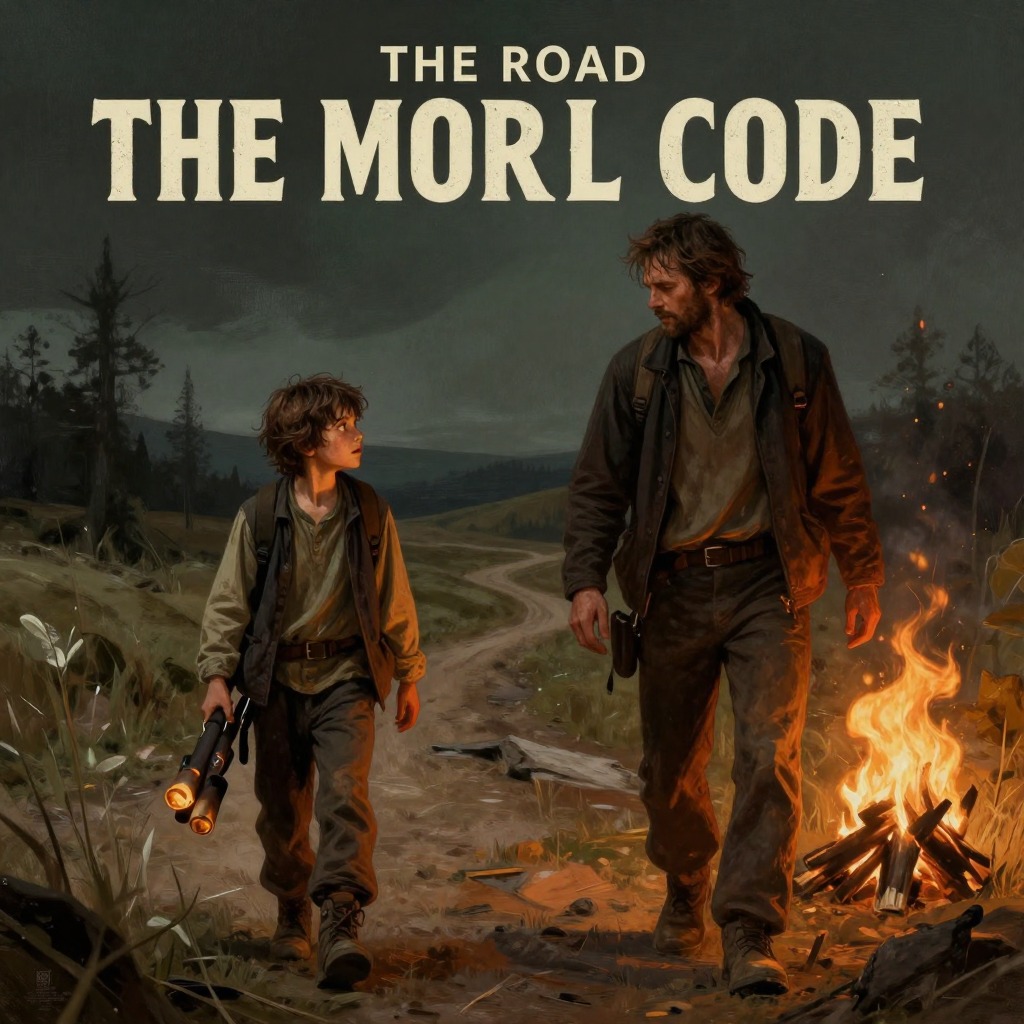
The RoadKeep trying, dont give up is the moral and existential rule that the man imparts to the boy at the moment of their greatest peril, and it becomes the defining principle of the good guys in Cormac McCarthy's The Road. The rule is articulated explicitly when the man, having just discovered a hidden bunker stocked with food and supplies, must persuade the terrified boy to descend into the darkness. The boy is frozen with fear, bobbing up and down, begging his father not to open the hatch. The man takes the boy's hand and says: "This is what the good guys do. They keep trying. They dont give up." This is not a casual encouragement; it is a formal definition of identity and action. The rule transforms the boy's fear into a shared purpose, and he agrees to hold the lamp while the man opens the door. The rule is thus born in a moment of crisis and becomes the template for all subsequent moral action.
The Rule as a Test of Identity
The rule is not merely a strategy for survival; it is the criterion that separates the good guys from the bad guys. Throughout the novel, the man and the boy encounter figures who have given up—the old man Ely, who wanders without hope; the thief who steals their cart; the marauding armies who eat human flesh. The good guys are defined not by their power or their resources but by their refusal to stop trying. When the boy asks, after witnessing the horrors of the road, whether they are still the good guys, the man answers: "Yes. We're still the good guys. And we always will be." The rule is the content of that promise. It is what makes them good, even when they are starving, even when they have nothing left to give. The rule is the fire they carry.
The Rule as a Legacy
The rule becomes the boy's final inheritance. When the man lies dying, he tells the boy: "You need to go on. ... Just go. It's all right. ... Keep going south. Do everything the way we did it. ... Just dont give up." The boy protests that he does not know how to carry the fire, but the man insists: "Yes you do. ... It's inside you. It was always there." The rule is not a set of instructions; it is an internalized disposition, a habit of the heart. After the man's death, the boy sits with the body for three days, then walks out to the road. When a stranger appears and asks if he is one of the good guys, the boy asks: "Are you carrying the fire?" The stranger, confused, answers: "Yeah. We are." The boy's question is the rule made manifest: he tests the stranger by the same standard his father taught him. The rule is what allows the boy to trust and to go on living.
The Rule and the Novel's Structure
The rule operates as a counterpoint to the novel's overwhelming despair. The world of The Road is one of relentless loss: the wife commits suicide, the man coughs blood, the boy nearly dies of fever, and every refuge is temporary. The rule does not promise success; it promises only the obligation to keep trying. The man himself admits that he does not know if they will survive, but he insists that they must not give up. This tension between hopelessness and perseverance is the novel's central dynamic. The rule is not a guarantee of a happy ending; it is a commitment to a way of being, even in the face of certain death. The boy's final acceptance into a new family is not a reward for following the rule; it is a consequence of his having internalized it so completely that he can recognize it in others.
The Rule and the Reader
The rule also functions as a direct address to the reader. The novel's bleakness is unrelenting, and the rule offers a minimal but real ethical anchor. It is the one thing the man can give the boy that cannot be stolen or consumed. The rule is the novel's answer to the question of how to live in a world where all meaning has been stripped away. It is not a religious consolation or a philosophical system; it is a simple, practical imperative: keep trying, dont give up. The rule is the fire that the boy carries, and it is the fire that the novel passes on to its readers.