Pájaro de Esperanza
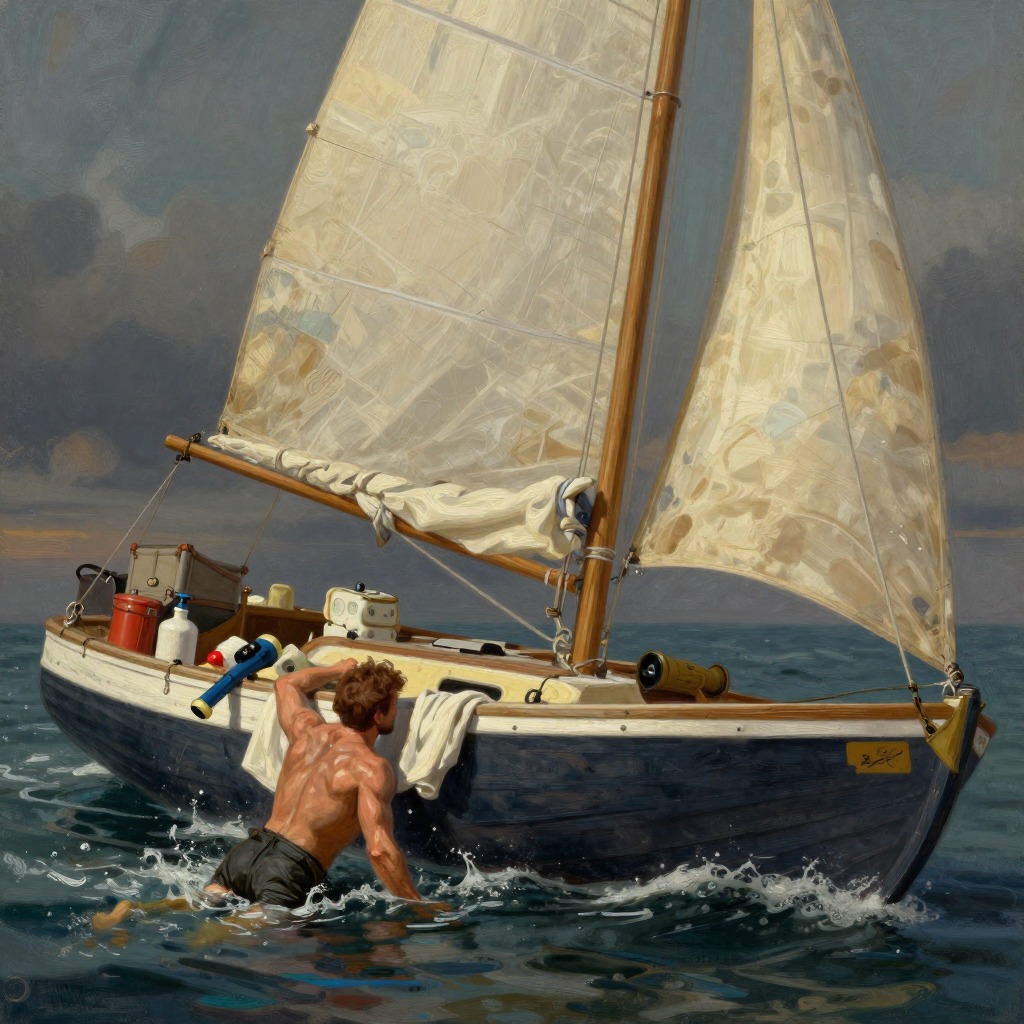
The RoadThe Pájaro de Esperanza is a derelict twin-masted sailboat, approximately sixty feet in length, that the man and the boy discover half-capsized and awash in the shallows off a desolate stretch of coast near the end of their journey south. The boat, whose name is Spanish for "Bird of Hope" and whose home port was Tenerife, lies keeled over in ten or twelve feet of water, its masts broken off close to the deck and its decks stripped of nearly everything by the sea. Its discovery comes at a moment of extreme deprivation, and the man's repeated swims to the wreck yield a cache of goods that briefly reverses their fortunes, providing food, clothing, tools, and a critical weapon. The boat thus functions as a paradoxical emblem of hope in a world where hope has become nearly meaningless, a remnant of a vanished maritime world that offers the pair a temporary reprieve but also deepens their awareness of the absolute isolation of their condition.
Discovery and Salvage
The man first spots the boat from a low promontory after the pair have been walking the beach for some time, and he decides to swim out to it despite the freezing water. He strips naked, wades in, and swims the length of the steel hull, gasping with cold, before pulling himself aboard. The deck is slanted and treacherous, the cabin door locked, but he forces it open with his shoulder. Inside, the boat has been ransacked not by people but by the sea: locker doors hang open, brasswork is green with corrosion, and a stagnant bilge fills the lower bulkhead. He searches the galley, the forward cabins, and the lockers, finding a damp sweater, a pair of yellow rubber seaboots, a nylon jacket, and sou'wester breeches, which he puts on against the cold. In a locker behind the wheel pedestal he discovers coils of nylon rope, steel bottles of gas, and a fiberglass toolbox containing rusty but serviceable pliers, screwdrivers, and wrenches. He also finds a half-full plastic jug of water, cans of olive oil, milk, tea, and coffee, and a plastic container of meal. The most significant discovery, however, comes when he investigates a hidden compartment beneath a cockpit bench, secured by rotary latches, where he finds a rolled two-man rubber raft, a box of flares, and a black plastic case containing an old 37-millimeter bronze flare pistol with eight rounds of flares. He also locates a square oak box with a brass plate, inside which is a brass sextant, possibly a hundred years old, made by Hezzaninth of London, which he holds in his hand and admires before returning it to its case. He makes multiple trips, swimming ashore shivering and naked, towing a seabag filled with clothing, a pair of women's sneakers for the boy, a folding knife, and a pair of sunglasses, as well as a bindle of canned juice, fruit, and vegetables wrapped in a tarp.
The Flare Gun and Its Significance
The flare pistol is the most consequential item the man retrieves from the boat. He shows it to the boy, who asks if it can be used to shoot people; the man explains that it would not kill them but might set them on fire. The boy asks to see it fired, and that evening, after dark, they walk down the beach away from their campfire, and the man loads the pistol and fires a flare out over the bay. The flare arcs up into the murk with a long whoosh and breaks in a clouded light, the hot tendrils of magnesium drifting slowly down. The boy asks if anyone could see it very far, and the man says no. The boy then asks if it could be used to show where you were, "like to the good guys" or "like God," and the man agrees. The flare gun thus becomes a symbol of the boy's persistent, almost metaphysical hope for connection and rescue, even as the man knows there is no one left to signal. Later, when the pair are attacked by an archer in a coastal town, the man uses the flare gun to defend them, firing a flare into the window where the archer stands, setting him on fire and allowing them to escape. The weapon, retrieved from a wreck that itself represents a failed voyage, becomes a tool of both desperate hope and violent survival.
The Boat as a Mirror of Loss
The Pájaro de Esperanza is more than a source of supplies; it is a relic of a world that has vanished, a world of navigation, trade, and human purpose. The man finds a set of china packed in excelsior, service for eight, carrying the ship's name, a gift that was never used. He finds a ship's log, which he searches for but does not find, and manuals and papers in Spanish. The boat's name, "Bird of Hope," stands in bitter contrast to its condition: stripped, flooded, and abandoned. The man reflects that he takes this windfall in a fashion dangerously close to matter-of-fact, and that good luck might be no such thing. The boat's discovery does not ultimately change their fate; it only postpones it. The man's final act on the boat is to remove one of the burners from the gimballed stove, disconnecting the braided flexline and fitting it to a gas bottle, a practical salvage that will allow them to cook on the road. But the sextant, the most beautiful object he finds, he leaves behind, a gesture that acknowledges the irrelevance of celestial navigation in a world without a future. The Pájaro de Esperanza, for all its bounty, is a monument to the end of voyaging, and the man's salvage is a final, desperate act of scavenging from the wreckage of a lost civilization.