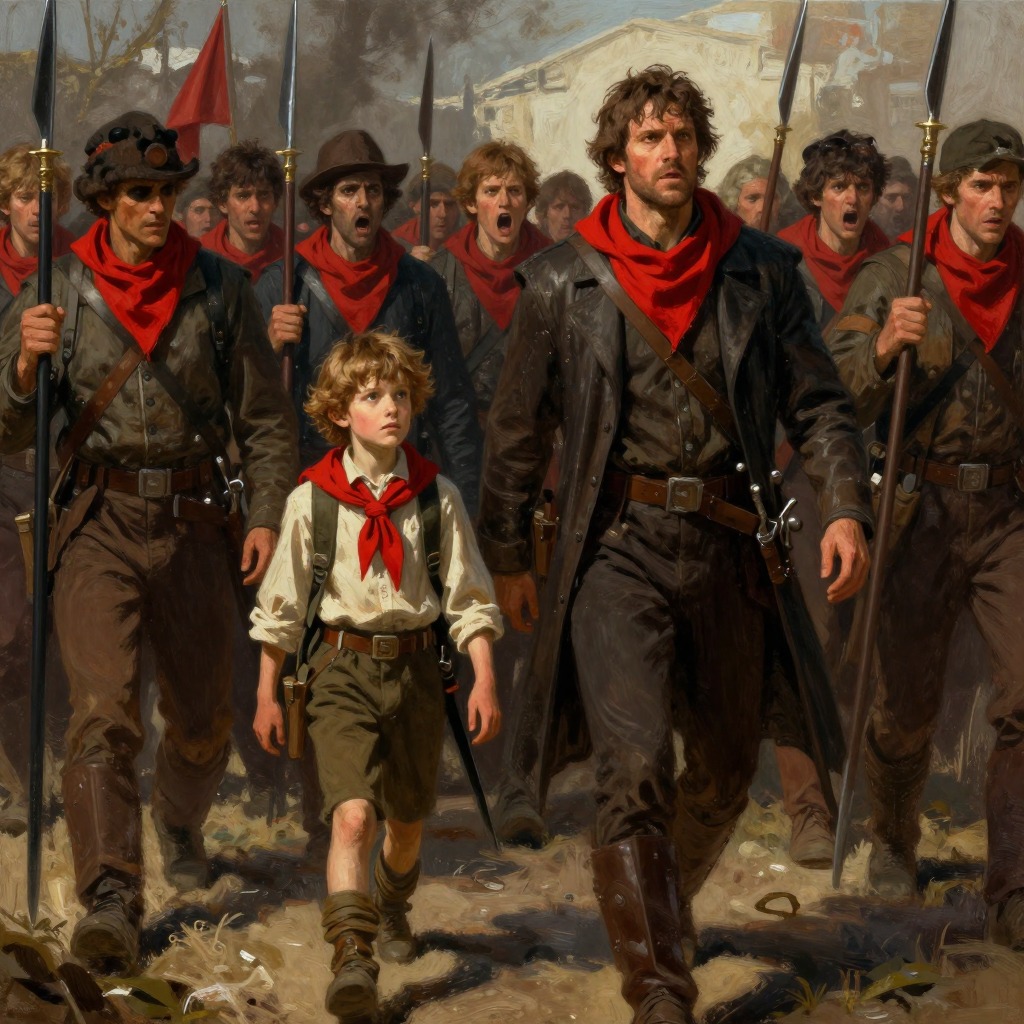
the bad guys
The RoadIn Cormac McCarthy's The Road, the bad guys are not a single organized force but a pervasive, defining condition of the post-apocalyptic world. They are the marauders, roadagents, and eaters who have abandoned all pretense of civilization, preying on the weak and consuming human flesh. They represent the ultimate moral test for the man and the boy, who define themselves in opposition to this savagery, clinging to the idea that they are "the good guys" who "carry the fire."
Appearance and Organization
The bad guys appear in various forms, from solitary cannibals to organized armies. The man and the boy witness a terrifying army marching four abreast, dressed in every description of clothing but all wearing red or orange scarves. They carry three-foot lengths of pipe with leather wrappings, some threaded with chains fitted with bludgeons. A phalanx follows with spears or lances tasseled with ribbons, the blades hammered out of truck springs. Behind them come wagons drawn by slaves in harness, piled with goods of war, followed by women—some pregnant—and a consort of catamites yoked together in dog collars. This army, with its "reptilian calculations" and "claggy" teeth "with human flesh," represents the most organized and terrifying form of evil the travelers encounter. Other bad guys are more feral, like the roadagent with a tattoo of a bird on his neck, who is lean, wiry, and rachitic, dressed in filthy blue coveralls. He carries a knife and is part of a group traveling in a diesel truck, men who have clearly been eating human flesh, as evidenced by the bones and skin the man later finds piled together with rocks over them, the bones looking "to have been boiled."
Cannibalism and Moral Depravity
The defining characteristic of the bad guys is their cannibalism. The man and the boy encounter its evidence repeatedly: the charred, headless, and gutted infant on a spit; the basement of a grand house where naked people are kept for slaughter, including a man with his legs "gone to the hip and the stumps of them blackened and burnt"; the pile of clothing in the house that the man realizes with horror is the belongings of victims. The roadagent with the tattoo, when confronted, reveals teeth "claggy with human flesh." This systematic consumption of other humans is the ultimate transgression in the novel's moral universe. The boy, horrified, asks his father if they would ever eat anybody, even if starving. The man's answer—"No. Of course not"—is the bedrock of their identity as "the good guys." The bad guys have crossed this line, and in doing so, they have forfeited their humanity.
Encounters and Threats
The bad guys are a constant, looming threat. The man and the boy are forced to flee from the truck people, hiding in the woods as the men search for them. The man kills the roadagent who threatens the boy, shooting him in the forehead at close range. Later, they are ambushed by an archer who shoots the man in the leg with a homemade broadhead. The man retaliates by firing a flare gun at the archer, setting him on fire. The threat is not just physical but psychological; the boy is traumatized by these encounters, and the man must constantly reassure him that they are still the good guys. The bad guys also include the thief who steals their cart, a man with the fingers of his right hand cut away, an outcast from one of the communes. The man strips him naked and leaves him in the road, a punishment the boy finds deeply troubling, arguing that they have effectively killed him.
The Boy's Compassion and the Moral Divide
The boy's compassion is the novel's central moral counterweight to the bad guys. He wants to help the lightning-struck man, the old man Ely, and even the thief who stole their cart. He asks his father, "What about the little boy?" when they flee a town where he saw another child. This compassion is what distinguishes the boy from the bad guys. The man, while sharing this moral code, is more pragmatic, driven by the need to survive. He tells the boy, "My job is to take care of you. I was appointed to do that by God. I will kill anyone who touches you." The bad guys force this brutal calculus upon him. The boy's final test comes when he meets the good man, a stranger who claims to be one of the good guys. The boy asks him, "Are you carrying the fire?" The man's affirmative answer allows the boy to trust him, to finally leave his father's body and join a new family. The bad guys, in their absence, have defined the terms of this final act of faith.