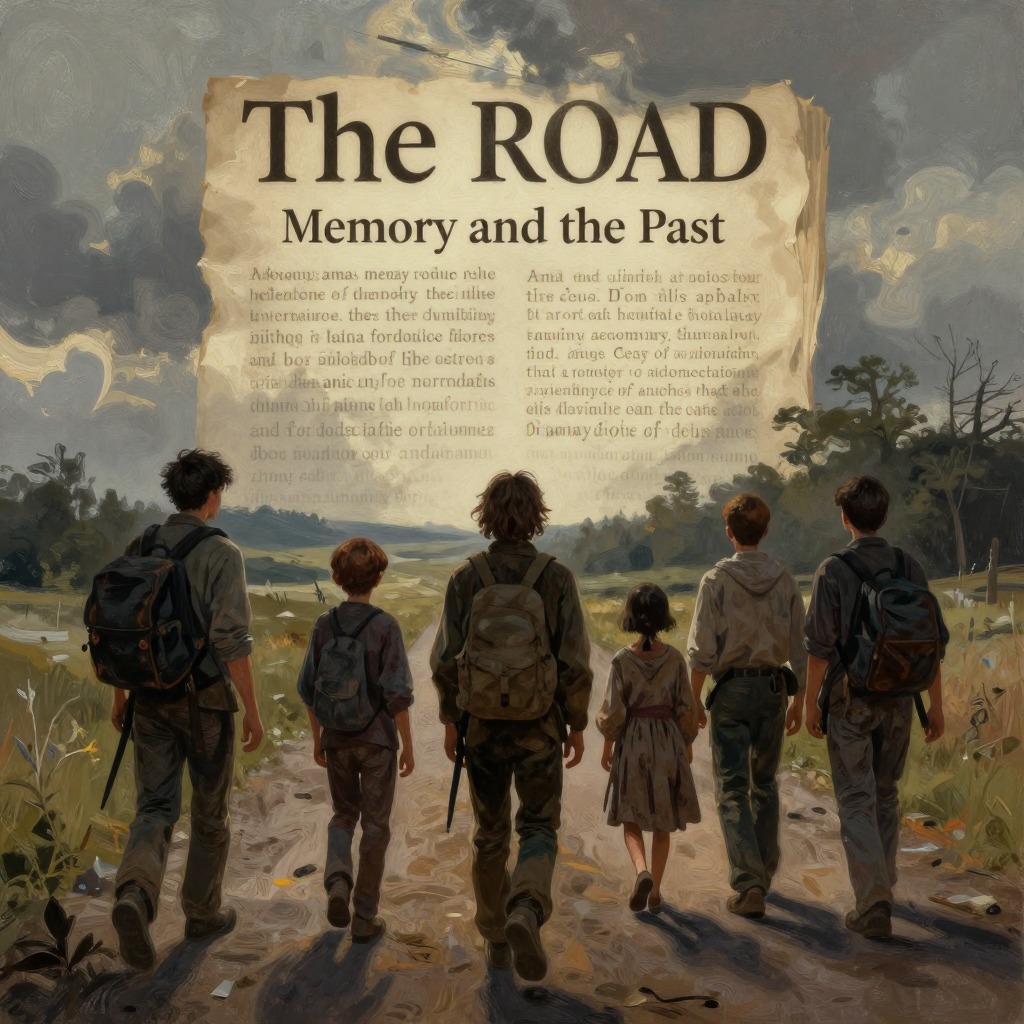
the perfect day of his childhood
The RoadThe perfect day of his childhood is a memory that the man carries from a world that no longer exists, a single afternoon spent with his uncle on a lake gathering firewood. It is the only memory from his early life that he explicitly identifies as perfect, and he considers it the day upon which all other days should be shaped. This memory stands in stark, painful contrast to the gray, ashen, and desperate journey he undertakes with his son, serving as a private, luminous anchor to a lost world of beauty, silence, and purpose.
The Memory Itself
The memory is set a mile from his uncle's farm, on a lake where they went in the fall for firewood. The man recalls sitting in the back of a rowboat, trailing his hand in the cold wake while his uncle rowed. The details are vivid and sensory: his uncle's feet in black kid shoes braced against the uprights, his straw hat, his cob pipe in his teeth with a thin drool swinging from the pipebowl. The shore was lined with birchtrees that stood bone pale against the dark evergreens, and the edge of the lake was a riprap of twisted stumps, gray and weathered, the windfall trees of a hurricane years past. They drifted over sandy shallows until the transom grated in the sand, and they left their shoes on the warm painted boards. They dragged the boat up onto the beach and set out the anchor—a lardcan poured with concrete with an eyebolt in the center. They walked along the shore while his uncle studied the treestumps, puffing at his pipe, a manila rope coiled over his shoulder. They picked out a stump, turned it over using the roots for leverage, and got it half floating in the water. With trousers rolled to the knee, they got wet, tied the rope to a cleat at the rear of the boat, and rowed back across the lake, jerking the stump slowly behind them. By then it was already evening, with just the slow periodic rack and shuffle of the oarlocks, the lake dark glass, and windowlights coming on along the shore. A radio played somewhere. Neither of them had spoken a word.
Significance as a Shaping Ideal
The man explicitly states that this was the perfect day of his childhood and that it was "the day to shape the days upon." This memory functions as a foundational ideal, a template for what life should be: a silent, purposeful, and beautiful communion with a trusted elder within a natural world that is whole and vibrant. In the post-apocalyptic present, this ideal is constantly invoked by its absence. The man's world is now one of barren, godless silence, where the only sounds are the wind, the boy's breathing, and his own coughing. The perfect day is a measure of all that has been lost, a standard against which the gray, cold, and desperate present is found wanting. It is a memory of a world where work was meaningful, companionship was wordless and complete, and the natural world was a source of sustenance and beauty, not a hostile, ashen waste.
Contrast with the Present
The memory of the perfect day is part of a larger pattern of the man's recollections of a lost world, which he often contrasts with his current reality. He remembers the taste of a peach from a phantom orchard, the scent of his wife, and the sight of trout in a mountain stream. These memories are rich in color and sensory detail, but they turn to ash instantly upon waking in the cold dawn. The perfect day, in particular, is a memory of a world where time was marked by the seasons and the slow, rhythmic work of gathering firewood, not by the desperate, daily struggle for survival. The silence of that day, broken only by the oarlocks and a distant radio, is a stark contrast to the oppressive, dead silence of the present, a silence that is "sightless and impenetrable" and "to hurt your ears with listening." The memory of the perfect day is thus a source of both profound solace and profound grief, a reminder of a beauty that can never be recovered.
Thematic Resonance
The perfect day of his childhood resonates with the novel's central themes of memory, loss, and the search for meaning in a meaningless world. It represents the "sacred idiom" of the man's past, a language of beauty and grace that has been "shorn of its referents" in the present. The memory is a form of treasure, a private, internal resource that the man draws upon to sustain himself, even as he knows that the world it describes is gone forever. It is a testament to the power of a single, perfect moment to shape a life, and a poignant illustration of the novel's assertion that "all things of grace and beauty such that one holds them to one's heart have a common provenance in pain." The perfect day, born in a time of peace and plenty, is now held in the heart of a man who lives in a world of grief and ashes, and its beauty is made all the more acute by the pain of its loss.