
The Multiplying Gleisters
The Robot Who Looked Like MeThis thread traces the discovery that time travel produces more Gleisters and follows the desperate attempt to make their expansion self-limiting.
increasing Bearing strength in each event
 decreasing
Bearing strength in each eventdecreasingA Life Split Across Tracks
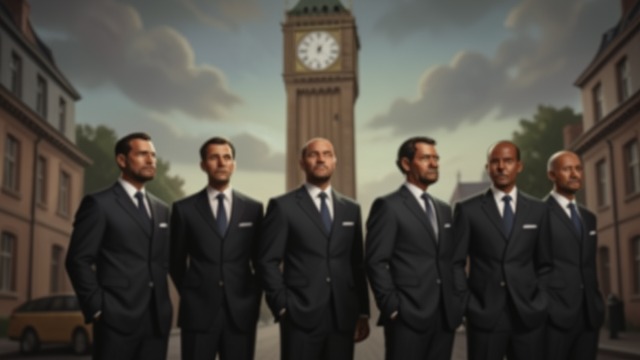
Many Versions of One Person
Similar beginnings
Different Gleisters share a common identity until their encounters and choices alter them. Their matching appearance does not make their later lives identical.
A crowded chronology
The time travelers encounter one another across different subjective moments. What appears to be one biography becomes a collection of divergent roles and personalities.
The Gathering Point

A Community of Doubles
Many names for one face
The Gleisters adopt different first names so they can communicate. Hieronymous, Egon, Mordecai, and others become socially distinguishable despite their shared origin.
Individual temperaments
Their differing experiences produce different emotional and political outlooks. The group discovers that a person can contain many conflicting positions even when all its members began as the same individual.
A Crisis of Scale
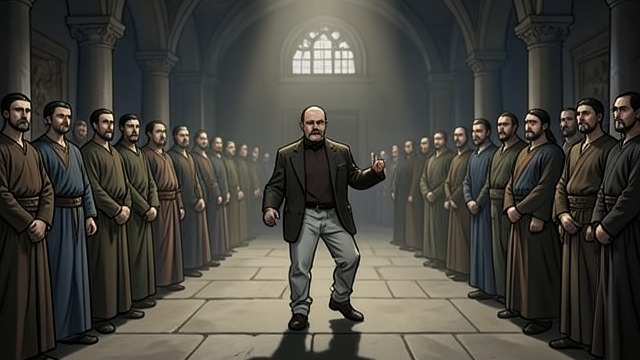
The Empire Fills with Doubles
The replacement rule
Mingus explains that every time a Gleister leaves a position in time, nature supplies another version to fill the gap. Each new arrival can then travel and create further replacements.
Exponential pressure
The resulting population grows at a geometric rate, overwhelming the Empire’s resources. The emperor’s political crisis is also a crisis in the physical capacity of the world to house its own doubles.
A Suicide as Limit
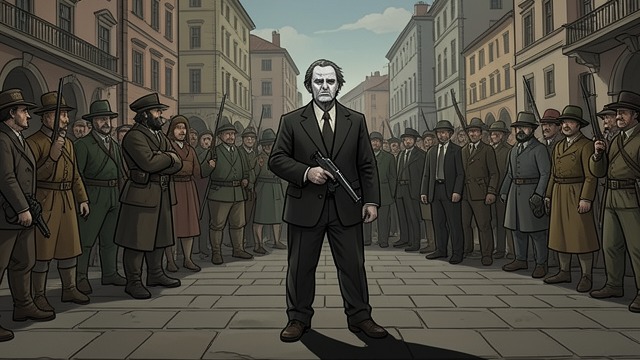
Termination Through Recurrence
An early interruption
Hieronymous proposes an out-of-continuity death, reasoning that ordinary deaths have not slowed the expansion. The plan is intended to introduce a limit at the beginning of the sequence.
A disputed identity
He believes he is the original Gleister and therefore must die, though his evidence is intuition rather than proof. The proposal makes the fate of the many depend on one man’s uncertain claim to priority.
The Cycle Continues
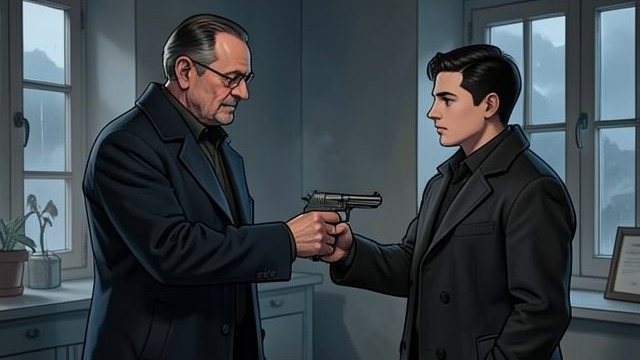
Emperor at the Beginning Again
A return to the audience room
Charlie opens his eyes in the imperial room and gives a younger Gleister the laser gun and a farewell. The act appears to begin the cycle again rather than end it.
Roles rotate
He understands that the Gleisters will have to occupy the different roles, including emperor and suicide, until the sequence contracts. His own survival is temporary and inseparable from the repeating history he tried to control.
After Charlie begins traveling through time
At the resistance meeting near the ruins of Norfolk
During Hieronymous’s later audience with Mingus
After the population crisis is explained
After Hieronymous returns to the past and dies
