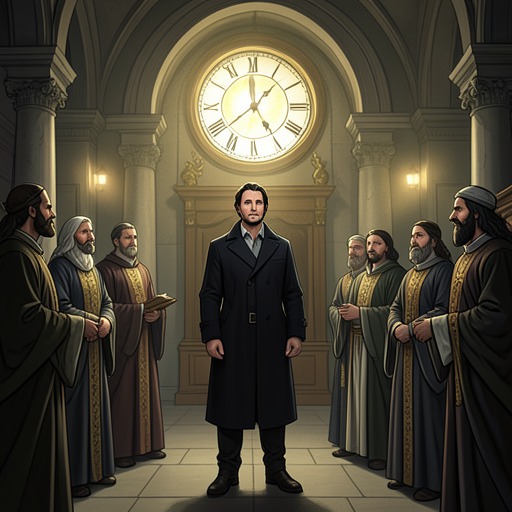
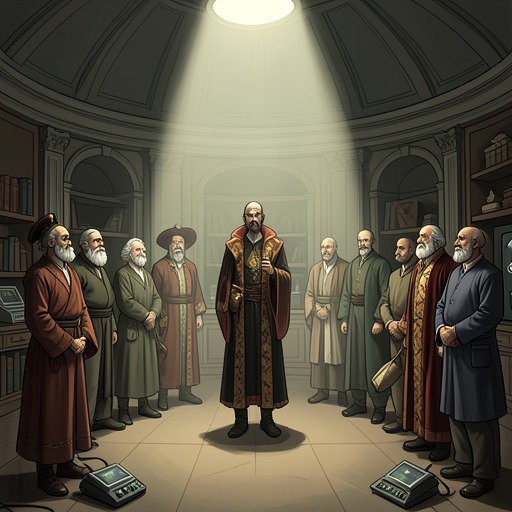
“The Emperor is the slave of time”
The Robot Who Looked Like Me“The Emperor is the slave of time” names the paradox at the heart of the Gleister time cycle: the ruler who appears to command history is instead constrained by its self-propagating consequences. First heard as a dark premonition, the phrase becomes a practical account of how time travel displaces Gleisters, multiplies them, and makes imperial power unable to contain the process.
The Oracle and Its Warning
The phrase first enters the story as a voice Hieronymous Gleister says he heard in a premonition. He offers no explanation, describing the words as a hint of something unpleasant whose meaning he cannot yet determine. The new Mingus calls it strange, dark, and ominous, and treats it as an oracle. The warning is thus introduced before its full mechanism is laid out: it sounds like a prediction about an emperor, but points toward a condition built into time itself.
Hieronymous later uses the same words to plead with Emperor Mingus to abdicate. He identifies himself as Mingus’s future self and as the succession of Gleisters he will become, and asks him to change what can still be changed. When Mingus demands a reason, Hieronymous answers with the warning. Mingus dismisses it as meaningless and questions the visitor’s identity. The exchange sets a prophecy against political confidence: the emperor hears a claim about the limits of his power but does not accept that it applies to him.
Time Displacement and Replication
The explanation lies in the effect of using a time machine. The first or original Gleister travels into the future, leaving a vacancy in his ordinary position in the space-time fabric. Nature fills that vacancy with an identical or nearly identical Gleister. Each further use of a time machine creates another displacement and another vacancy, which Nature fills by producing another Gleister. The phrase therefore describes more than an emperor’s personal misfortune: it condenses a rule in which an individual’s attempt to move through time generates consequences that cannot simply be recalled or cancelled.
Charlie Gleister’s account of his prospective actions makes the cycle’s unsettling logic visible at a smaller scale. He expects to get his time machine working, travel into the future, and return to meet himself just before the invention. The other Gleister confirms the account, while Charlie recognizes that the sequence is strange. The encounter makes identity positional: the traveler and the self he meets may be identical up to contact, but their paths diverge once they encounter one another.
Why the Emperor Cannot Escape the Cycle
After recognizing that he has multiplied the human population of Gleisters, Gleister considers returning to the time before he invented the machine and choosing not to invent it. The experience of the other Gleister has shown that this cannot simply undo what has happened. The past contains no empty niche waiting for a returning self; every action modifies the conditions around it. Nor would persuading another Gleister provide a clean escape, because there is not one unchanged counterpart but a multiplicity of potential Gleisters, each altered by contact. The warning’s force lies in this absence of a single, recoverable starting point.
The same principle overturns Mingus’s claim to imperial continuity. Egon Gleister tells him that by returning to the past he has ceased to be the emperor. There is no uniquely real emperor: there is a Gleister who travelled to the future, seized power, met opposition from an organization, returned to the past to take it over, and was killed in the attempt. The title belongs to a position in a sequence, not to an inviolable identity. Mingus’s return changes that position, while the sequence preserves its consequences.
The Material Cost of Rule
The warning becomes literal in the scale of the replication crisis. Mingus says that he has managed to house about twelve million Gleisters, but the empire is running out of resources and new arrivals are coming more thickly than before. Even shooting them on sight would not control the mounting progression. He imagines Earth eventually carpeted in Gleisters, with more continuing to pour in. The emperor’s power cannot arrest the temporal process that has helped make his empire possible.
The phrase thus joins personal identity, historical recurrence, and political collapse. Mingus can hold imperial authority within one stretch of events, but cannot command the succession of positions and replications that produced it. His acknowledgment that he is open to suggestions leaves the crisis unresolved; the warning is not a promise that abdication, force, or any other available measure will stop the cycle. It is the recognition that imperial rule is enclosed by the very history it seeks to master.