Apollonian–Dionysian cultural conflict
The Robot Who Looked Like MeThe Apollonian–Dionysian cultural conflict is Veerhe’s explanation of why the Lorians believe the Terrans will eventually dominate them. The danger, as he presents it to Johnny Bezique, lies not chiefly in weapons but in an unequal willingness to pursue victory: a trusting people committed to rules cannot safely meet an aggressive people prepared to break them.
The Cultural Opposition
Veerhe describes the Lorians as straightforward, stable, reasonable, and trusting, while characterizing the Terrans as aggressive, unbalanced, and capable of deviousness. He does not expect the Lorians to find a sufficiently clear reason to destroy the Terrans; nor, he argues, can they simply refuse contact or cooperation. Their interaction will instead involve repeated discussions, treaties and violations, explanations and encroachments, and eventually clashes. He names this encounter, in his terms, one between an extreme Apollonian culture and an extreme Dionysian culture.
The opposition is therefore not presented as a simple contest between advanced and primitive societies. Veerhe concedes that Lorian technology could destroy anything the Terrans sent against them, but argues that technological superiority cannot settle a conflict whose course is shaped by psychology and conduct. The Lorians’ stability and trustfulness, ordinarily defining strengths, make them vulnerable when facing opponents who are more willing to exploit negotiation and pursue advantage.
Why the Lorians Will Not Adapt
Johnny suggests that the Lorians could change themselves to meet the threat. Veerhe rejects the premise that culture can be altered by an act of will: intelligence cannot simply make a people become different. Even if the Lorians could become more aggressive, doing so would mean becoming like the Terrans, a transformation they would not want. He adds a practical obstacle: they could not compress tens of thousands of years of aggressive development into a few years, and might lose even with their armament advantage if they tried to fight according to Terran rules.
Johnny recognizes the force of this argument because he has independently imagined taking Lorian ships by surprise under cover of a peace parley. Veerhe sees that Johnny has reached the same conclusion, and Johnny admits that the Terrans want victory more intensely: the Lorians follow rules even in life-and-death contests, while the Terrans will stop at nothing to win. The exchange makes the conflict’s imbalance concrete. The threat is not merely that one side has greater strength, but that each side understands winning differently.
The Predicted Outcome
Veerhe frames eventual Terran control as the likely result if other conditions remain unchanged. The Lorians, he says, will be psychologically unable to respond in kind, while the Terrans are unlikely to give them an unambiguous reason for outright destruction. That combination leaves gradual takeover more plausible than a decisive battle: contact continues, conflict accumulates, and the more ruthless side gains the advantage.
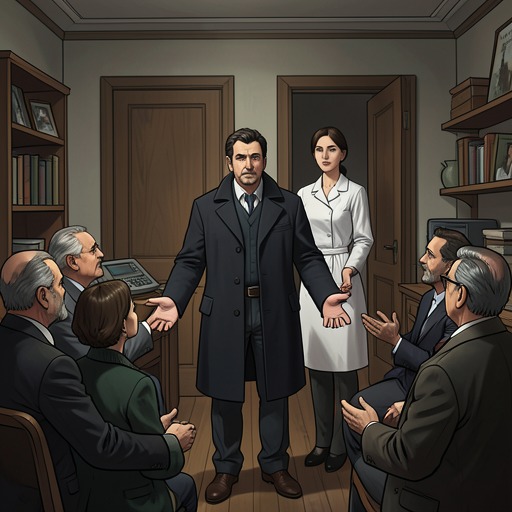
The Lorians’ response is to put Johnny in charge of them immediately, on the grounds that doing so will save time and trouble. The proposal turns Veerhe’s forecast into a political act: rather than wait for a drawn-out process of encroachment and defeat, the Lorians voluntarily yield authority to the very representative of the people they fear will take them over. Their surrender is thus both an attempt to manage the predicted outcome and a demonstration of the cultural vulnerability Veerhe has described.
Significance
The conflict defines a reversal in the usual measure of power. Superior weapons do not guarantee security when the opponent has a greater appetite for victory and fewer restraints. Veerhe’s account also resists treating cultural change as an easy strategic adjustment: the Lorians cannot simply choose aggression without abandoning qualities they value, and imitation would not quickly make them competitive on the Terrans’ terms.
In the exchange between Veerhe and Johnny, the cultural diagnosis is tested against an immediate example of Terran opportunism and Lorian rule-bound trust. The resulting handover makes the contrast more than an abstract label: it becomes the logic by which the Lorians anticipate their own defeat and attempt to avert it.