Brimstone
The Robot Who Looked Like MeBrimstone is a remote mining settlement at the northeastern edge of The Territory, defined by its stark desert setting and by the Devil’s Highway, a natural rock bridge that reaches beyond The Set. The town becomes a threshold in Washburn’s story: he rides there intending to escape the West, but turns back before crossing. That reversal makes Brimstone not simply a point on the edge of the landscape but the setting where the choice to leave gives way to a final confrontation.
Setting and Geography
Brimstone is described as desolate, with the Devil’s Highway rising above it: a broad, gently sloping bridge of natural rock. Its far end lies out of sight from town and is anchored just outside The Set, two hundred yards and 150 years away. The bridge therefore joins distance and time in a single visible route. From Brimstone, escape appears physically close, yet the far end also marks a passage out of the West’s particular world and into another reality.
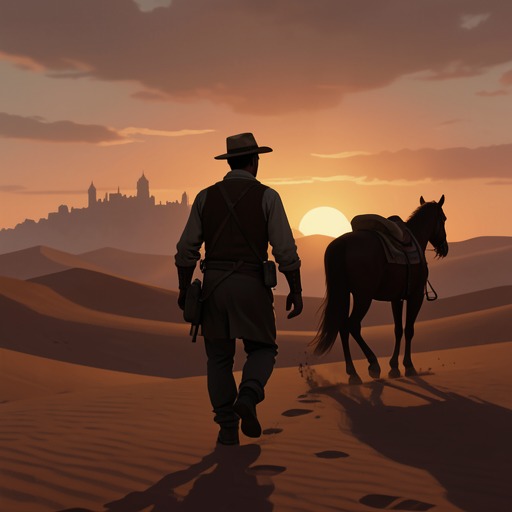
The surrounding approach is harsh and exposed. A rider crosses a high ridge into the desert, passing wind-carved rock formations beneath the noon sun; at evening he camps, tends his horse, and rations his water. He arrives in Brimstone on a limping horse. These details place the settlement at the end of a demanding journey rather than presenting it as a comfortable refuge. Its isolation gives the decision made there weight: the route out is tangible, but reaching it has required a long ride through an unforgiving landscape.
A Threshold of Escape
Washburn announces that he is riding for Brimstone and then onward, away from Little Joe Potter and the whole West. When Natchez Parker asks whether he is running, the question gives the planned departure a sharper meaning: leaving is also an attempt to avoid a reckoning. Brimstone is where that intention becomes concrete. Washburn can see a way beyond the Western setting, and imagines being with Consuela, reading newspapers, and watching television once he is out.
The Devil’s Highway appears to offer a clean ending. Washburn pauses to admire it, measuring the short ride across against a life he hopes to resume elsewhere. Before setting off, he takes one last drink of redeye. But the town has not yet released him from the conflict he meant to leave behind. The contrast between the apparent simplicity of the crossing and the unresolved presence of Little Joe Potter turns the bridge into a test of whether escape is actually possible.
The Return to Brimstone
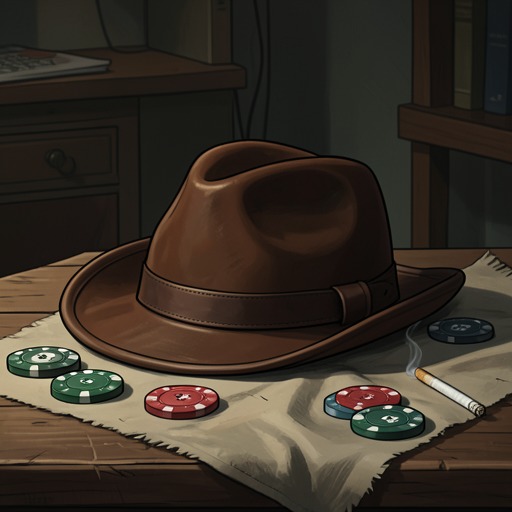
After Washburn reaches the bridge, he rides to the highest point of its curve and stops astride the joint between two worlds. He is bareheaded: the battered derby he had been carrying is no longer on him. Rather than continue across, he turns his horse around and rides back down toward Brimstone. The narrative does not give a spoken explanation for this reversal; the action itself supplies the answer. The route out remains open, but Washburn chooses to return to the town and the encounter he had set out to avoid.
The townspeople see him coming and scatter for cover behind wagons, water troughs, and grain sacks. Little Joe Potter alone remains in the dusty street. Washburn dismounts, moves his horse out of the line of fire, and walks toward him. The town’s ordinary objects become improvised shelter as its open street turns into a place of danger. Brimstone’s small, exposed public space concentrates the conflict: there is no crowd intervention, and no one else takes the place of the two men facing each other.
The Shootout and the Town’s Significance
Little Joe Potter asks whether Washburn has returned for his hat. Washburn answers that he has come back because it is their dance. They laugh together, making the impending violence momentarily seem like a shared joke; then both draw their .44s. The gunfire fills the town, and smoke and dust briefly obscure the outcome. When they clear, both men are still standing, but Little Joe Potter’s gun falls from his hand and he collapses. Brimstone is thus the site not only of Washburn’s abandoned escape but of the confrontation’s decisive outcome.
The sequence gives the settlement a double function. Its position beside the Devil’s Highway makes departure imaginable, while its street becomes the place where Washburn returns to meet Little Joe Potter. The bridge’s connection to a world beyond The Set frames the possibility of leaving; the turn back and the shootout frustrate any simple passage from one life to another. Brimstone’s significance lies in that reversal: the edge of the West offers an exit, but the story’s final movement there is back toward the conflict.