Charles
The Robot Who Looked Like MeCharles, introduced under the alias Mr. Watson, is an interplanetary broker who tries to fit work and personal life into a tightly managed schedule. When he falls in love with Elaine, the feeling resists his usual systems of planning. He responds by commissioning an exact robotic double to perform the courtship he has no time to undertake himself; Elaine’s confession that she has also turned to Snaithe makes the scheme less a one-sided deception than a shared, awkwardly revealed expedient.
Identity and Background
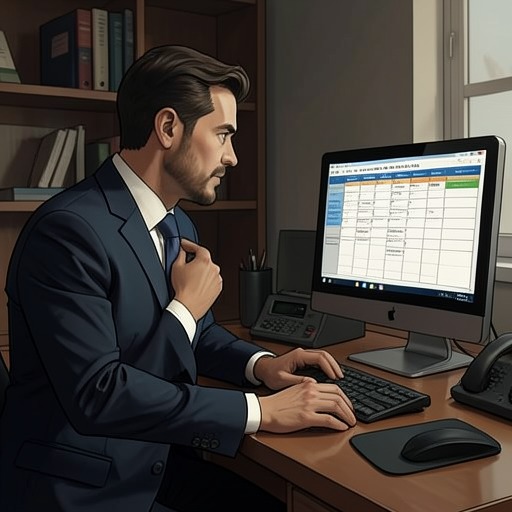
Charles lives and works in Manhattan’s Upper Fifth Vertical, paying extra for a view of the sky. His business is interplanetary brokerage, specializing in certain classes of rare-mineral speculation. Work consumes most of his life, and he treats even leisure and intimacy as items to be allotted their proper places. He reserves three hours a week for sexuality under the Doris Jens Executive Sex Plan, two for friendship, and two for leisure. At night, a Sleep-inducer provides his quota of 6.8 hours while hypno-paedics delivers professional reading.
His schedule can accommodate contingencies. Its marriage subprogram allows four weekly hours for interaction with a wife; a second program, accounting for a wife and child, adds two more. Through reprogramming, the projected loss of productivity is limited to 2.3 percent or 2.9 percent, respectively. Charles has already decided to marry at 32.5 and obtain a wife through the Guarantee Trust Matrimonial Agency, whose credentials he considers impeccable. This plan presents marriage as manageable in advance—until a particular person unsettles it.
Love and the Demand for Courtship
Charles first notices Elaine at a friend’s wedding, which he attends during one of his leisure hours. She is the fiancée’s maid of honor. He finds her charming and expects to think no more about her; instead, her image remains with him over the following days and nights. His appetite declines, he sleeps badly, and his computer considers a nervous breakdown possible, while identifying love as the strongest inference. The bodily disruption arrives before he has made any deliberate decision to pursue her.
Charles does not reject the feeling. He regards being in love with a future wife as potentially helpful to a good relationship, has Elaine investigated by Discretion, Inc., and hires the professional go-between Mr. Happiness to propose and arrange matters. The plan fails at the point where personal attention is required: Mr. Happiness reports that Elaine is a traditionalist who expects to be courted. Charles has found a suitable prospective partner, but his timetable cannot supply the customary process she wants.
The Robotic Double
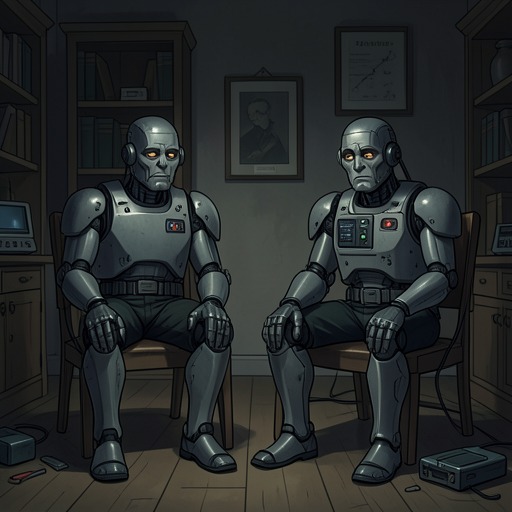
Seeking a solution, Charles asks Gordon Simms who makes the best individualized robots. Simms names Snaithe of Greater New Newark. Charles arranges for Snaithe to build an unmarked robot identical to him and capable of reproducing his behavior patterns, paying heavily for the work. In Snaithe’s workshop, amid humanlike heads, limbs, torsos, and dangling wires, Charles sees the finished double unveiled from beneath a sheet. The resemblance is exact, down to the textures of skin and hair. Looking at the robot’s face, he recognizes in his own features a hint of brutality and impatience. He does not test the robot’s voice or behavior at that first inspection, but pays Snaithe and asks him to deliver it to his apartment.
Once the robot arrives by pneumo-express, Charles animates it, transfers relevant information directly to its memory tapes, and enters a courtship plan. Tests produce results better than he expected, so he calls Elaine and arranges a date. At eight o’clock that evening he dispatches the robot, which he calls Charles II, then takes a brief nap and returns to work on the Spring market offers accumulating on his desk. The arrangement makes the division plain: Charles supplies the data and the plan; his double performs the encounter while he remains at his work.
Confession and Significance
The arrangement is exposed when Elaine describes knowing girls who had got into a similar situation and gone to a clever robot-maker named Snaithe. Charles laughs and admits that he, too, has used Snaithe. Elaine realizes that Charles sent a robot to court her and objects to the possibility that she might actually have been present herself. Her response makes clear that the practice is not his private invention, though the passage does not explain the precise circumstances of her own use of a robot.
The exchange changes the balance between them. Charles observes that neither has much ground for indignation, then asks whether her robot came home the previous night. The question leaves the outcome of either robot’s courtship unresolved, but replaces a simple exposure of Charles’s deception with mutual recognition: both have tried to manage intimacy through a mechanical proxy. The irony lies in how meticulously Charles can budget for marriage and still cannot schedule his way around Elaine’s expectation of courtship—or around the disruptive feeling that made him seek her out.