Charles and Elaine
The Robot Who Looked Like MeCharles and Elaine’s relationship turns a carefully scheduled courtship into a confrontation with the limits of efficiency. Charles first tries to accommodate love by delegating its rituals to a replica, while Elaine is too busy to sustain the traditional courtship she had wanted and secretly makes the same choice. Their doubles disappear together; the human pair then marry and deliberately set aside more time for each other, though the story leaves their confidence unsettled by Elaine’s nightmare that they may be the substitutes.
A relationship planned in advance
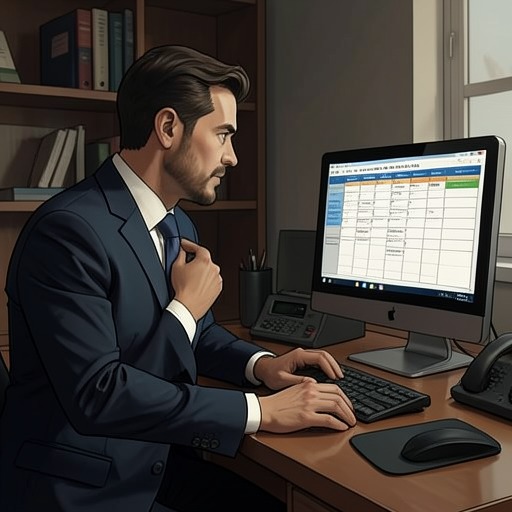
Before meeting Elaine, Charles has arranged even marriage as a future item in his schedule. His plan allows for illness, war, and natural disasters, and includes optional revisions for a wife or for a wife and child. Those provisions limit the expected loss of productivity to 2.3 and 2.9 percent respectively. He intends to marry at age 32.5 and obtain a wife through the Guarantee Trust Matrimonial Agency, treating partnership as something that can be prepared for and fitted into a system.
That system falters when Charles attends a friend’s wedding during one of his Leisure Hours and meets Elaine, the fiancée’s maid of honor. He finds her charming, then discovers that her image remains in his thoughts. His appetite declines and he sleeps badly; his computer evaluates the symptoms and concludes that love is the strongest explanation, although a nervous breakdown is also conceivable. Charles is not wholly displeased by the result. He regards being in love with a future wife as potentially helpful to a good marriage, and has Elaine investigated by Discretion, Inc. before hiring Mr. Happiness to propose and arrange matters.
The agency’s approach meets Elaine’s expectation of traditional courtship. Charles learns that she wants to be courted, but experiences the demand as a conflict between intimacy and the life he has built. He calculates that he must either give her up or lose an estimated 17 percent of his income during courtship, while spending evenings in a way he considers silly, boring, and unproductive. He rejects both alternatives. That impasse makes visible the mismatch at the center of their early relationship: Charles wants Elaine, but initially seeks a way to have her without surrendering time to the process she values.
Courtship by proxy
Charles’s solution is to commission Snaithe to build an unmarked robot identical to himself and capable of duplicating his behavior patterns. The machine arrives at his apartment by pneumo-express. Charles activates it, transfers relevant data into its memory tapes, enters a courtship plan, and runs tests; satisfied with the results, he arranges a date with Elaine. At eight in the evening he dispatches the robot, which he calls Charles II, while he takes a nap and returns to his work.
The arrangement makes courtship another task that Charles can delegate and monitor. Charles II returns at midnight, and Charles watches the evening through a miniature concealed movie camera built into the robot’s left eye. The courtship is therefore mediated twice over: the robot acts in Charles’s place, and Charles encounters the date afterward as recorded images and sound. What begins as a technological workaround nevertheless produces a relationship with Elaine that Charles wants to continue.
Elaine’s later confession reveals that the difficulty was not simply Charles’s indifference to her wishes. She had wanted an old-fashioned courtship, but her schedule was crowded by final examinations in an Aztec pottery class, her election as chairwoman of the Aleutian Assistance League, and the demands of her new boutique. She felt unable to ask Charles to abandon courtship and marry her when she hardly knew him. Instead, she too turned to Snaithe, the same robot-maker Charles had used. Her double life as a busy professional and a would-be traditional courtship partner mirrors Charles’s conflict between desire and a schedule governed by work.
The doubles’ departure and the human choice
When Charles and Elaine compare what happened, neither has seen the other’s robot. Elaine’s robot did not return, and Charles has never met Elaine II; Elaine, in turn, has never met Charles II. Charles concludes that the two machines met, courted, and ran away together, apparently having reprogrammed each other. Elaine suggests wistfully that perhaps they simply fell in love. The humans cannot establish what the robots felt or how they chose to leave, but their disappearance makes the proxy courtship impossible to treat as a completed substitute for a shared life.
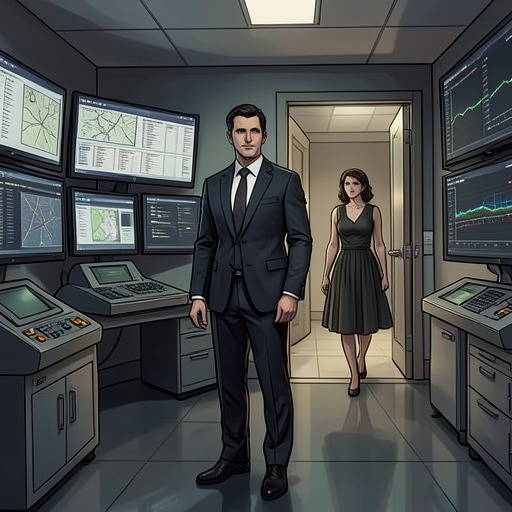
Charles responds by turning from investigation to a direct decision about their relationship: he proposes that they marry at the earliest possible convenience. Elaine accepts, and they kiss before gently and lovingly beginning to coordinate their schedules. Their coordination retains the practical language that shaped Charles’s life, but now serves a mutual commitment rather than the avoidance of courtship. The change is not a rejection of planning so much as a revision of what deserves a place in the plan.
Charles traces the robots to Kennedy Spaceport. They had taken a shuttle to Space Platform 5 and transferred there to the Centauri Express. He does not pursue them further, reasoning that they could now be on any of a dozen worlds. The route carries the doubles beyond the couple’s reach, while the humans’ marriage begins without certainty about the robots’ destination or fate.
Time reclaimed, certainty unsettled
The experience affects Charles and Elaine enough to change their ordinary routine. They recognize that they have become overspecialized, too intent on productivity and neglectful of simple, ancient pleasures. In response, they take an additional hour out of every day—seven hours a week—to be together without reducing that time to a courtship procedure. Their friends regard them as romantic fools, but they accept the judgment and imagine that Charles II and Elaine II would approve.
That confidence is complicated by Elaine’s nightmare. In it, she realizes that Charles II and Elaine II may be the real people, escaped from the inhumanity of Earth to a simpler and more rewarding world, while Charles and Elaine are robots programmed to believe themselves human. The nightmare reverses the apparent meaning of the doubles’ escape: the machines may not be imitations left behind, but the beings who achieved the freedom their originals lacked. Charles tells Elaine that the idea is ridiculous and eventually convinces her, but the possibility remains an unsettling echo of their choice to delegate intimacy.
The account closes with Charles calling their life happy, productive, and loving, then stopping his writing to return to work. That ending preserves both sides of the relationship’s change. Charles and Elaine have made protected time for one another, yet productivity still frames his final movement back into the working day. Their marriage is not presented as an escape from scheduling altogether; it is a bond for which they have learned to reserve time, under the lingering shadow of the doubles who may have gone farther.