Charlie Gleister
The Robot Who Looked Like MeCharlie Gleister is the inventor at the center of a time-travel paradox that multiplies him into a population of competing selves. His machine first fails as a time machine, then gains its working design through knowledge brought back from the future; the result is a loop in which Charlie’s invention creates the very history that teaches him how to complete it. The story follows that loop from an Indiana basement to a resistance movement and, finally, to an ending that begins again.
Identity and the First Machine
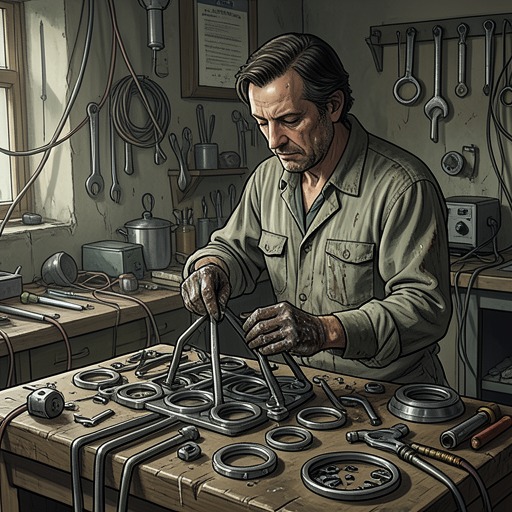
At the outset, Charlie is a technically gifted inventor working in his basement laboratory on Apple Street, in Harvest Falls, Indiana. His device is about the size of a white plastic shoe box and is crowded with dials, switches, levers, buttons, and colored glow bulbs. When activated, it makes noises and causes a tingling sensation, but it does not transport anyone through time. Its conspicuous failure matters: Charlie has built a machine that displays the signs of activity without yet performing its intended work.
The machine becomes functional only after Charlie receives enough insight from the future to adjust it in the present. That order makes invention inseparable from time travel. The first machine enables the journey that supplies the knowledge needed to perfect the first machine, so the cause and consequence cannot be neatly separated. The narrative openly identifies the paradox and treats it not as a flaw to be resolved but as one of the forces on which its universe runs.
Before that temporal disruption expands his identity, Charlie has an ordinary life with its own unsettled prospects. Myra is his fiancée, but she is out driving with Carter Littlejohn, a former football player who is to become the father of Myra’s daughter, Hilda. This detail places Charlie’s extraordinary invention beside a personal future already moving beyond his control. Yet the story soon makes clear that his defining entanglement is not a conventional domestic plot: it is the multiplication of Charlie himself.
The Many Gleisters
Charlie encounters a stranger who looks like him and learns that they are both Charlie Gleister, occupying different time tracks. This encounter turns the machine’s abstract paradox into a visible relationship: Charlie is no longer the only version of himself, and the boundary between original and duplicate becomes unstable. The other Charlie can speak with the authority of someone who has already lived through consequences that the laboratory inventor has not yet reached.
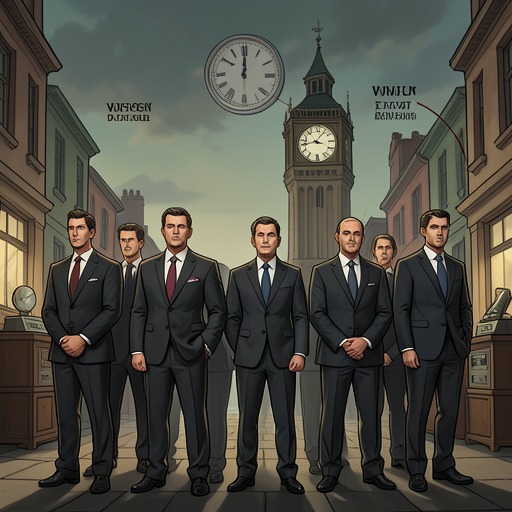
At a later gathering of Gleisters, the versions of Charlie organize themselves into a resistance against Emperor Mingus. The meeting’s chairman chooses the name Egon, and during a recess Charlie adopts the name Hieronymous. That chosen name distinguishes him from the crowd, but not from the shared identity that binds the assembled Gleisters together. He shakes hands with Michelangelo Gleister and Chang Gleister before the meeting resumes, a small, concrete sign of a society made from proliferating versions of one person.
Egon names the gathering place the Time-Space Center for Resistance to the Rule of the Emperor Mingus. The assembled Gleisters believe they are serious threats to Mingus’s rule, and they suspect that some of their near-fatal accidents before inventing the time machine were attempts by the emperor to eliminate them. The resistance therefore grows out of two linked dangers: a ruler who may be targeting the Gleisters and a time-travel process that keeps producing more of them. Charlie’s new identity as Hieronymous places him inside a collective struggle that is also a struggle over his own origins.
Recognition and the Proposed Solution
During the meeting, Hieronymous recognizes Mordecai Gleister as the emperor. He runs toward the stage and warns the others that Mordecai is Mingus; Egon hesitates, then moves with him. Their advance stops when Mordecai draws a blue-steel automatic and aims it at Egon. The recognition exposes the emperor inside the Gleister assembly, collapsing the distinction between the resistance and the power it opposes. The confrontation also shows how fragile the group’s attempt at collective action is when its members’ identities and loyalties can be entangled with the ruler they seek to defeat.
When the Gleisters consider how to solve the problem, Hieronymous proposes killing the original Charlie before he can invent the time machine. The proposal identifies the beginning of the chain as the only point that might prevent its expansion. But the attempt is said to be impossible: the Gleisters cannot travel far enough back, and they can encounter Charlie only after the invention. Each failed journey back adds another Gleister to the progression. Hieronymous’s solution is therefore clear in principle but unavailable in practice; the very means by which the Gleisters might reach their origin cannot reach it, and their attempts at prevention intensify the condition they are trying to end.
Death, Return, and Narrative Role
After pushing a button on his machine, Hieronymous is gone. In the first termination sequence, Charlie returns to Harvest Falls on a September afternoon and passes the white-frame house that held his laboratory. He considers going inside to speak with himself, then decides that he has had enough of Gleisters. The remark makes the duplicates not only a physical proliferation but an exhaustion: even the impulse to revisit his own beginning has become intolerable.
Charlie leaves town on Route 347, crosses a field and woods, and sits by a brook beneath an oak tree where he had fished as a boy. There, after a pause, he dies by suicide. The quiet return to familiar Indiana ground contrasts with the crowded, political world of the Gleisters. His death appears to offer an individual exit from the multiplying identities, but the next sequence refuses that closure.
Charlie opens his eyes in the imperial audience room. Statistics before him report that more than twelve million Gleisters have settled and that more are arriving every minute. He hands a laser gun to the young Egon, who activates his time machine and disappears. The gesture places Charlie back inside the machinery of the cycle: rather than ending the succession, his return helps equip the next participant. The abrupt recurrence gives his apparent death a bleakly provisional quality and makes the growing number of Gleisters the clearest measure of the loop’s consequences.
Charlie’s importance lies in this double position as inventor and recurring product of his invention. The machine begins as an ineffective object in a basement, becomes effective through knowledge from the future, and then supports a history in which versions of its inventor gather, resist, fail to reach their origin, and multiply. As Hieronymous, Charlie can identify the need to stop the first invention; as Charlie, he cannot escape the sequence that follows from it. The story’s repeated returns make his personal fate a demonstration of its governing paradox: every effort to intervene in the chain remains caught within the chain it seeks to break.