Consuela
The Robot Who Looked Like MeConsuela is Washburn’s new wife and an outsider to the lethal conventions of The Never-Ending Western Movie. Her unease at his return to The Set brings the private risks of his celebrated gunfighter role into view, contrasting a real marriage with the violence and performance that define his screen life.
Identity and Background
At the time of Washburn’s return, Consuela has been his wife for less than two months. She is a former Miss Chile and has acted in Gaucho dramas filmed in Buenos Aires and Montevideo. Washburn identifies her as his fourth wife, placing their brief new marriage against a history of relationships he describes as repeated journeys along much the same trails. Her English is not yet very good, a detail that also shapes how readily she can follow his explanations of the film world.
Her Understanding of The Movie
Consuela comes from a South American film tradition in which productions are staged, effects are faked, and guns fire blanks. She cannot understand why the American movie must be made for real when its effects could be contrived without anyone being killed. Washburn has tried to explain the practice, but says it sounds ridiculous in Spanish. The gap is not simply between two filmmaking styles: for Consuela, the danger is unnecessary, while for Washburn it is part of the reality of the role.
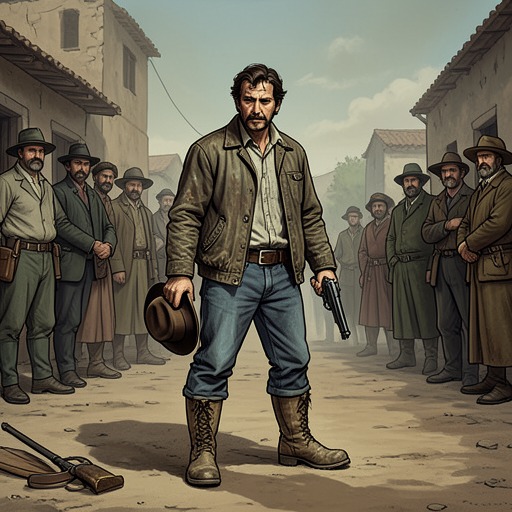
That difference becomes especially clear when Washburn explains that he is returning from retirement for a cameo under a no-kill contract. He is to perform a comedy bit with Old Jeff Mangles and Natchez Parker, improvising without a script. Consuela knows about contracts to kill, but a contract that forbids killing is new to her experience. The distinction that makes the appearance seem safe within the Movie’s own rules does not erase her difficulty in understanding why real danger belongs in entertainment.
At the Threshold of The Set
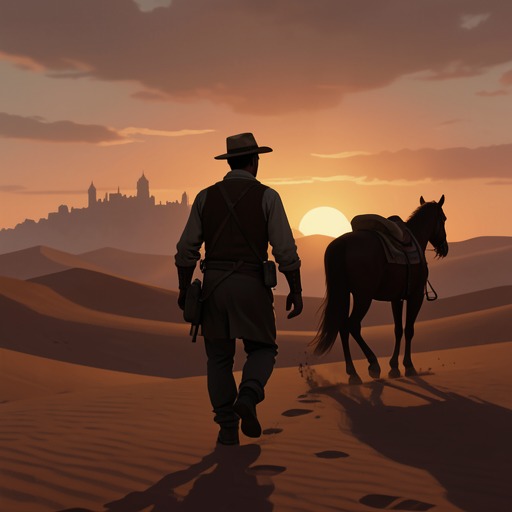
As the Cadillac approaches the weather-beaten Wells Fargo Station, Consuela shivers. The station marks an entrance to The Set: on one side is twenty-first-century America; beyond it stretches the vast landscape of the Western, watched by concealed cameras and microphones. Her physical reaction precedes any acceptance of Washburn’s account. The contrast between the modern car and the constructed entrance also makes the boundary she fears concrete: her husband is about to leave their shared present for a world where the gunfighter’s dangers are real.
Before he crosses into the Movie, Consuela hugs and kisses him. Tears are in her eyes, and she tells him to come back to her soon. Washburn presents the farewell as part of the intensity of their first months together, even as he turns away to resume his public role. The scene holds the excitement of a new marriage beside the uncertainty of a departure whose risks Consuela does not regard as theatrical.
Narrative Role
Consuela is seen through Washburn’s first-person account; the narrative gives her words and visible reactions but does not provide access to her private thoughts. Her questions and distress therefore register the cost of the Movie from outside its conventions. To Washburn and his manager, the return is entangled with career, reputation, and the old gunfighter persona; to Consuela, a no-kill contract remains a bewildering condition in a world where people can be killed for real.
Her presence also sharpens the contrast between Washburn as actor and Washburn as the figure the audience watches. He leaves her at the station and passes into the Western landscape, while the narration later describes him as both performer and spectator of his own performance. Consuela’s farewell anchors that divided identity in a relationship beyond the screen: the heroic image continues into the Movie, but someone outside it waits for him to return.